
One small tag on a song's player page can change how a listener feels about it before the first beat drops. On 14 October 2026, YouTube Music began rolling out labels that mark tracks "created primarily using generative AI", and the label will also come to the main YouTube app. For India, where YouTube is often the first place a fan hears a new song, this is a big deal.
The most important detail for independent artists isn't the label itself. It's how YouTube decides who gets it: partly from what your distributor declares when your music is delivered, and partly from YouTube's own detection tools. So the AI question is now part of your release metadata, just like your ISRC, credits and language.
Here's what changed, what the three new AI categories mean, and how to answer them honestly so your human-made music is never mistaken for a machine's. At MV Distribution, we deliver to YouTube Music, Spotify, JioSaavn, Apple Music and 100+ other stores, so we've broken it down step by step.
What YouTube Music Announced on 14 October
According to Music Business Worldwide and Digital Music News, both reporting on YouTube's own blog post that day:
- The label appears directly on the player page. Tapping it opens a short explanation.
- The first focus is fully machine-made audio, for example a track where a generative model created both the composition and the vocals.
- YouTube says listeners told it they want transparency when they're hearing an AI-generated track.
- The labels are rolling out on YouTube Music now and will expand to the main YouTube app. No timetable was given for that.
YouTube hasn't said whether labelled tracks are treated differently in recommendations or royalty payouts. In May, it said that a disclosure label on its own does not affect a video's recommendations or monetisation.
The Three AI Categories Every Artist Should Understand
The practical heart of this news is the delivery side. Music partners such as labels and distributors can now declare generative AI use when they send content to YouTube through industry-standard DDEX or CSV templates. Each release gets one of three designations.
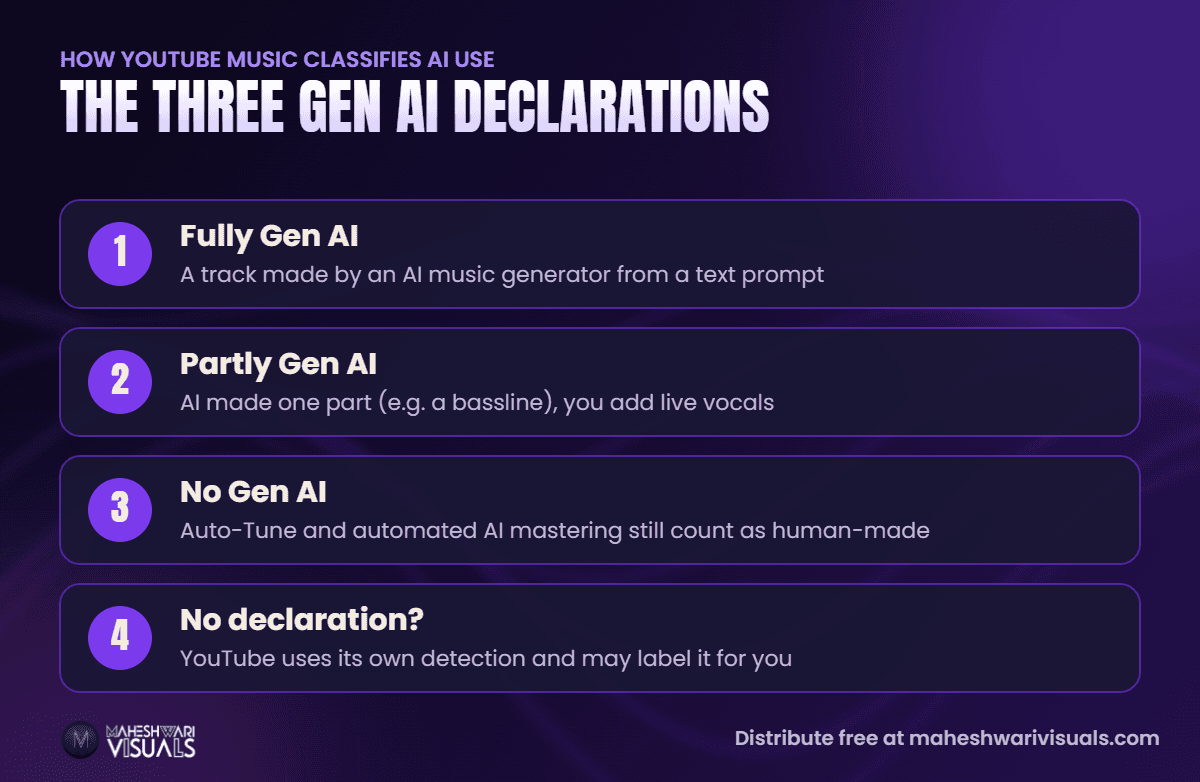
Fully Gen AI
A track downloaded from an AI music generator after typing in a text prompt. The machine wrote and performed it.
Partly Gen AI
You used AI for one element, say a bassline or a string section, and then added your own live vocals and instruments. The song is yours, with some AI help.
No Gen AI
Normal studio tools don't count. YouTube's own examples of "No Gen AI" include pitch correction such as Auto-Tune and automated AI mastering. So a Bhojpuri singer who records live vocals, uses Auto-Tune and gets an online AI master is still in the human-made category.
One more important rule: if no AI information is supplied, YouTube relies only on its own signals and may label content as fully or partly AI-generated by itself. Leaving the field blank doesn't mean you avoid the question. It means a machine answers it for you.
Why This Matters So Much for Indian Independent Artists
YouTube is where Indian fans discover music
From Haryanvi and Punjabi hits to Bhojpuri and Tamil indie releases, a huge share of Indian music discovery happens on YouTube. A label that sits on the player page will be seen by a lot of your listeners. Your metadata needs to tell the truth about your song in a way that protects it.
The whole industry is moving the same way
YouTube isn't alone. In the space of a few months, almost every major platform has started marking AI music:
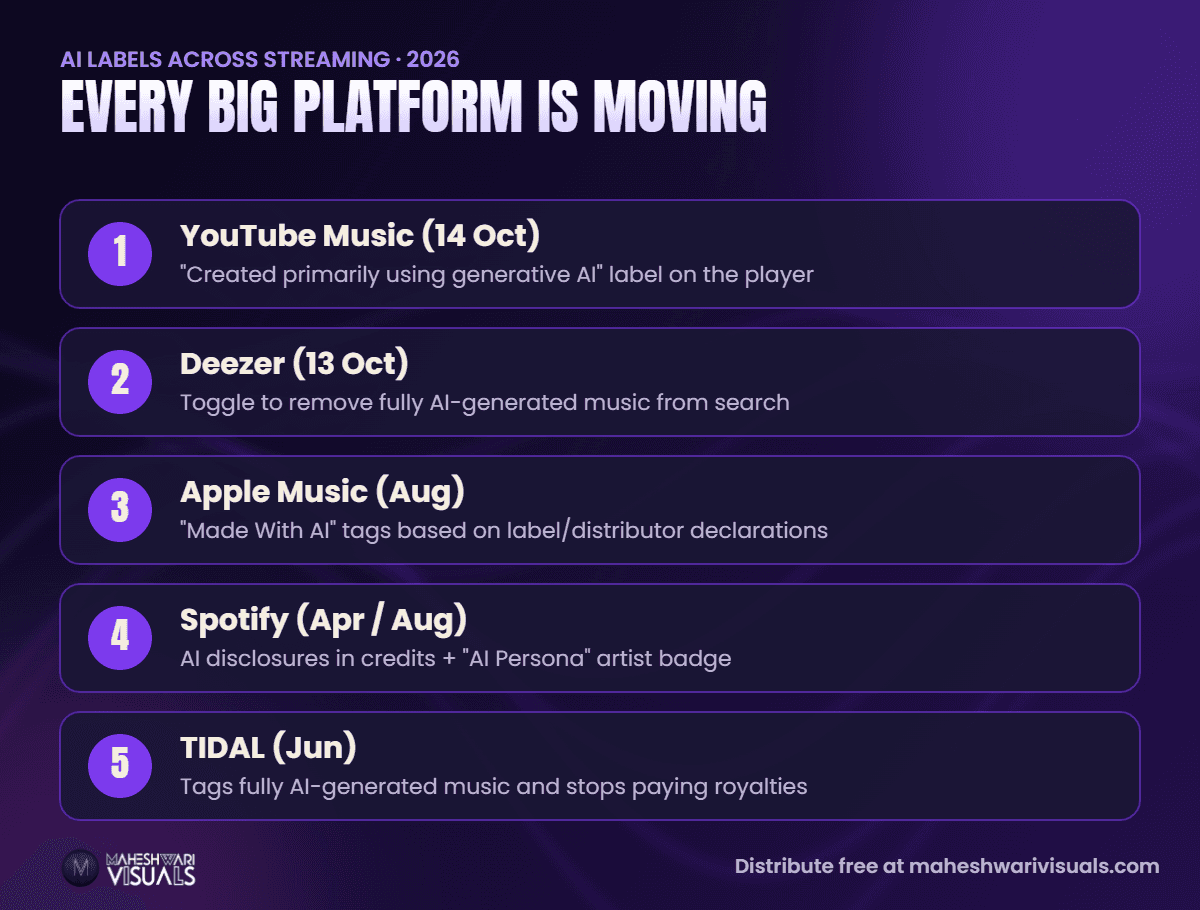
- Deezer said on 13 October that users will be able to remove fully AI-generated music from search, and that it receives nearly 90,000 fully AI-generated tracks a day. We covered it in our post on Deezer's new AI music filter.
- Apple Music told partners in August that its AI Transparency Tags will show listeners a "Made With AI" label later this year, based on what labels and distributors declare.
- Spotify began testing AI disclosures in song credits in April, and in August announced an "AI Persona" badge for AI-generated artist profiles, which are kept out of editorial and algorithmic recommendations by default.
- TIDAL said in June it would tag fully AI-generated music and stop paying royalties on it.
The pattern is clear: honest AI declarations at delivery are becoming standard everywhere. And when fully AI-made tracks carry a visible tag, real voices and real musicians stand out more.
What Indian Artists Should Do Before Their Next Release
You don't need to panic or stop using helpful tools. You need a simple routine.
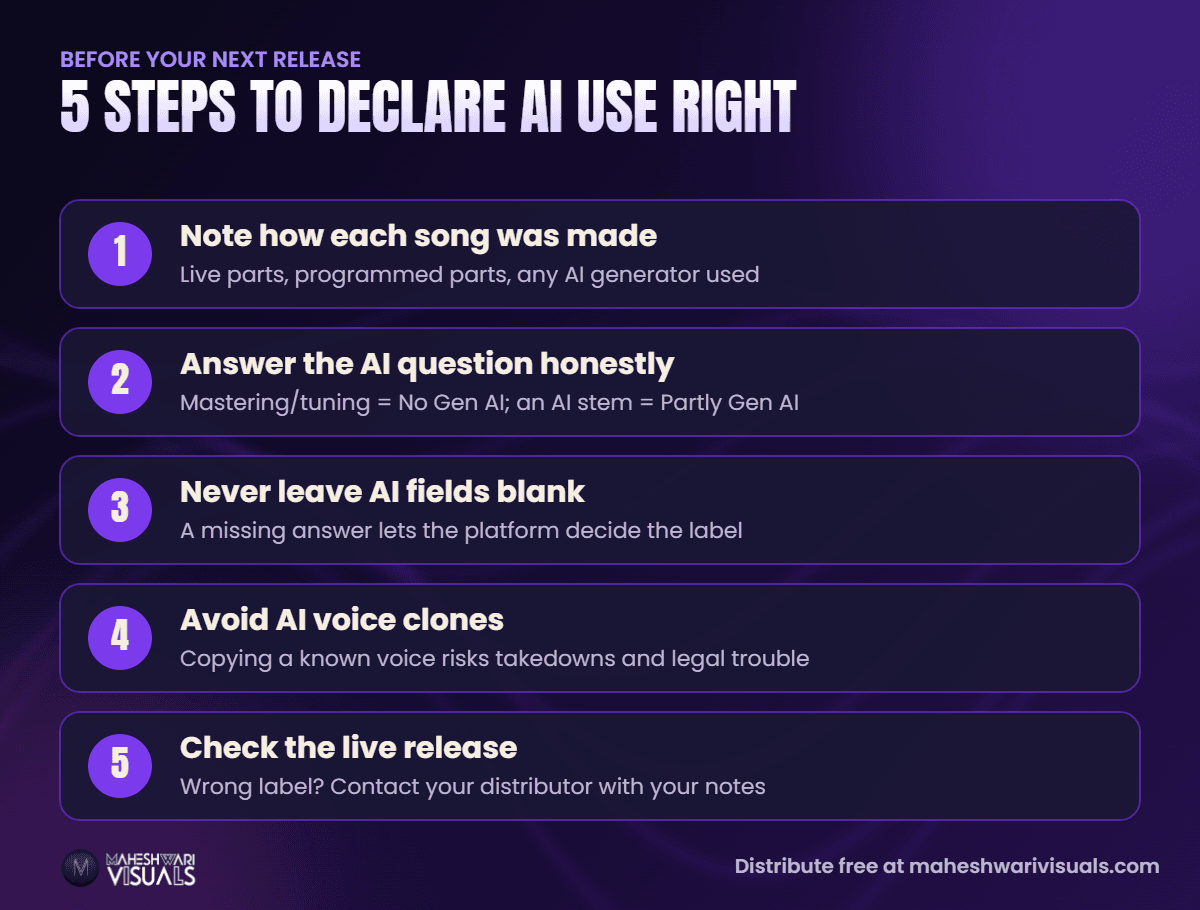
- Keep a note of how each song was made. Write down which parts were recorded live, which were programmed, and whether any AI generator was used for melody, lyrics, vocals or instruments.
- Answer the AI question honestly when you distribute. If AI only helped with mastering or tuning, that's "No Gen AI". If AI made a stem you kept, that's "Partly Gen AI". Don't guess, and don't hide it. Platforms also run their own detection.
- Never leave AI fields blank. As YouTube's rules show, a missing answer lets the platform's systems decide the label for you.
- Be careful with AI vocals and voice clones. Using AI to copy a known singer's voice can bring takedowns and legal trouble. Our guide on protecting your voice from AI clones explains how to stay on the right side of the line.
- Check your release after it goes live. Open it on YouTube Music. If a label appears that doesn't match how the song was made, contact your distributor quickly with your production notes.
How Maheshwari Visuals Helps You Get It Right
Getting metadata right is exactly what a good distributor should take off your plate. With MV Distribution, your music goes to 100+ stores including YouTube Music, Spotify, Apple Music, JioSaavn, Amazon Music and Gaana, typically live within 24 hours. You keep 100% of your rights, and our human support team replies within 24 hours if you're unsure how to describe the way a song was made.
More than 200,000 artists trust Maheshwari Visuals, and when platforms change their rules, as YouTube did this week, we explain it in plain language.
Conclusion
YouTube Music's AI labels mark a new normal. Three things to remember: the label is driven by what's declared at delivery plus YouTube's own detection; everyday tools like Auto-Tune and AI mastering still count as "No Gen AI"; and leaving the AI question blank hands the decision to an algorithm.
Treat the AI declaration like any other piece of release metadata: accurate, honest and decided by you. Do that, and transparency works in your favour, because real artistry is easier to recognise when it's clearly labelled.
Ready to release your next song with metadata done right? Sign up for free music distribution with Maheshwari Visuals and get your music to YouTube Music, JioSaavn, Spotify and 100+ stores.
Frequently Asked Questions
Will YouTube Music label my song as AI if I use Auto-Tune?
No. According to YouTube's examples, pitch correction like Auto-Tune and automated AI mastering fall under "No Gen AI". The label is aimed at tracks created primarily with generative AI.
Does an AI label reduce my views or royalties on YouTube Music?
YouTube hasn't said how labelled music tracks are treated in recommendations or payouts. For videos, it said in May that a disclosure label alone does not affect recommendations or monetisation eligibility.
What happens if my distributor doesn't declare AI use?
YouTube says that without partner information it relies on its own detection signals and may label content as fully or partly AI-generated. That's why it's safer to declare accurately at delivery.
I used AI to create one instrument part. Is my song "Partly Gen AI"?
Based on YouTube's example, yes: using AI for an element such as a bassline or string section, then adding your own vocals and instruments, fits "Partly Gen AI".
Do other platforms in India label AI music too?
Yes, the trend is spreading. Apple Music is introducing "Made With AI" tags, Spotify has AI disclosures in credits and an "AI Persona" badge, and Deezer is adding a filter for fully AI-generated music.
Sources: Music Business Worldwide, "YouTube Music starts labeling AI-generated songs…" (14 October 2026); Digital Music News, "YouTube Music Adds Labels for Tracks 'Created Primarily' With Gen AI" (14 October 2026); Digital Music News on Deezer's AI toggle (13 October 2026).
Comments
Related Articles

Producer Sues Sony Over Half-Rate Royalties: What Indian Artists Should Check

Spotify Q3 2026 Results: 788M Listeners, 38% in Rest of World — What It Means for Indian Artists
