
One licence instead of two. One phone call instead of a week of emails. That is the promise behind Warner Music Group's latest restructure, and it says a lot about where music licensing is heading. On 21 October 2026, WMG announced that it has merged the sync teams of its record labels and its publishing arm, Warner Chappell, into a single global division. If you are an independent artist in India hoping to hear your song in a web series, an ad or a film trailer, this is worth understanding, because the lesson behind it applies to you just as much as to a major label.
In this explainer we break down what Warner changed, why sync licensing keeps getting more attention, and the practical steps that make your own tracks easy to license.
What Warner Music Group Announced
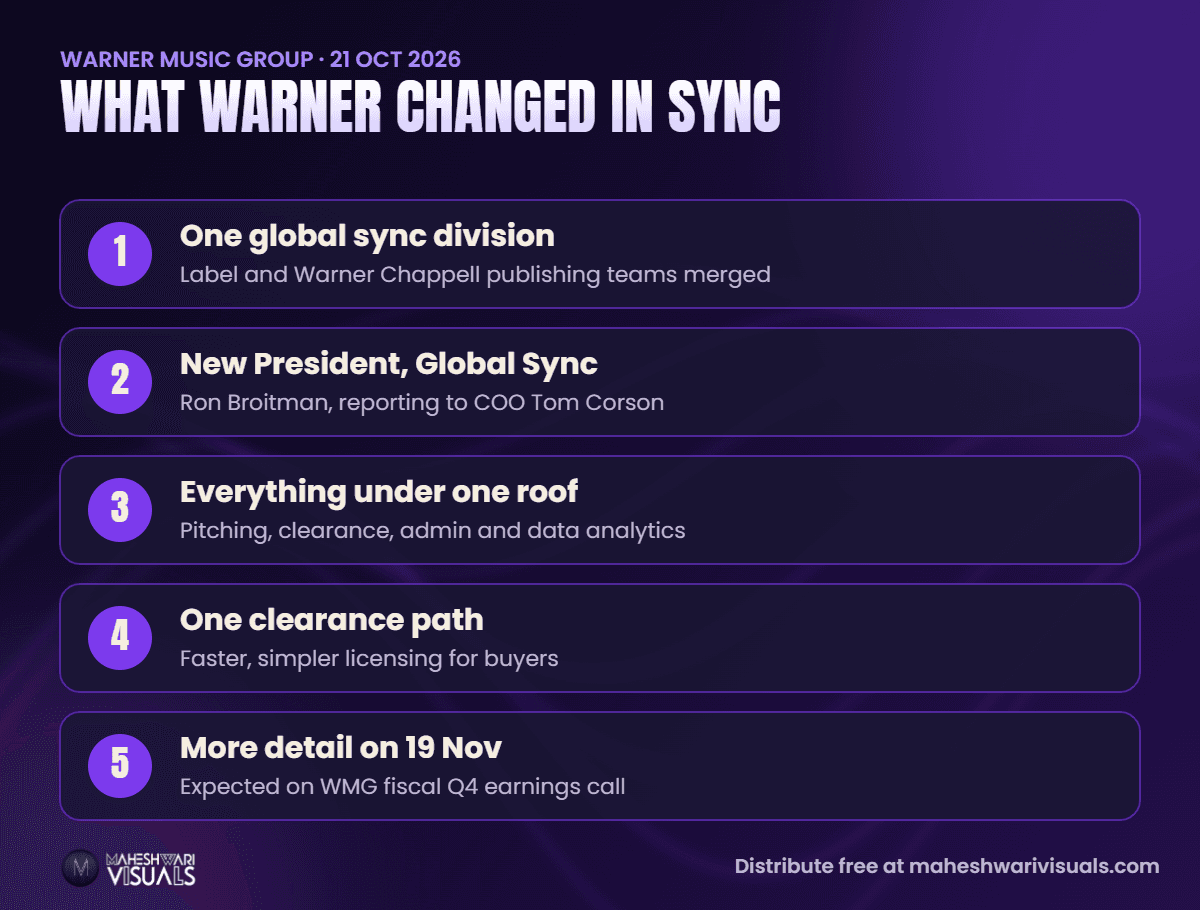
According to Music Business Worldwide and Digital Music News, both reporting on 21 October 2026, the key points are:
- One global sync organisation: teams that sat inside Warner Chappell, Atlantic Music Group, Warner Records Group and ADA now work as one unit.
- New leader: Ron Broitman, a long-time Warner executive, has been promoted to President, Global Sync, based in Los Angeles. He reports to COO Tom Corson, with Warner Chappell chief Guy Moot giving strategic oversight.
- Everything under one roof: creative pitching and marketing, business development, licence clearance, administration and data analytics.
- The goal: faster, simpler licensing. Corson described it as one creative strategy and "one clearance and one admin path" for all of WMG's sync rights.
More detail may come on Warner's fiscal Q4 earnings call, scheduled for 19 November.
Why Sync Licensing Matters More Than Ever
Sync (short for synchronisation) is the licence that lets someone pair your music with moving pictures: films, OTT series, TV and digital ads, games, trailers and branded videos. Unlike streaming, where income arrives in small amounts per play, a sync deal is usually a one-time fee agreed up front, and a good placement can also send new listeners to your catalogue.
The numbers show why labels are reorganising around it:
- The RIAA's 2026 mid-year report puts US recorded-music sync revenue at $231.8 million for the first half of 2026, up 18.2% year on year, faster than the US market's overall growth of 6.9%.
- MBW reports that Warner Chappell earned $60 million from sync in the three months to 30 June, up 7.1% at constant currency.
- Globally, the picture is mixed: IFPI data cited by MBW shows recorded-music sync fell 2.0% in 2025 to $641 million, ending a four-year growth run.
So sync is valuable but competitive. When growth slows, the companies that make licensing quickest and easiest win more placements. That is exactly the problem Warner is trying to solve.
The Real Lesson: Buyers Want One-Stop Music
Every song has two sets of rights:
- The master: the actual sound recording, usually owned by whoever paid for or released it (the artist or label).
- The composition: the lyrics and melody, owned by the songwriters and their publisher.
A music supervisor or ad agency needs permission for both before your song can appear on screen. At a major company these often sit in different departments, which is why Warner merged them. Every extra approval adds time, and deadlines in advertising and OTT production are often tight.
Here is the good news for independent artists: you may already be "one-stop". If you wrote the song, produced it and own the master, you can clear both sides yourself, often in a single conversation. A busy supervisor choosing between a track that needs three approvals and a track that needs one will often pick the easier option, provided the music fits the scene.
What can block a deal
- A co-writer or producer who was never credited or never agreed to splits
- Unclear ownership of a beat, sample or loop
- Missing metadata, so nobody knows who to contact
- No instrumental version when the scene needs one
What Indian Independent Artists Should Do Now
India has a huge appetite for licensed music: Hindi and regional films, OTT originals, YouTube brand content, Instagram Reels campaigns and TV ads all need songs. You do not need a major label to be part of that, but you do need to be ready when someone asks.
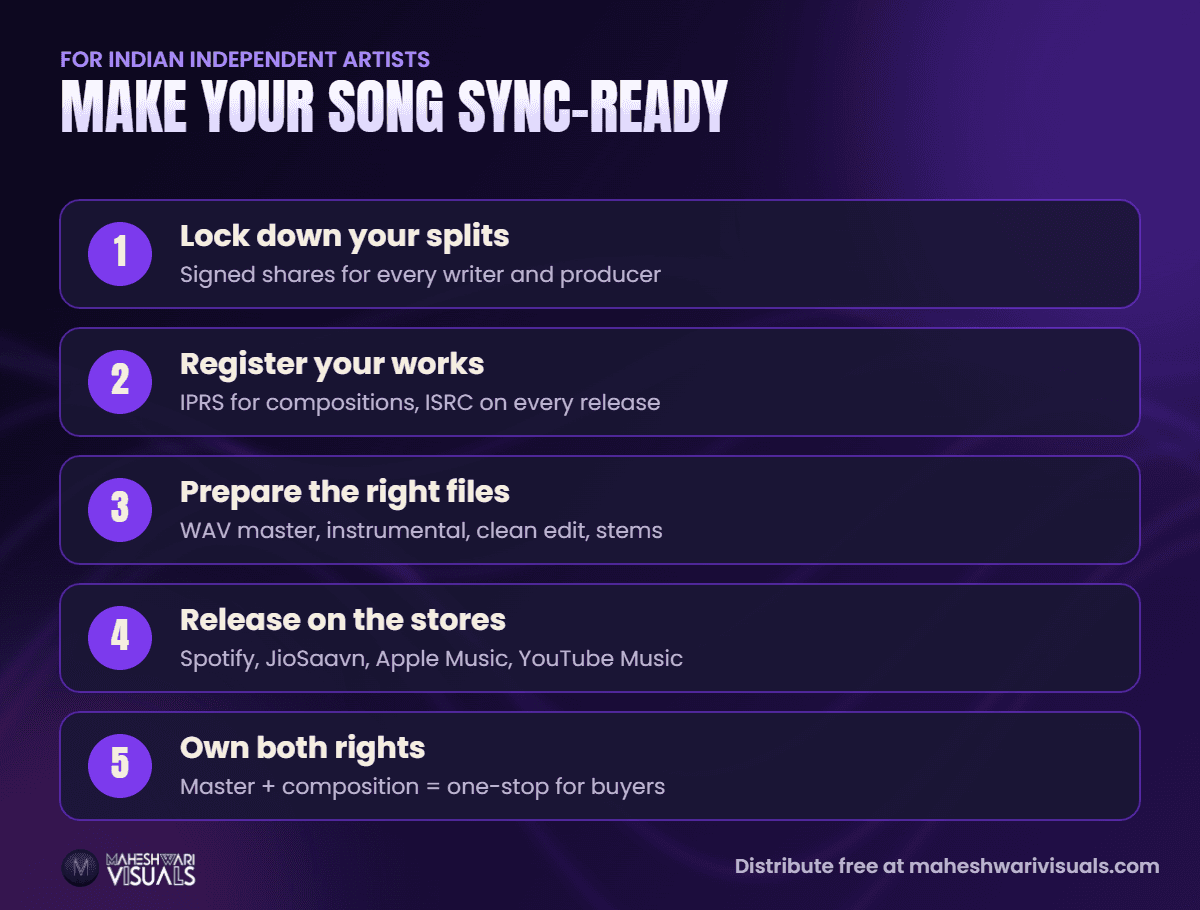
1. Lock down your splits
Agree on and write down who owns what share of the composition and the master, signed by every writer and producer, before release. A simple split sheet avoids disputes later.
2. Register your works
Register your compositions with IPRS, India's society for authors, composers and publishers, so performance royalties can be tracked. Make sure every release carries a correct ISRC code and accurate credits.
3. Prepare the right files
Keep high-quality WAV masters, an instrumental, a clean version (if the lyrics are explicit) and, where possible, stems. Supervisors often ask for these at short notice.
4. Get your music onto the stores
Supervisors and brand teams discover songs on Spotify, JioSaavn, Apple Music, YouTube Music, Amazon Music and Gaana. A professional release with correct metadata makes you easy to find and easy to verify. Our complete guide to music distribution explains how this works.
5. Protect against unlicensed use
Sync also has a flip side: brands sometimes use music in social videos without permission. We covered this in our post on Warner's lawsuit over unlicensed music on social media. Knowing your rights is the first step to getting paid when your music is used.
How Maheshwari Visuals Helps
Getting sync-ready starts with a clean, professional release. With MV Distribution, your music reaches 100+ stores including Spotify, Apple Music, JioSaavn, Amazon, YouTube Music and Gaana, usually live within 24 hours, and you keep 100% of your rights, which is exactly what makes you a one-stop option for licensing. Our human support team replies within 24 hours if you get stuck.
When your catalogue is ready, MV Marketing can help you pitch for placements. Explore our sync licensing services to see how we connect artists with film, OTT, ad and digital video opportunities.
Conclusion: Make Your Music Easy to Say Yes To
Warner Music Group's sync restructure is really about speed: one team, one clearance path and less friction for buyers. Three takeaways matter for you. First, sync licensing is a real revenue stream, and the US numbers show it is still growing. Second, licensing buyers favour music that can be cleared quickly, and independent artists who own their masters and compositions already have that advantage. Third, being ready, with clear splits, registrations, metadata and files, is what turns an enquiry into a deal.
You don't need a global corporation behind you to compete for placements. You need well-organised rights and music that is easy to find. Start with a professional release: sign up for music distribution with Maheshwari Visuals and build a catalogue that is ready for the screen.
Frequently Asked Questions
What is sync licensing in music?
Sync licensing is permission to use a song alongside visuals, such as in a film, web series, advertisement, game or online video. The user usually needs two licences: one for the sound recording (master) and one for the composition (publishing).
What did Warner Music Group change in its sync business?
On 21 October 2026, WMG merged the sync teams of its record labels and its publisher, Warner Chappell, into one global division led by Ron Broitman, President, Global Sync. The aim is faster licensing with a single clearance and admin path.
Can independent artists in India get sync deals?
Yes. Films, OTT shows, ads and brand videos all need music, and independent artists who own their masters and compositions can often clear both rights quickly. Being properly released, registered and organised makes a big difference.
What does "one-stop" mean in sync licensing?
A one-stop track is one where a single party can approve both the master and the composition. It saves the buyer time, which is why music supervisors often prefer it.
How much does a sync deal pay?
Fees vary widely depending on the use, length, territory, duration and the size of the production. There is no standard rate, so always get the terms in writing before agreeing.
Sources: Music Business Worldwide, 21 Oct 2026; Digital Music News, 21 Oct 2026; RIAA 2026 Mid-Year Music Industry Revenue Report.
Comments
Related Articles

Producer Sues Sony Over Half-Rate Royalties: What Indian Artists Should Check

Spotify Q3 2026 Results: 788M Listeners, 38% in Rest of World — What It Means for Indian Artists
