
Nearly 90,000 fully AI-generated tracks land on a single streaming service every day. On 13 October 2026, that service — Deezer — announced it will let listeners switch them off completely. For the first time, a major platform is handing fans a button that says, in effect, "show me music made by people".
For independent artists in India, the Deezer AI music filter is more than a tech headline. It is a signal of where streaming is heading: platforms are starting to sort music by how it was made, and "human-made" is turning into something listeners can actively choose. In this explainer, we break down what Deezer announced, why it matters even if most of your listeners are on JioSaavn, Spotify or YouTube Music, and the practical steps you can take now so your releases are on the right side of that line.
What Deezer Announced on 13 October 2026
Deezer says it will add an on/off toggle to its app before the end of 2026, rolling out globally. When a listener turns it on, fully AI-generated tracks, albums and their related artist profiles disappear from search results. Turning it off brings them back.
According to Deezer's newsroom, tracks its system detects as fully AI-generated are already kept out of algorithmic recommendations and editorial playlists. The company says it has used its own AI-detection tool since early 2025 and became the first streaming platform to label AI-generated music in June 2025.
One detail matters a lot for working musicians: the filter targets music created entirely by generative AI. Deezer says songs with limited AI-assisted elements inside a broader human creative process are treated differently. If you use an AI tool to clean up a vocal or sketch an idea, but the song is written, performed and produced by you, that is not what this toggle is built to hide.
The Numbers Behind the Deezer AI Music Filter
The figures Deezer shared, also reported by Music Business Worldwide on 13 October, show why platforms are acting:
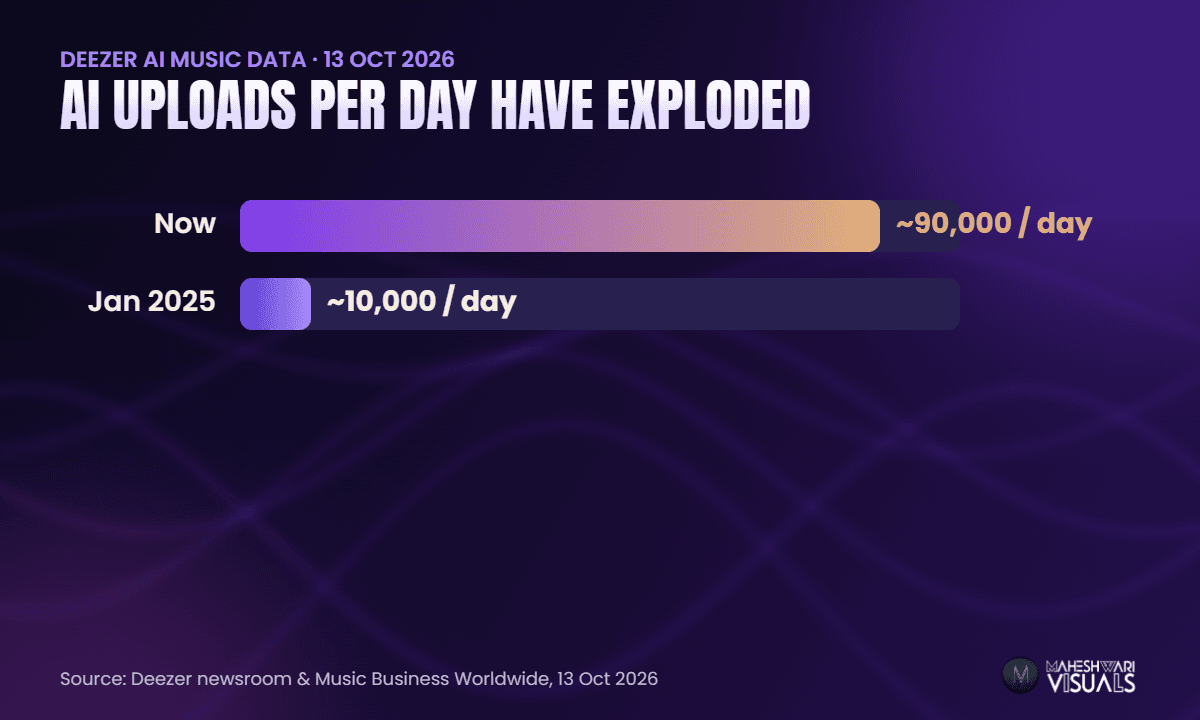
- Nearly 90,000 fully AI-generated tracks are delivered to Deezer every day, up from about 10,000 when its detection tool launched in January 2025.
- On peak days, these tracks make up more than 50% of all new music delivered to the platform.
- Yet they account for only 1–3% of streams.
- Up to 85% of streams on fully AI-generated tracks in 2025 were found to be fraudulent, and Deezer excludes manipulated streams from royalty payments.
- More than 42 million AI-generated tracks were detected and removed from recommendations between January 2025 and August 2026.
Read that gap carefully. AI uploads are flooding in, but real listeners are barely playing them — and a large share of the plays they do get are fake. That pattern is exactly what we explored in our post on the first prison sentence for AI streaming fraud.
Why Listeners Asked for This
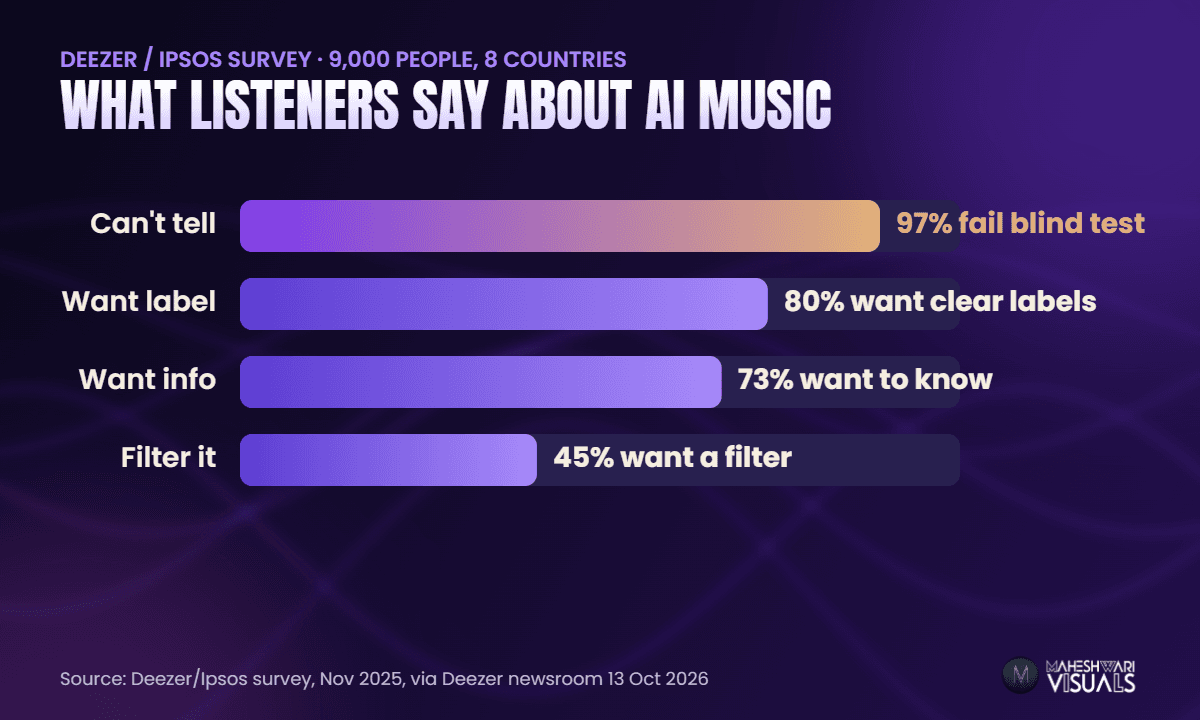
Deezer's case for the toggle rests on a survey it ran with Ipsos in November 2025, covering 9,000 people in eight countries:
- 45% of streaming users said they want to be able to filter out 100% AI-generated music.
- 97% could not tell fully AI-generated music from human-made music in a blind test.
- 80% said fully AI-generated music should be clearly labelled.
If most people can't hear the difference, labels, metadata and trust become the deciding factor — so how your music is described and delivered matters more than ever.
What It Means for Indian Independent Artists
Deezer is one platform, and most Indian listeners stream on JioSaavn, Spotify, YouTube Music, Gaana and Amazon Music. So why should a Bhojpuri singer in Patna or an indie producer in Pune care?
1. The flood is real everywhere
When over half of a day's deliveries can be machine-made, a genuine new release gets harder to notice. Platforms that filter or label that content are, in practice, clearing space for human artists.
2. Other platforms are under pressure to follow
Deezer has been licensing its detection technology to the wider industry since January, with French collecting society Sacem as its first partner. Earlier this month, Sony Music was reported to be pulling more than 250,000 infringing AI uploads from streaming services. The direction of travel is clear: more detection, more labels, and more ways for fans to choose.
3. Royalties are at stake
Industry research from CISAC and PMP Strategy, cited by MBW, estimates 24% of music creators' revenues could be at risk by 2028 because of generative AI. Every fraudulent stream that gets filtered out of the royalty pool protects the share that should go to real artists.
4. Your story is now a selling point
When fans can hide machine-made music with one tap, "a real person made this" becomes part of your brand. Share studio clips, live takes and behind-the-scenes Reels.
Five Steps to Protect Your Releases Right Now
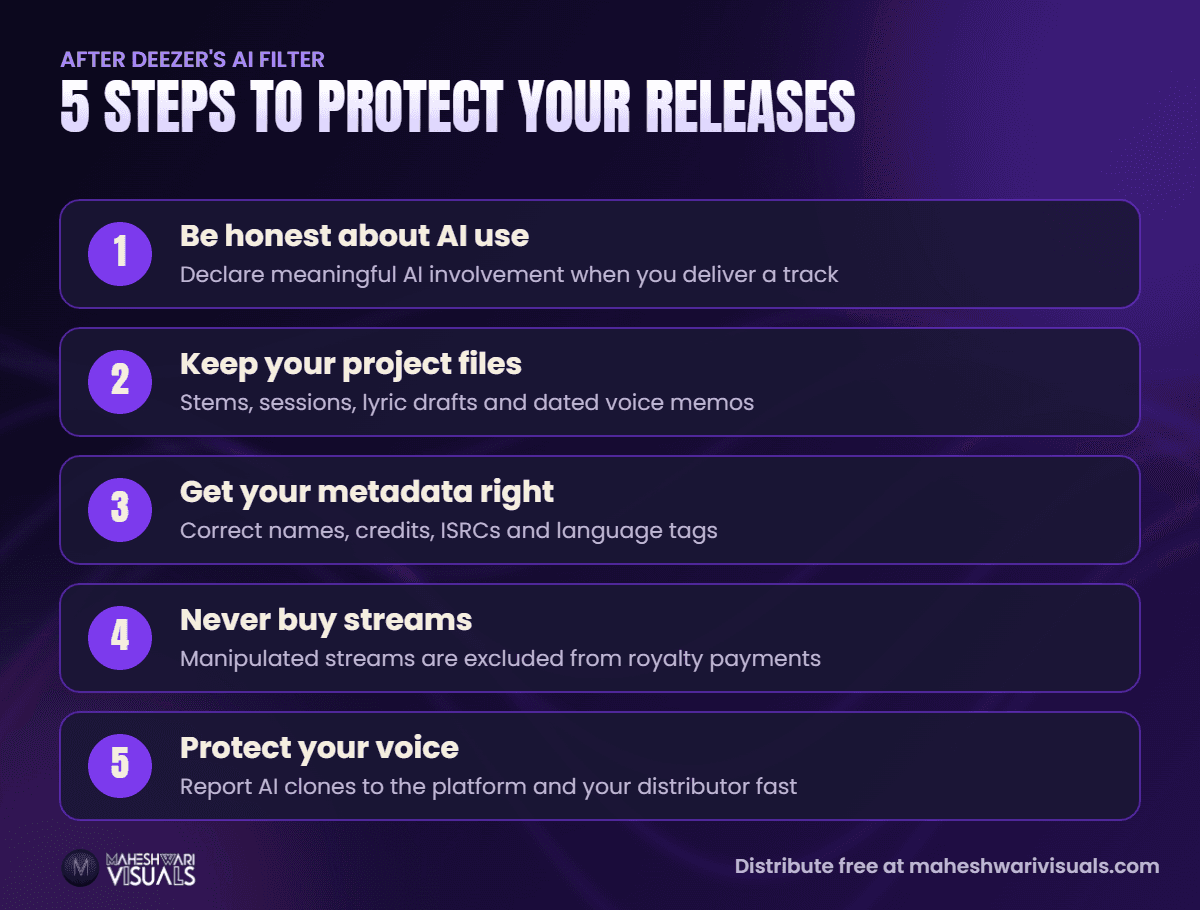
- Be honest about AI use. If an AI tool played a meaningful part in a track, say so when you deliver it. Accurate declarations protect you if platforms tighten their rules later.
- Keep your project files. Save stems, session files, lyric drafts and dated voice memos. If a song is ever wrongly flagged, this is your evidence that a human made it.
- Get your metadata right. Correct artist names, songwriter and producer credits, ISRCs and language tags help platforms identify your work as yours — and help fans find it.
- Never buy streams. Detection systems are built to catch artificial plays, and Deezer already strips manipulated streams from payouts. Fake numbers can cost you real money and your catalogue.
- Protect your voice. If someone uploads an AI clone of your voice or style, report it to the platform and your distributor quickly. Our guide to protecting your voice from AI clones covers this in detail.
How Maheshwari Visuals Helps
MV Distribution delivers your music to 100+ stores — including Spotify, Apple Music, JioSaavn, Amazon Music and YouTube Music — and releases can go live within 24 hours. You keep 100% of your rights, and real people on our support team reply within 24 hours if you need help with metadata, credits or a takedown request. Learn more on the MV Distribution page, or explore our playlist pitching service to get your human-made music in front of curators.
Conclusion
The Deezer AI music filter shows three things clearly. First, AI uploads are arriving at enormous scale, but listeners are barely streaming them — and many of those plays are fraudulent. Second, fans want transparency: labels, filters and the right to choose human-made music. Third, platforms are responding, and others may follow with their own detection and labelling.
For independent artists, that is good news: the more platforms separate real artistry from automated noise, the more room there is for your voice. Keep your process transparent, your metadata clean and your streams genuine.
Ready to put your human-made music on 100+ platforms? Sign up with Maheshwari Visuals for music distribution and release your next track the right way.
Frequently Asked Questions
What is the Deezer AI music filter?
It is an on/off toggle Deezer plans to launch globally before the end of 2026. When switched on, it removes fully AI-generated tracks, albums and related artists from search results, so listeners see human-made and AI-assisted music.
Will my song be hidden if I used AI tools in production?
Deezer says the filter targets music created entirely by generative AI. Songs with limited AI-assisted elements within a broader human creative process are treated differently. Keep your project files as proof of your human work in case of any mistaken flag.
Do JioSaavn, Spotify or YouTube Music have a similar AI filter?
As of mid-October 2026, Deezer's toggle stands out — reports note that Spotify, for example, does not offer a similar button. Other platforms have their own policies on AI content and spam, and the industry is moving towards more detection and labelling.
Can AI-generated songs still earn royalties?
On Deezer, fully AI-generated tracks are already kept out of algorithmic recommendations and editorial playlists, and manipulated streams are excluded from royalty payments. Rules differ between platforms, so always check each store's current policy.
How can I prove my music is human-made?
Keep your stems, session files and lyric drafts, and credit every contributor correctly in your metadata.
Source: Deezer Newsroom — AI music toggle (13 October 2026); Music Business Worldwide (13 October 2026); Digital Music News (13 October 2026).
Comments
Related Articles

Warner Music Sues Ray-Ban Owner Over Unlicensed Music on Social Media: What Indian Artists Should Learn

MTV Hustle 5 Winner Dhadkan Takes ₹1 Crore: What It Means for India's Independent Rappers
