
One percentage point sounds tiny. On a song that keeps streaming for years, it can add up to serious money. That is why a new lawsuit filed in New York this month has caught the attention of producers and artists everywhere, including here in India.
On 16 October 2026, producer Ishmael "ISM" Montague, co-producer of Chris Brown's 2016 single "Party", sued Sony Music Entertainment in a US federal court, as reported by Music Business Worldwide and Digital Music News on 23 October. He claims he was paid half the royalty rate he agreed to, and he is asking for at least $1.25 million and a full audit.
These are allegations, and the court has not ruled on them. But the questions the case raises are ones every independent artist and producer should be able to answer about their own music. Below, we break down what happened, why it matters for royalty statements in India, and a simple checklist to protect your share.
What the Sony royalty lawsuit is about
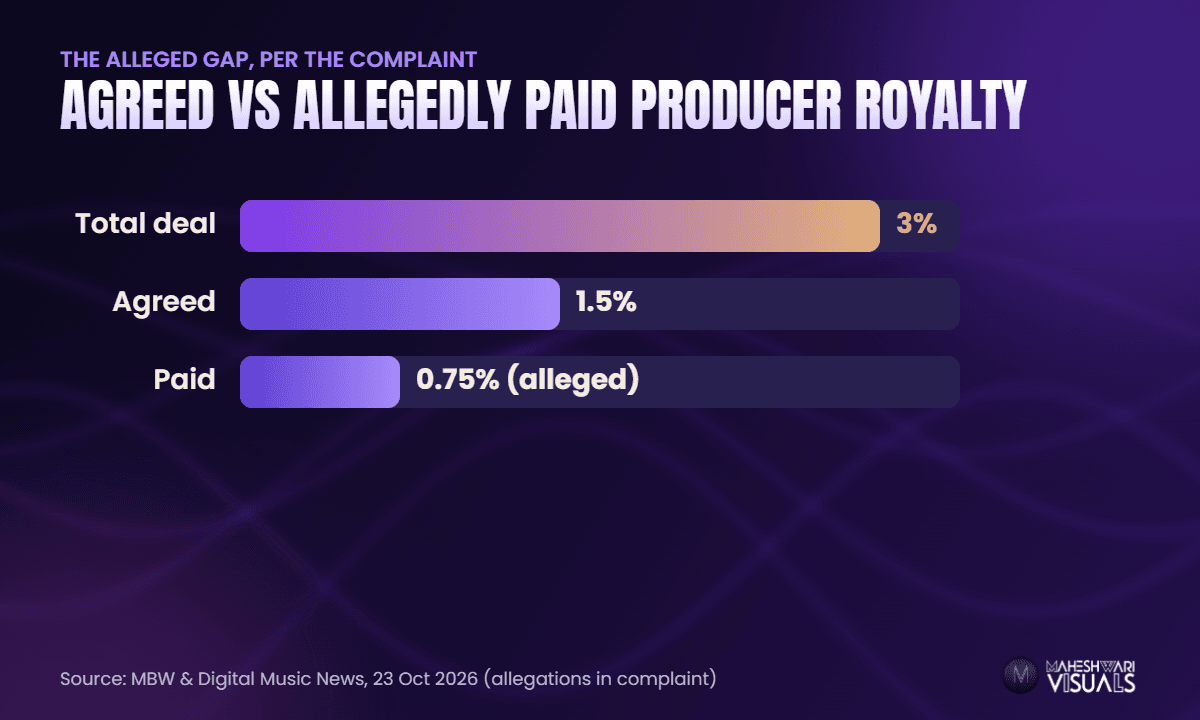
According to the complaint, as reported by MBW and DMN, Montague and his co-producer signed a producer agreement with Chris Brown's company in November 2016. The deal set a 3% producer royalty on "Party", split equally between the two producers, so Montague's share should be 1.5%.
The complaint alleges three things:
- Half-rate payments: a third-party review in July 2026 allegedly found Sony was applying a 0.75% rate to his account instead of 1.5%.
- No full accounting: he says he has not received a complete breakdown and wants a court-supervised audit at Sony's expense.
- A delayed payment switch: when he sold his royalty interest in the song to a royalty investment company in June 2026, he says Sony took about six weeks to redirect payments and pushed a "letter of direction" form that included giving up the right to audit.
Sony's in-house counsel reportedly denied liability, arguing there was no direct contract between Sony and the producer. MBW asked Sony for comment, and no response had been reported at the time of writing.
Why this royalty dispute matters for Indian artists
You may never sign with a major label or produce for a global star. But the problem at the heart of this case is universal: the money you earn depends on the percentage written in your agreement and the percentage actually applied on your statement. If those two numbers don't match, nobody will call you to say so.
Small percentages, big money
Royalty errors rarely look dramatic. A share entered as 25% instead of 50%, a featured artist missing from a split, or a rate copied wrongly from one release to the next. Each mistake repeats every month for as long as the song earns, which on a catalogue song can be years.
Indian music has more royalty streams than ever
Indian songs now earn from streaming on JioSaavn, Spotify, YouTube Music, Gaana and Amazon Music, from YouTube Content ID, and from public performance. In June 2026, PPL India was registered as a copyright society for licensing sound recordings in hotels, restaurants, malls, events and radio, and IPRS collects for lyricists, composers and publishers. More streams of income means more places where a split or a rate can go wrong.
Selling or assigning royalties is becoming common
The case also shows how royalties are now treated as assets that can be sold. If you ever sell a share of your future royalties or change who gets paid, the paperwork (a letter of direction) matters. Read every line before you sign it, especially anything that waives your right to check the accounts.
What Indian artists and producers should do now
You don't need a lawyer on retainer to protect yourself. You need clear paperwork and the habit of checking it. Here is a simple routine.
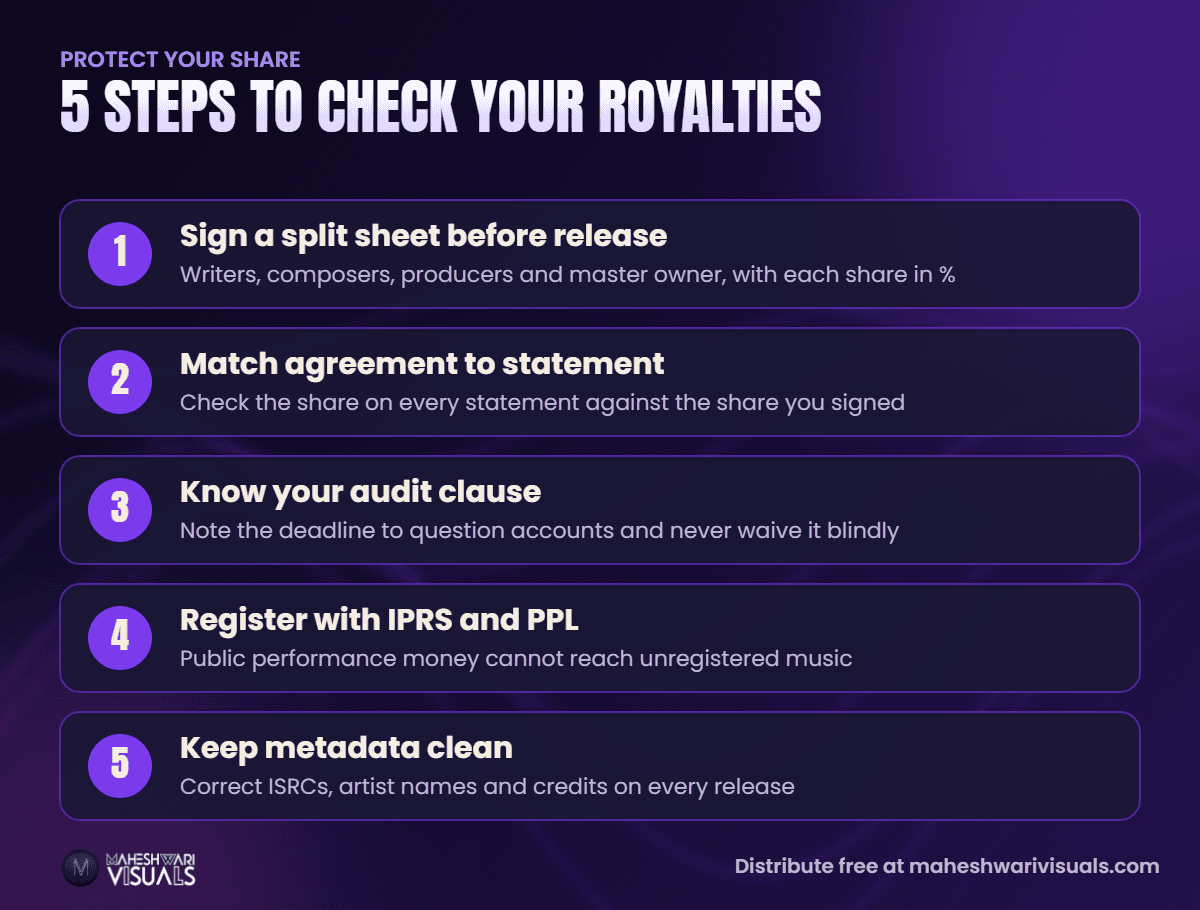
1. Put every split in writing before release
Use a split sheet for every song: who wrote the lyrics, who composed, who produced, who owns the master, and each person's percentage. Get everyone to sign it before the song goes live. It takes ten minutes and prevents most disputes.
2. Match your agreement to your statement
Each time a statement arrives, pick one or two songs and check that the share shown is the share you agreed. Keep a simple spreadsheet with song, ISRC, agreed share and the share you see on statements.
3. Know your audit and accounting rights
Many contracts let you request an accounting or audit within a set time. Find that clause now, note the deadline, and never sign a form that gives up this right without understanding what you lose.
4. Register with the right societies
Lyricists, composers and publishers should be registered with IPRS so public performance royalties can reach them. Labels and master owners should understand how PPL licenses their recordings. Unregistered music often means uncollected money.
5. Keep your metadata clean
Royalties follow data. Correct ISRCs, consistent artist names and accurate credits make it far easier for every platform and society to pay the right person. For a refresher on rights after you sign, read our explainer on the US Supreme Court song-rights ruling.
How Maheshwari Visuals helps you stay in control
Disputes like this often start when artists hand over rights and lose sight of their own numbers. With MV Distribution, you keep 100% of your rights, and your music reaches 100+ stores including Spotify, Apple Music, JioSaavn, Amazon Music, YouTube Music and Gaana, usually live within 24 hours.
More than 200K artists already trust Maheshwari Visuals, and if anything on your earnings looks unclear, our human support team replies within 24 hours. You can compare plans on our pricing page.
Conclusion: your royalties, your responsibility, your power
The Sony case is still only a set of claims, but its lessons are already clear. First, the percentage in your agreement only matters if it is the percentage applied on your statement. Second, split sheets, clean metadata and society registrations are what turn streams into money that actually reaches you. Third, never sign away your right to check the accounts without knowing exactly what it means.
You don't need to be a finance expert to protect your music. A few minutes of checking every quarter puts you firmly in control of what you have created.
Ready to release with full ownership and clear support? Sign up for music distribution with Maheshwari Visuals and start your next release today.
Frequently asked questions
What is a producer royalty?
A producer royalty, often called producer "points", is a percentage of the income from a master recording paid to the producer. The rate and how it is split between co-producers should be written in the producer agreement.
How do I check if my music royalties are correct?
Compare the share in your agreement or split sheet with the share shown on your royalty statements, song by song. If they don't match, raise it in writing with whoever pays you and keep copies of every email.
What is a royalty audit?
An audit is a formal review of the accounts that calculate your royalties. Many contracts allow it within a fixed period, so check your agreement for the audit clause and its deadline.
Do I need to join IPRS or PPL?
If you write lyrics or compose music, registering with IPRS helps you collect public performance royalties for your works. PPL licenses sound recordings, so labels and master owners should understand how it applies to their catalogue.
What is a letter of direction in music?
It is a document telling a label or distributor to pay royalties to someone else, for example after you sell a share of your royalties. Read it carefully, because it can include extra terms such as waiving audit rights.
Sources: Music Business Worldwide, 23 October 2026; Digital Music News, 23 October 2026; Outlook India, 20 June 2026. All claims in the case are allegations that have not been tested in court.
Comments
Related Articles

Spotify Q3 2026 Results: 788M Listeners, 38% in Rest of World — What It Means for Indian Artists

Warner Music Unifies Its Global Sync Teams: What It Means for Indian Independent Artists
