
Your voice took years to build. With today's AI tools, a stranger can clone it in an afternoon and drop a "new song" in your name before you've even had your morning chai. That is exactly the problem a new law in Denmark is trying to fix, and the ripple effects matter for every independent artist in India.
On 8 October 2026, Danish culture minister Zenia Stampe presented a bill to parliament that would make it illegal to share realistic AI-generated imitations of a person's voice or likeness without their consent. In this explainer, we break down what the Danish deepfake law says, why music people around the world are watching it, where Indian artists already stand, and five practical steps you can take this week to protect your voice and your releases.
What Denmark's deepfake law actually proposes
According to Complete Music Update (CMU), 9 October 2026 and The Copenhagen Post, 8 October 2026, the bill does four big things:
- Consent first: making a realistic digital imitation of someone's voice or appearance available to the public without that person's consent would be unlawful.
- Not just AI: it covers deepfakes made with AI and imitations made with conventional digital editing tools, as long as they are realistic enough to be confused with the real person.
- Room for satire: parody, caricature and criticism stay legal, unless the content is misinformation that could seriously harm others.
- Platforms must act: the minister's stated priority is getting big tech platforms to remove manipulated content quickly.
The protection sits inside Danish copyright law but, as an IFPI Denmark director explained to CMU, it works as a separate right over a person's own characteristics rather than a traditional copyright. Stampe hopes it can take effect around the start of 2027. It still has to pass parliament, so treat the details as a proposal for now.
Why a Danish bill matters to an artist in Lucknow or Ludhiana
Denmark is a small market, but laws like this tend to travel. CMU notes that the Danish approach, along with proposals in the US Congress, could shape similar rights in other countries. Streaming platforms and social apps operate globally, and when one country forces them to build faster takedown systems for voice clones, those systems often roll out far more widely.
There is also a commercial angle. Once your voice is clearly yours by law, it becomes something you can license, not just defend. CMU points out that artists could one day license their voice or likeness to AI platforms directly or through their music business partners. For independent artists, that could turn a threat into a new income line, on your terms.
For singers in Hindi, Punjabi, Bhojpuri, Haryanvi and other regional scenes, where a distinctive voice is often the whole brand, this is not a distant tech debate. Fake "unreleased tracks" and AI covers already circulate on YouTube, Instagram Reels and short-video apps, and every fake play is attention that should have gone to you.
Where Indian artists already stand on AI voice cloning
India does not have a Denmark-style statute yet, but artists are not starting from zero.
Courts are protecting personality rights
In 2024, the Bombay High Court granted Arijit Singh interim protection in Arijit Singh v. Codible Ventures LLP, covering his name, voice, vocal style, likeness and persona. As WIPO Magazine reports, the court held that offering AI tools that convert any voice into a celebrity's voice without permission violates their personality rights. That case was brought by a superstar, but the principle it rests on applies to every performer.
The IT Rules now cover AI-generated content
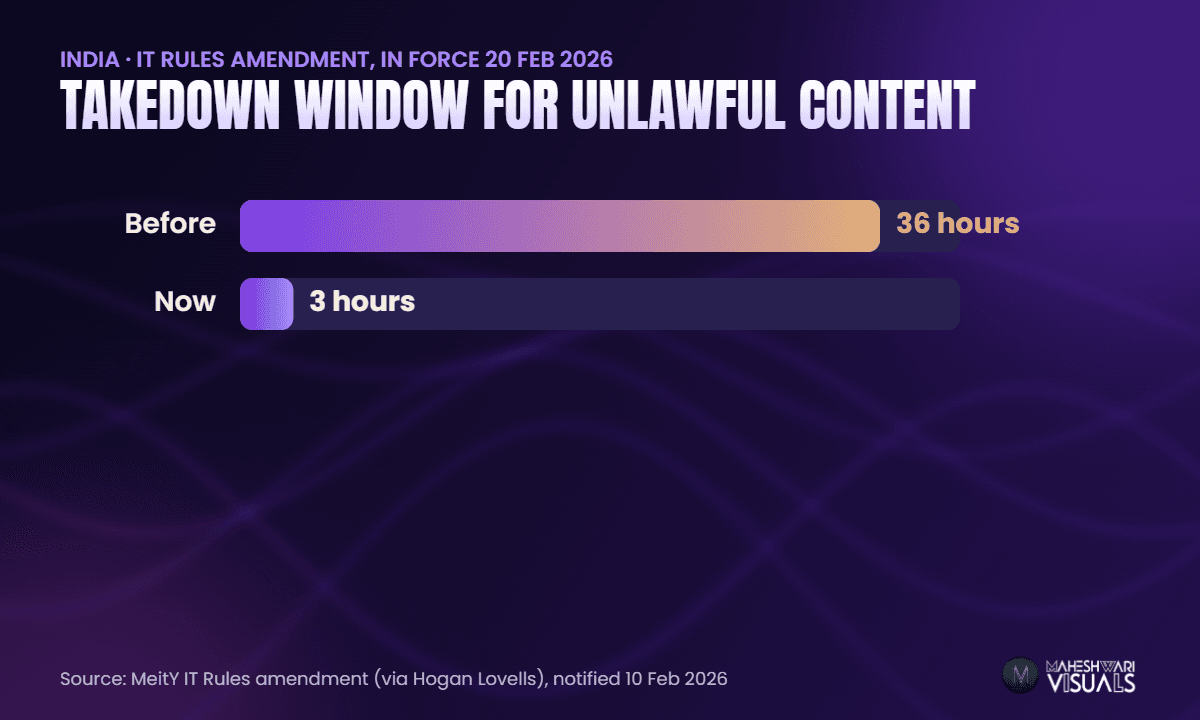
On 10 February 2026, MeitY notified amendments to India's IT Rules that took effect on 20 February 2026. As summarised by Hogan Lovells, they bring "synthetically generated information", including deepfake audio, under the rules. Permitted AI content must be clearly labelled, large platforms must ask users to declare AI content, and platforms must act on government or court orders within three hours, down from 36.
The gap? These tools mostly help once you can prove something is fake and that it is yours. That is why the boring paperwork of your releases matters more than ever.
5 steps to protect your voice from AI clones today
You don't need a legal team to get started. You need clean records and fast reactions.
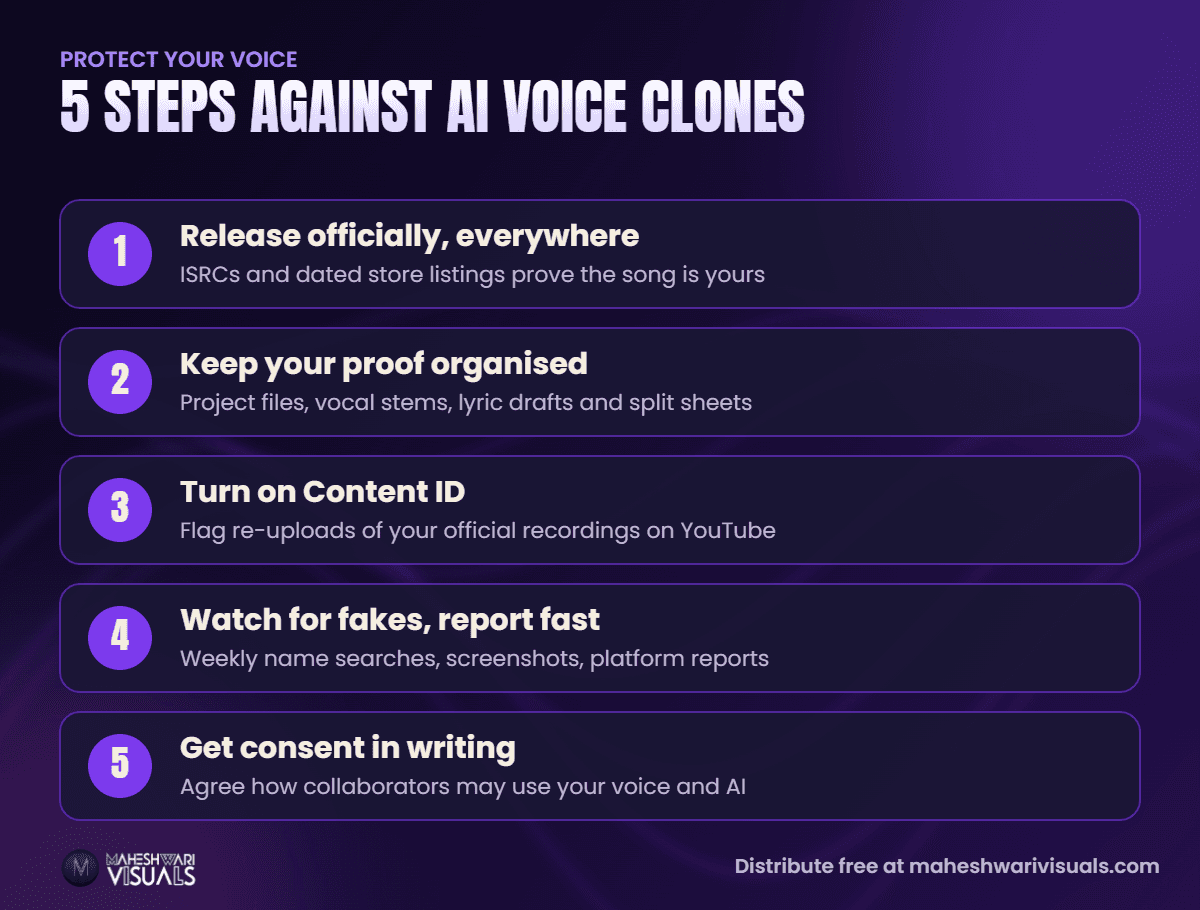
1. Release officially, everywhere
The strongest proof that a song is yours is an official release with your name, ISRC codes and release dates on record across Spotify, Apple Music, JioSaavn, Amazon Music, YouTube Music, Wynk and Gaana. Unreleased demos sitting on WhatsApp are easy to clone and hard to claim.
2. Keep your proof organised
Save your project files, vocal stems, lyric drafts and split sheets with dates. If someone uploads a cloned version of your voice, these files help you show what's original.
3. Turn on Content ID for your catalogue
YouTube Content ID can match re-uploads of your official recordings, so copies of your tracks get flagged instead of quietly earning for someone else. Ask your distributor to enable it for every release.
4. Watch for fakes and report fast
Search your name every week on YouTube, Instagram and Spotify. Report impersonation and AI fakes through each platform's tools, and keep screenshots and links. With India's three-hour clock for orders, a well-documented complaint carries weight.
5. Get consent in writing
If you collaborate with producers who use AI tools, agree in writing on how your voice can and can't be used, including whether it can be used to train a model.
How Maheshwari Visuals helps you stay protected
Laws can set the rules, but your release setup decides how quickly you can act on them. With MV Distribution, your music reaches 100+ stores including Spotify, Apple Music, JioSaavn, Amazon, YouTube Music, Wynk and Gaana, usually live within 24 hours, so your official version is out there first. You keep 100% of your rights, which is exactly what you need to prove ownership, and real humans reply to support queries within 24 hours when something looks wrong.
If you are worried about fake streams too, read our earlier explainer on AI streaming fraud and what it means for Indian artists.
Conclusion: own your voice before someone else copies it
Denmark's deepfake law is a clear signal that consent over your voice and face is becoming a legal right, not just a nice idea. India is already moving in the same direction through court-backed personality rights and the 2026 IT Rules with their three-hour takedown window. The artists who benefit most will be the ones with official releases, organised proof and a habit of reporting fakes quickly.
Your voice is your signature, and it deserves the same care as your songs. Make sure every track you put out is properly released and registered in your name. Sign up free with Maheshwari Visuals and distribute your music to 100+ stores while keeping 100% of your rights.
Frequently asked questions
Is AI voice cloning illegal in India?
There is no single AI voice law in India yet. However, courts have protected singers' personality rights, including their voice, against unauthorised AI cloning, as in the Arijit Singh case at the Bombay High Court in 2024. The 2026 IT Rules also require platforms to label AI content and act quickly on takedown orders.
What is Denmark's new deepfake law?
It is a bill presented to the Danish parliament on 8 October 2026 that would ban sharing realistic imitations of a person's voice or likeness without consent, with exceptions for satire and parody. The government hopes it will take effect around the start of 2027.
How do I remove an AI song that uses my voice?
Collect the links and screenshots, then report it through the platform's impersonation or copyright tools. Keep your official release records and project files ready to show the original is yours, and speak to a lawyer if the fake is spreading or earning money.
Can I license my voice to AI companies?
Possibly, in future. As laws like Denmark's treat your voice as your own protected characteristic, it becomes easier to license it on your terms. Always get any such deal in writing and understand how your voice will be used.
Does distributing my music help protect it from AI copies?
Yes. An official release gives your recordings ISRC codes, dated store listings and access to tools like YouTube Content ID, which make it much easier to prove ownership and flag copies.
Sources: CMU, 9 October 2026; The Copenhagen Post, 8 October 2026; WIPO Magazine; Hogan Lovells on India's 2026 IT Rules.
Comments
Related Articles

Deezer's New AI Music Filter: What It Means for Indian Independent Artists

Warner Music Sues Ray-Ban Owner Over Unlicensed Music on Social Media: What Indian Artists Should Learn
