
A finished song sitting on a hard drive can feel like the safest thing an artist owns. This week showed how quickly that can turn into the most argued-over thing they leave behind. On 13 November 2026, the parents of late Punjabi star Sidhu Moose Wala said the label Saga Music was releasing his unreleased track 'Phantom' without their permission, and announced legal action. The label says it holds an agreement Moose Wala signed himself.
We won't guess who is right; that is for the parties and, if needed, the courts. But the question in the middle of this row, who owns unreleased songs and who gets to release them, matters to every independent artist in India. Here's what happened, what the Copyright Act says, and the paperwork you can sort out this week so your music never ends up in a dispute.
What happened with 'Phantom'
According to ThePrint and ANI (13 November 2026), Moose Wala's parents, Balkaur Singh and Charan Kaur, said in a public statement that 'Phantom' was being released by Saga Music without their permission or authorisation. They said they had asked the label to stop and discuss a resolution, and that it went ahead without valid documentation from the family. They also asked other artists and labels who claim rights in his work to talk to the family before any release.
Saga Music's side, as reported by NewsBytes and Billboard India, is that it is acting on a content assignment agreement signed by Moose Wala during his lifetime, that payments for the audio rights were made, and that the producer was hired and paid in full in 2020. On 13 November it posted invoices, payment records and emails on Instagram to back this up. No court ruling on 'Phantom' has been reported yet.
This isn't the first time: in 2022, a Mansa court restrained the release of another posthumous track, 'Jaandi Vaar', after the parents objected, observing that they had a prima facie case as his legal heirs (as reported by ThePrint).
Who owns unreleased songs under Indian copyright law?
Unreleased doesn't mean unowned. Under the Copyright Act, 1957, copyright exists the moment a work is created, published or not. A typical song carries at least two rights:
- The composition (lyrics and music): owned first by the songwriter and composer, unless they made it as an employee or signed it away.
- The sound recording (the master): owned by whoever produced the recording, often the label or whoever paid for it.
Ownership can move in two main ways. The first is assignment, a deal that transfers rights. The second is inheritance: when an artist passes away, their copyrights pass to their heirs or to whoever their will names. Section 20 even says that if a will leaves someone the original manuscript of an unpublished work, the copyright goes with it unless the will says otherwise.
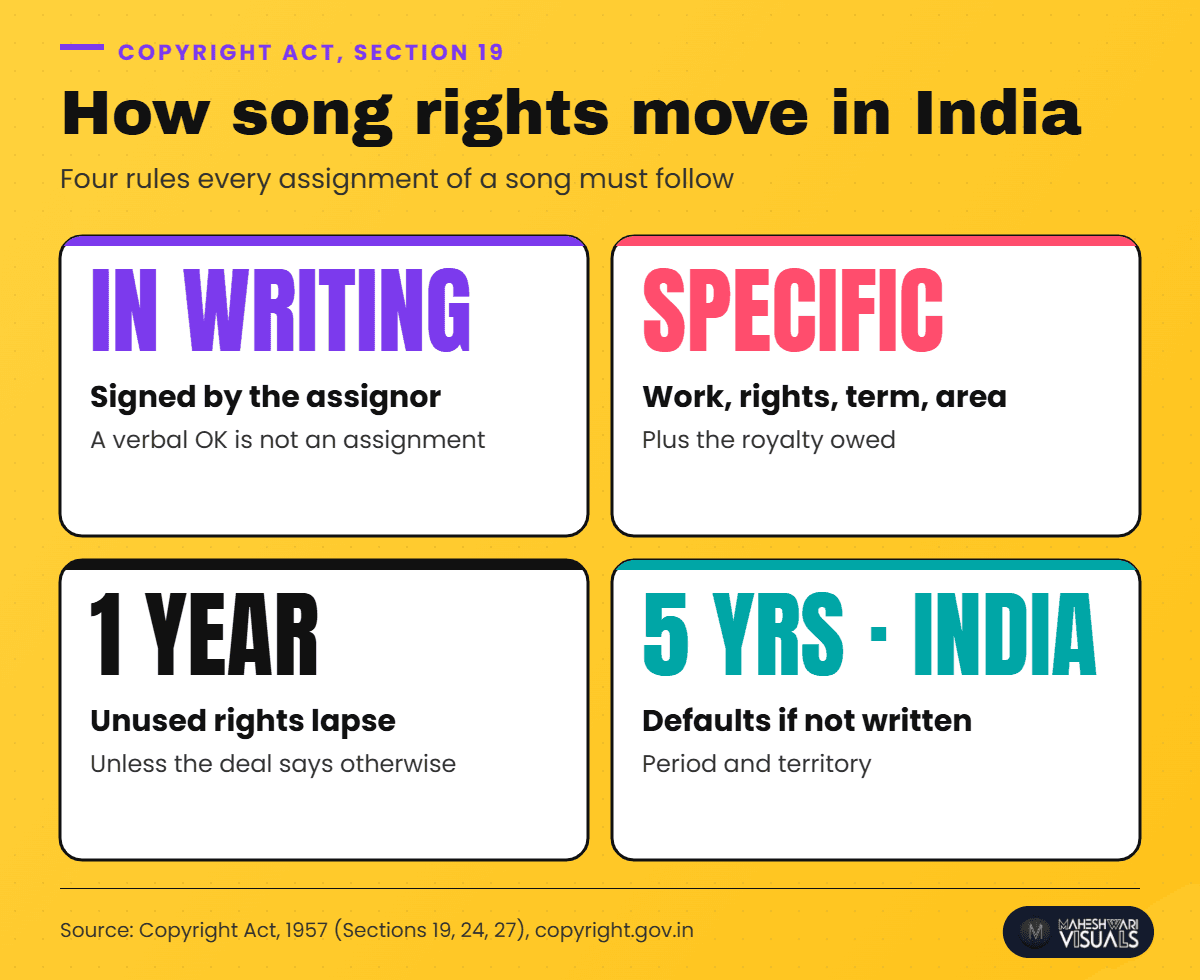
The four Section 19 rules every artist should know
Section 19 of the Act sets how an assignment must be made, and these rules protect artists more than most people realise:
- In writing and signed: an assignment is valid only if it is written and signed by the person giving the rights (or their authorised agent). A verbal "you can release it" is not an assignment.
- Specific: it must identify the work, the rights given, the duration, the territory and the royalty or other payment due to the author or their heirs.
- Use it or lose it: if the buyer doesn't exercise the rights within one year, the assignment of those rights lapses, unless the agreement says otherwise.
- Defaults: if no period is written, it's five years; if no territory is written, it's India only.
Two more points matter for songwriters. Section 18 says lyricists and composers whose work is in a sound recording keep an equal share of royalties for its use, a right they cannot sign away except to legal heirs or a collecting society. And a posthumous song isn't a free-for-all: a musical work unpublished at the author's death stays protected for 60 years from the year after it is first published (Section 24), and a sound recording for 60 years from the year after publication (Section 27).
None of this tells us who wins the 'Phantom' dispute. That depends on what the signed papers actually say. That's exactly the lesson.
What independent artists should do now
Most disputes over unreleased music come down to missing or vague paperwork. You don't need a big legal budget to fix that; you need a habit.
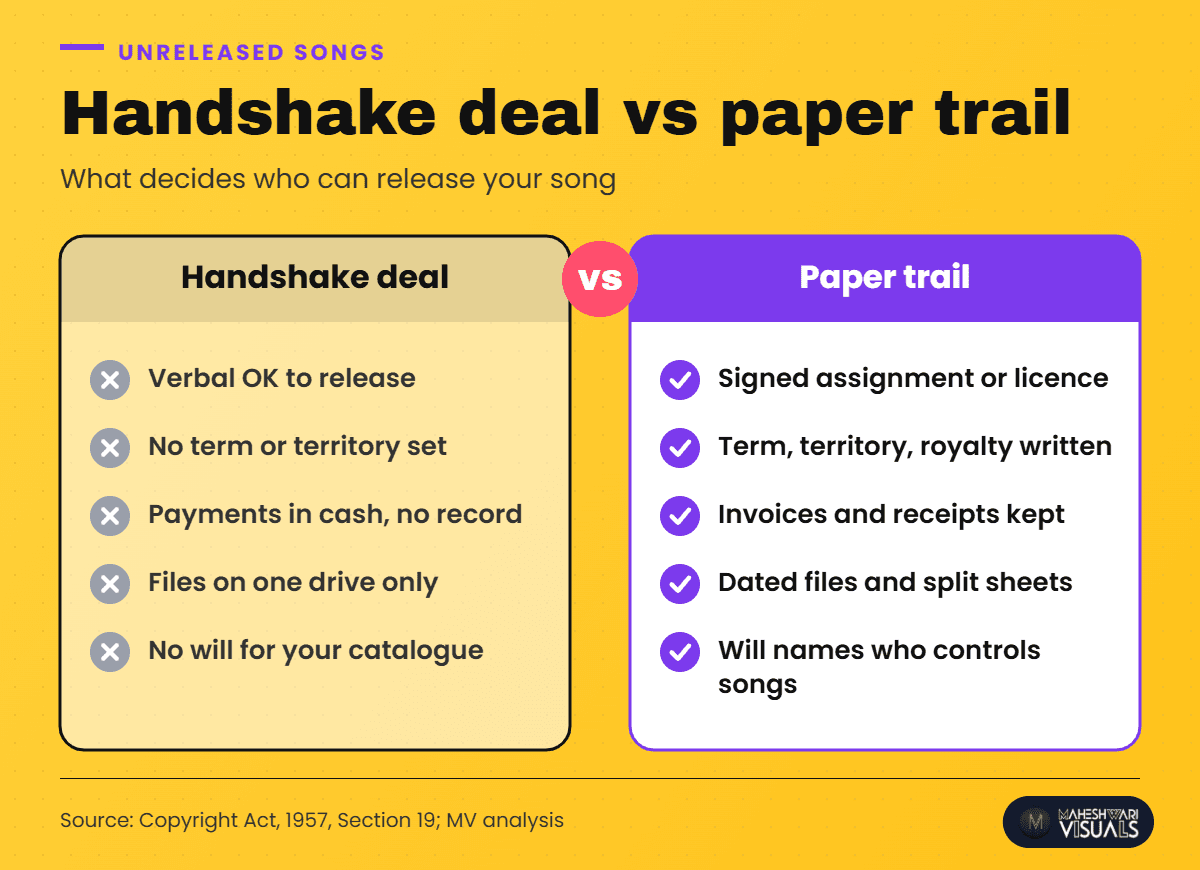
Put every deal in writing
Producer, label, featured artist, lyricist, video team: if someone has rights in your song, write down what they get, for how long and where. Include what happens to unreleased songs and who can approve a release.
Keep your own paper trail
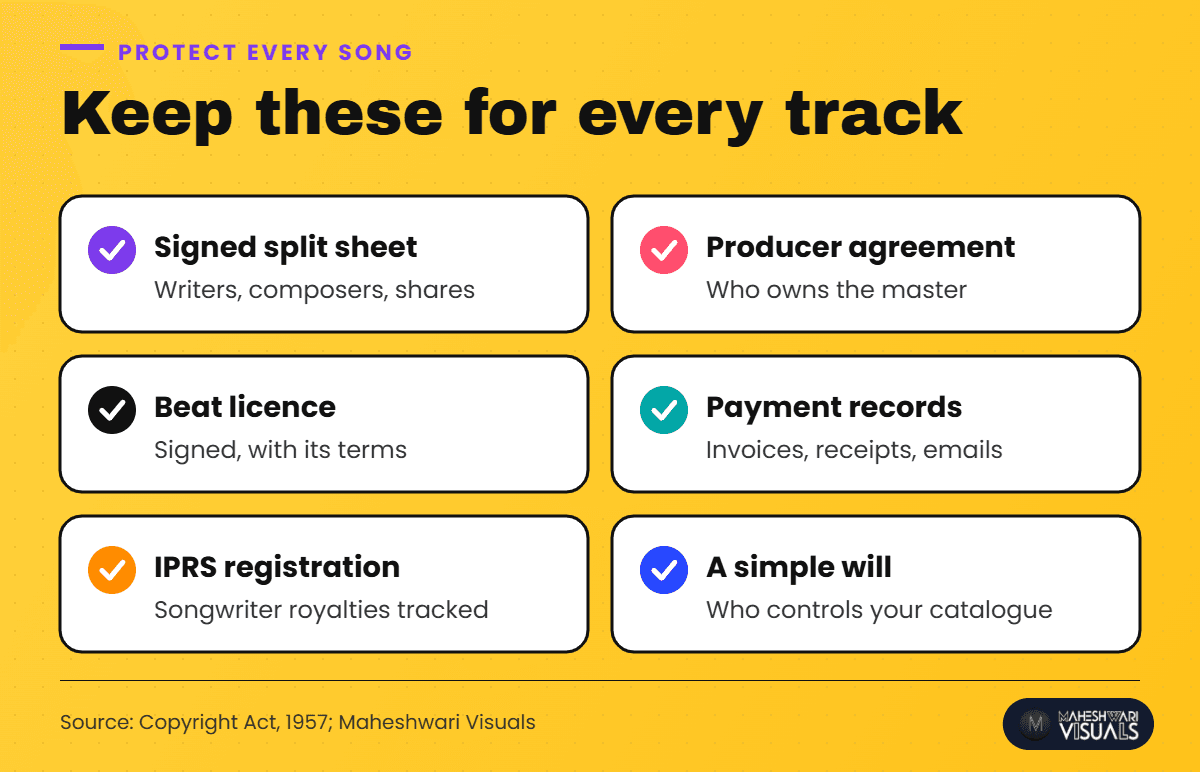
Saga Music's defence leans on invoices, payment records and emails. Keep yours too: split sheets, payment receipts, chats where terms were agreed, and dated project files. If you buy a beat, get a signed licence; even a cheap online beat deal needs one. We explain why in our short video below.
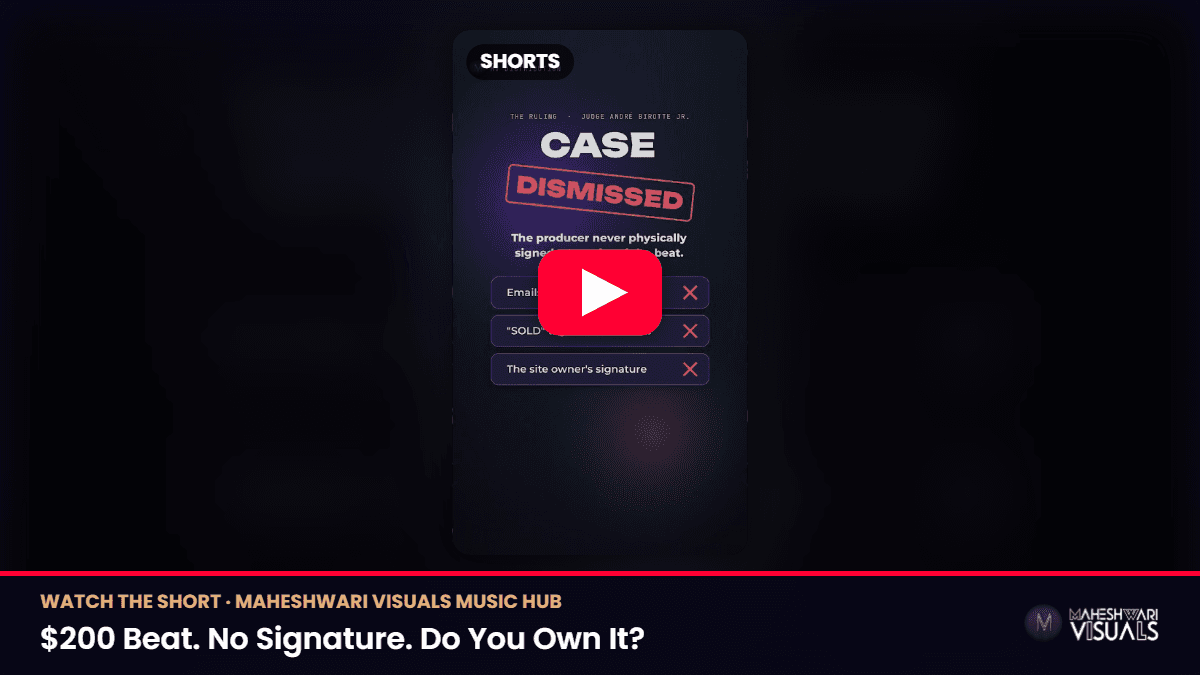
▶ Watch on YouTube: $200 Beat. No Signature. Do You Own It?
Plan for your catalogue's future
It isn't a pleasant thought, but a simple will that names who controls your songs, masters and unreleased folders can save your family years of conflict. Tell them where your files and agreements are kept.
Register your work
Register as a songwriter with IPRS so your share of performance royalties is tracked, and keep your release metadata (writers, producers, ISRC) accurate. See our guide on how to release a cover song legally in India for another side of the Copyright Act.
How Maheshwari Visuals helps
When you release through MV Distribution, you keep 100% of your rights: your masters stay yours, and you decide when a song goes out. Your music reaches 100+ stores, including Spotify, Apple Music, JioSaavn, Amazon Music, YouTube Music, Gaana and Instagram, and can go live within 24 hours. Our human support team replies within 24 hours if you have questions about credits or metadata. More than 200K artists already trust us with their releases.
Conclusion
The 'Phantom' row is still developing, and both sides have made claims that only documents and courts can settle. For every other artist, the takeaways are clear. First, unreleased songs are still owned, and that ownership passes by contract or inheritance. Second, under Section 19, an assignment must be written, signed and specific, and unused rights can lapse after a year. Third, the artist who keeps clean records and a clear will protects both their music and their family.
Your songs are your life's work. Protect them while you're making them, not after a dispute starts. When you're ready to release on your own terms, sign up for music distribution with Maheshwari Visuals and keep 100% of your rights.
FAQs
Who owns an artist's unreleased songs after they die in India?
Copyright passes like other property: to the people named in the artist's will, or to their legal heirs. If the artist had already assigned rights in a song through a signed written agreement, the person holding that assignment may control those rights, depending on its terms.
Can a label release a song without the artist's family's permission?
Only if it holds valid rights to do so, usually a written, signed assignment or licence covering that song. Whether a specific agreement is valid and still in force is a legal question for the parties and courts.
Does a music assignment in India need to be in writing?
Yes. Section 19 of the Copyright Act says an assignment is valid only if it is in writing and signed by the assignor or their authorised agent. It should also state the rights, duration, territory and royalty.
What happens if a label doesn't release my song within a year?
Under Section 19(4), if the assignee doesn't exercise the assigned rights within one year, the assignment of those rights is treated as lapsed, unless the agreement says otherwise. Check your contract for such a clause.
How long does copyright last for a posthumous song in India?
For a musical work unpublished when the author died, copyright lasts 60 years from the start of the year after it is first published. A sound recording is protected for 60 years from the year after it is published.
This article explains general provisions of Indian copyright law and is not legal advice; speak to a lawyer about your own agreements.
Source: ThePrint, "Who owns Sidhu Moose Wala's unreleased music? 'Phantom' release triggers legal row" (13 Nov 2026), theprint.in; ANI (13 Nov 2026); NewsBytes (13 Nov 2026); Billboard India, This Week In Music (13 Nov 2026); Copyright Act, 1957, Chapters IV and V, copyright.gov.in.
Comments
Related Articles

Streaming Fraud Crackdown: What IMPALA's Call Means for Indian Independent Artists

False YouTube Copyright Claim on Your Song? What One Musician's Case Teaches Indian Artists
