
A musician's own recording disappeared from YouTube after a company that runs hundreds of AI-music channels said it owned the song. She filed two counter-notifications. Both were turned down. The video came back only after journalists started asking questions. The case of singer and writer Samantha Shokin, reported by 404 Media on 16 November 2026 and followed up by Digital Music News on 18 November, is a warning for every independent artist who uploads music to YouTube, including artists in India who record folk songs, bhajans and traditional tunes.
Here is what happened, why it matters, and the simple paperwork habits that make a false YouTube copyright claim much easier to beat.
What happened to Samantha Shokin's video
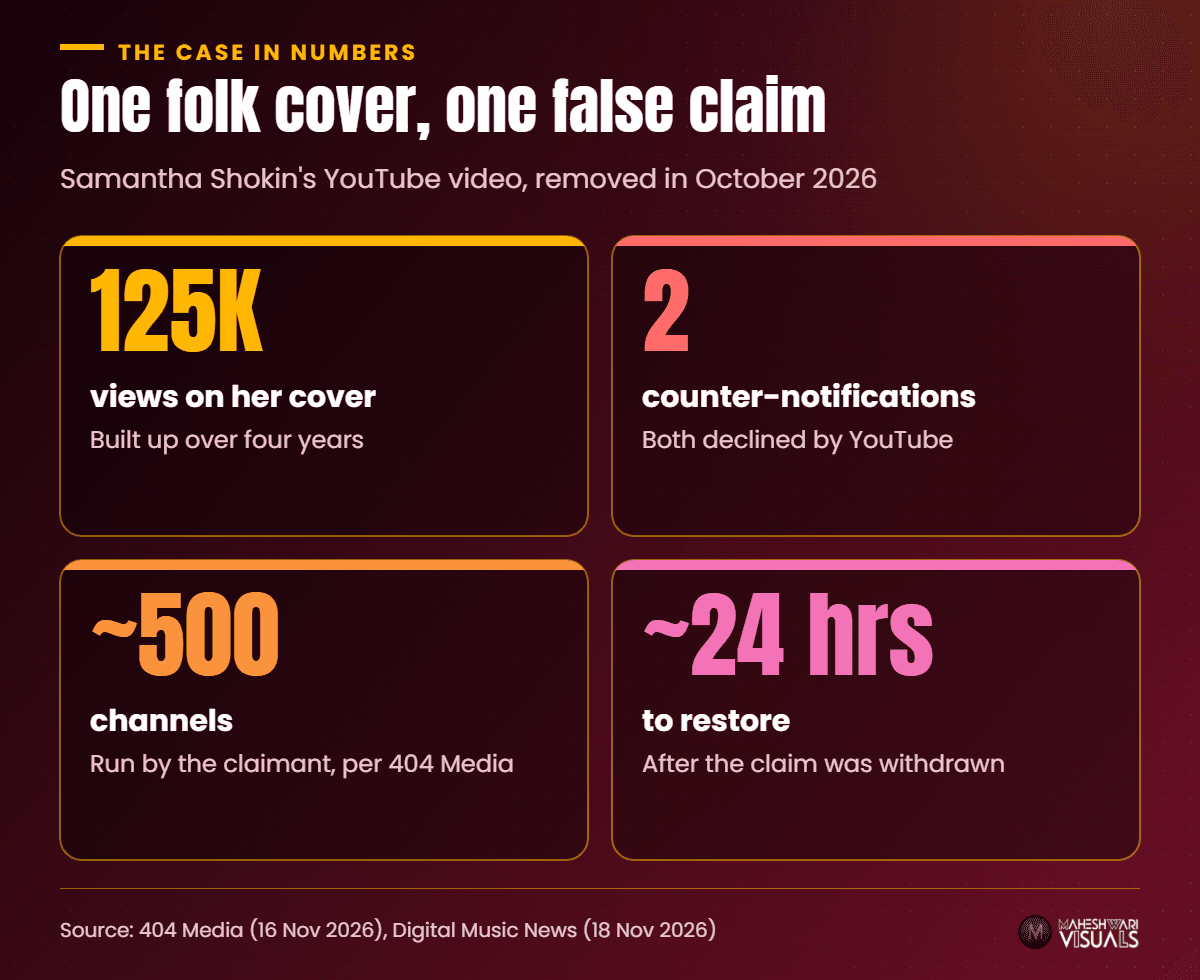
Shokin had posted a short a cappella cover of "Bre Petrunko", a 19th-century folk song with no known writer. The video had built up around 125,000 views over four years. In October, YouTube removed it after a copyright complaint from Media Nov Records, a company that 404 Media reports runs around 500 YouTube channels filled with AI-generated and looping electronic music.
Shokin filed two counter-notifications. YouTube declined to process both, saying it could not tell whether she had valid grounds, and told her to take it up with the claimant. She told 404 Media she could not get in touch with a human being.
After 404 Media contacted Media Nov, the company asked Shokin for her original audio files and recording dates, then withdrew its complaint. YouTube restored the video about 24 hours later, and a YouTube spokesperson confirmed this. Media Nov said withdrawing did not waive any rights it may hold. As quoted by Digital Music News, Shokin summed it up as "a broken system".
Why this matters for independent artists
Copyright systems on big platforms are built to handle huge volumes automatically. That works well when the claimant is the real owner. It works badly when someone with a large catalogue of uploaded content files claims against a small artist who has no paperwork ready.
Three lessons stand out:
- Old and traditional songs are easy targets. A folk song with no known writer is usually in the public domain, but your recording of it is still your own work. If someone else uploads a similar version first, automated systems may side with them.
- Your proof decides the outcome. The claim was dropped soon after Shokin was asked for her original files and dates. Artists who can produce that evidence quickly are in a much stronger position.
- Visibility helps, but you can't rely on it. Shokin's video came back after press attention. Most artists won't get a journalist on their side, so the formal process has to be enough.
For Indian artists this is close to home. Lok geet, bhajans, devotional and regional folk songs are recorded again and again by different artists. If you sing a traditional song, your recording, arrangement and video are yours, and you should be able to prove it.
How YouTube copyright claims work
On YouTube Help, a claim can block, monetise or track a video. When you receive one, YouTube gives you several options: leave the claim in place, remove the claimed part (mute, trim or replace the song), share revenue if you are in the YouTube Partner Program, or dispute the claim if you are confident you have all the rights you need.
Timing matters. The steps below are taken from YouTube's own help pages.
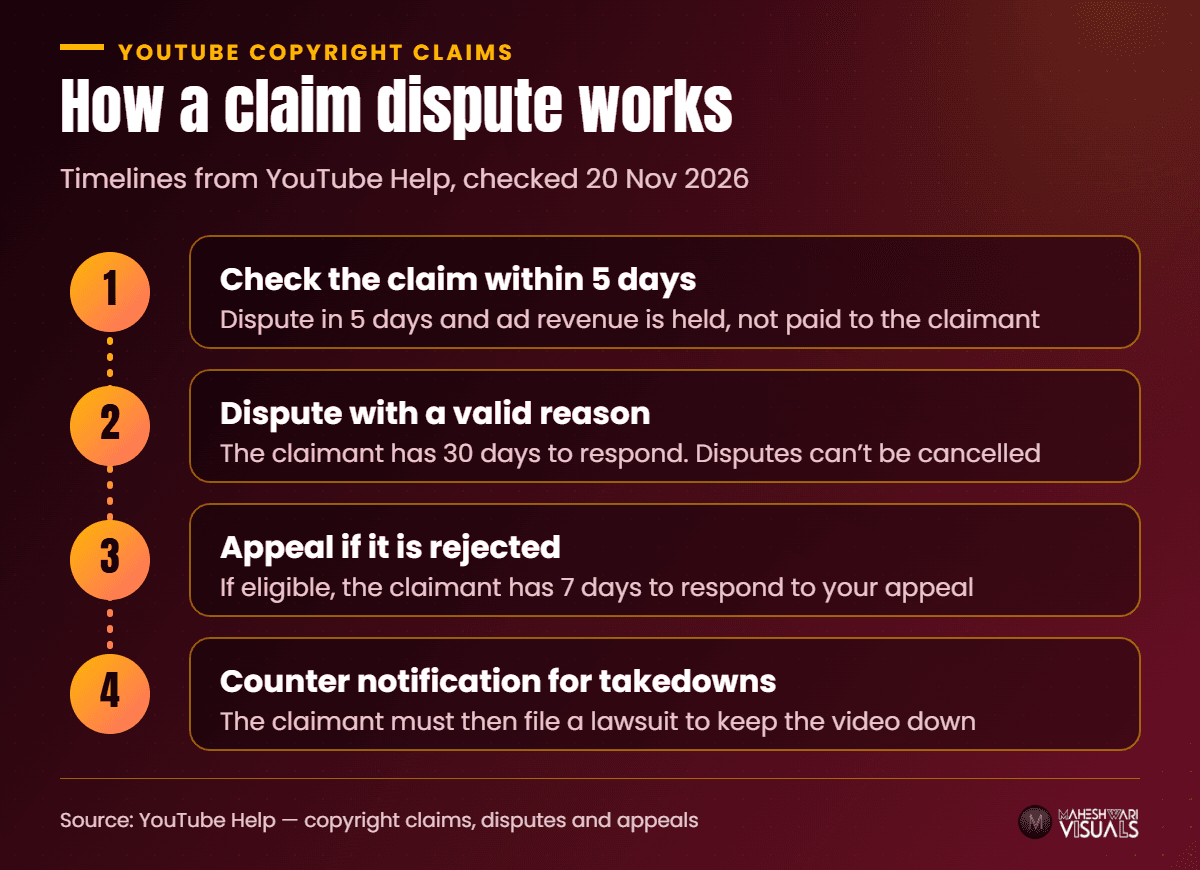
- Step 1: Check the claim within 5 days. YouTube says that if you dispute within 5 days, ads keep running and the revenue is held until the claim is settled. If you do nothing, held revenue is released to the claimant after 5 days.
- Step 2: Dispute with a valid reason. The claimant has 30 days to respond. Valid reasons include owning the rights or the claim being a misidentification. "Giving credit" or "choosing not to monetise" are not valid reasons, and a dispute can't be cancelled once you send it.
- Step 3: Appeal if the dispute is rejected. If you are eligible to appeal, the claimant then has 7 days to respond.
- Step 4: Counter notification for takedowns. If your video was removed through a copyright removal request, you can submit a counter notification. YouTube's dispute page says the claimant then has to file a lawsuit to keep the video down.
One warning from YouTube itself: disputing without a valid reason can lead the claimant to send a removal request, and a valid removal request means a copyright strike on your channel. Dispute when you are sure, and keep your evidence ready before you click submit.
What Indian artists should do now
You can't stop a stranger from filing a claim, but you can make sure you win quickly when it happens. Build a simple "proof of ownership" folder for every release, before it goes live.
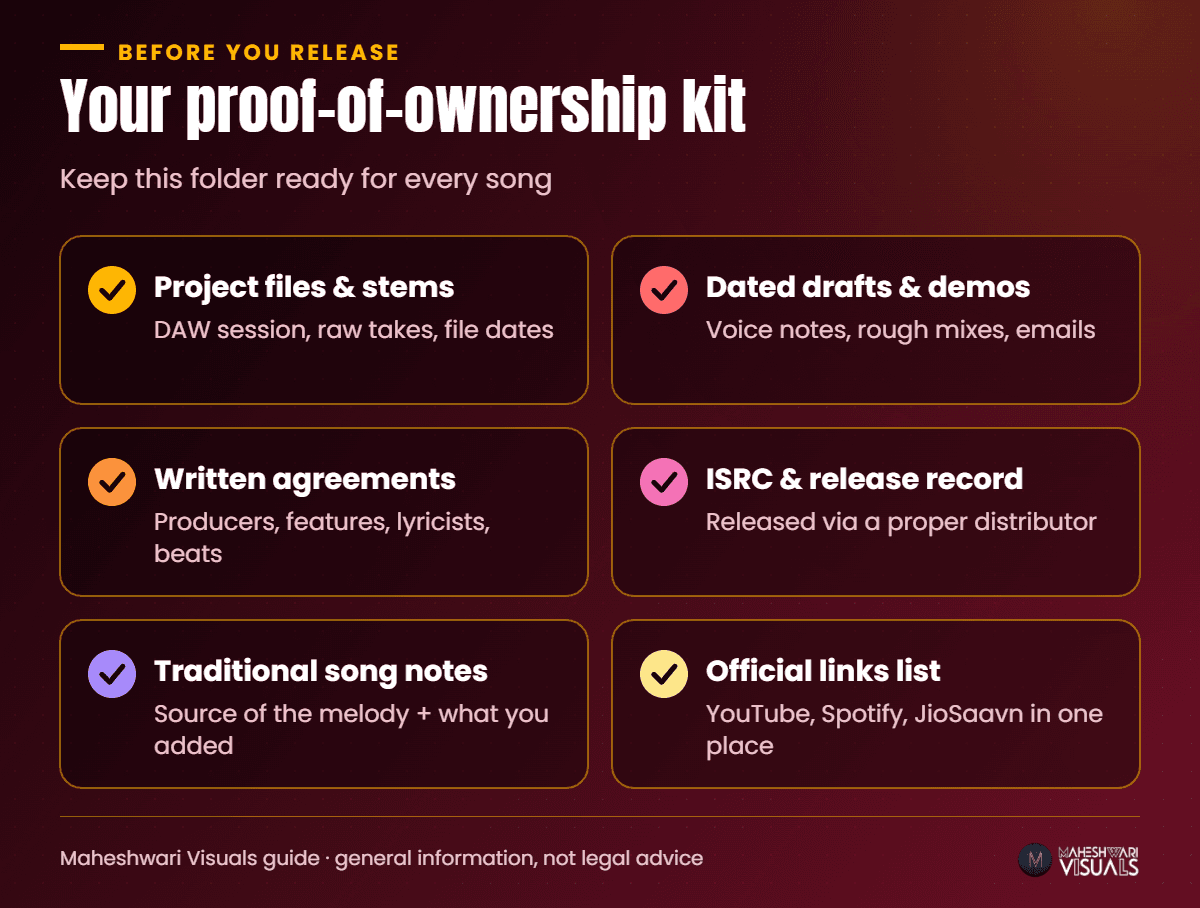
- Keep your original project files and stems. Save the DAW session, raw vocal takes and stems with their file dates. These were exactly what the claimant in this case asked for.
- Save dated drafts and demos. Voice notes, rough mixes and emails to your producer show when the song existed and who made it.
- Get agreements in writing. Producers, featured artists, lyricists and beat sellers should confirm in writing who owns what. Our guide on who owns unreleased songs in India explains why this matters.
- Release through a proper distributor. A release on Spotify, JioSaavn, Apple Music and YouTube Music with an ISRC and a release date creates a public, dated record that your recording is yours.
- Note traditional material clearly. If you record a folk song or bhajan, write down where the traditional melody and lyrics come from and what you added: your arrangement, production and performance.
- Link your official uploads. Keep a list of your official YouTube, Spotify and JioSaavn links in one place so you can share them in a dispute within minutes.
If you get a claim, read it carefully first. Is it a claim or a takedown? Who is the claimant? Which part of the video is matched? Then use YouTube's dispute, appeal or counter-notification route with your evidence attached. For serious cases, especially if a strike is involved, speak to a qualified lawyer. This article is general information, not legal advice.
How MV Distribution helps
When you release with MV Distribution, your music goes to 100+ stores including Spotify, Apple Music, JioSaavn, Amazon Music, YouTube Music and Gaana, usually live within 24 hours, and you keep 100% of your rights. Every release gets proper metadata and an ISRC, which becomes part of your proof of ownership.
There's another kind of claim artists run into: one on a video that uses your own song, such as a video on your own channel. If that happens with a release you distributed through us, you can request a YouTube Claim Release from Help & Support in your MV dashboard. We walk through it step by step in our 2-minute tutorial below.
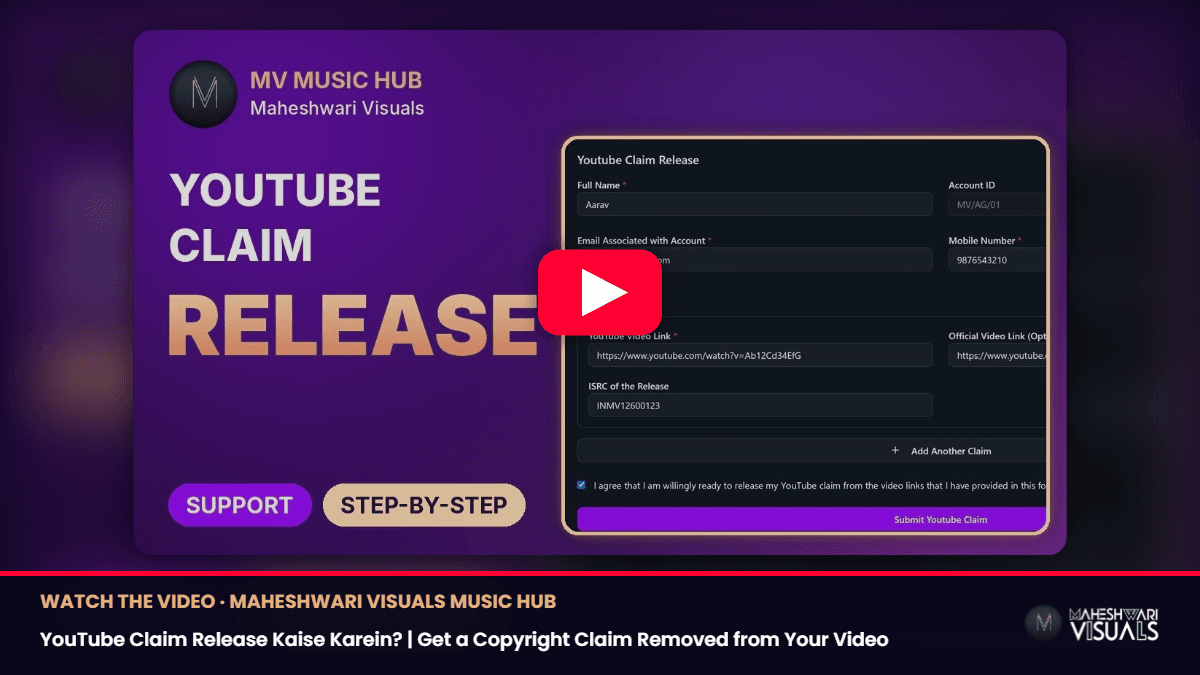
▶ Watch on YouTube: YouTube Claim Release Kaise Karein? | Get a Copyright Claim Removed from Your Video | MV Dashboard
Our support team replies within 24 hours, so you are never stuck trying to reach a human. To build your official presence on YouTube, see our Official Artist Channel guide.
Conclusion
Samantha Shokin got her video back, but only after two rejected counter-notifications and a news story. Most artists won't get that kind of attention, so preparation is your best protection. Keep your files, dates and agreements organised, release through a proper distributor, and know YouTube's claim timelines before you need them. If you're ready to put your music out with clean metadata and full ownership, sign up for MV Distribution and release your next song the right way.
FAQs
What should I do if I get a false copyright claim on YouTube?
Read the claim, check who filed it and what was matched, and gather your proof: original files, stems, dated drafts and release links. Then dispute the claim in YouTube Studio with a valid reason. YouTube says disputing within 5 days keeps your ad revenue held instead of going to the claimant.
How long does a YouTube copyright dispute take?
According to YouTube Help, the claimant has 30 days to respond to a dispute. If the dispute is rejected and you appeal, the claimant has 7 days to respond to the appeal.
Can someone claim copyright on a folk song or bhajan I recorded?
Traditional songs with no known writer are usually in the public domain, but your recording and arrangement are your own work. Keep records of your recording and what you added so you can prove it if someone else claims it.
Does a Content ID claim give me a copyright strike?
YouTube says claims usually don't affect your channel. A strike comes from a valid copyright removal request, which can follow if you dispute a claim without a valid reason.
Sources: 404 Media, "How an AI content mill put a real musician through copyright hell", 16 Nov 2026 · Digital Music News, 18 Nov 2026 (US time) · YouTube Help: Learn about copyright claims and Dispute a Content ID claim, checked 20 Nov 2026.
Comments
Related Articles

Streaming Fraud Crackdown: What IMPALA's Call Means for Indian Independent Artists

India's Music Economy Hits ₹17,400 Crore as Independent Music Reaches 43%: What Artists Should Do
