
Scroll through YouTube or Instagram and you will find Indian artists covering Bollywood classics, Punjabi hits and Telugu chartbusters. Covers are one of the fastest ways to get discovered, because listeners are already searching for the song. But here is the uncomfortable truth: a cover song is still someone else's song. If you release it on Spotify, JioSaavn or YouTube Music without the right permission, you can lose your earnings, get the track taken down, or face a legal claim.
The good news is that releasing a cover song legally in India is very doable once you understand how the rules work. This guide explains what Indian law says about cover versions, the two ways to get permission, how YouTube treats covers, and a checklist to follow before you upload — so you can release your next cover with MV Distribution with confidence.
This guide is general information, not legal advice. For a specific deal, speak to a copyright lawyer.
What Counts as a Cover Song?
A cover is your own new recording of a song that has already been released by someone else. You sing it, you play it, you produce it — but the composition (the melody and lyrics) still belongs to the original songwriter, composer and their music publisher or label.
That distinction matters. A song carries two separate copyrights:
- The composition — lyrics and music, usually owned by the writers and their publisher or label.
- The sound recording (master) — the original recording, usually owned by the label that released it.
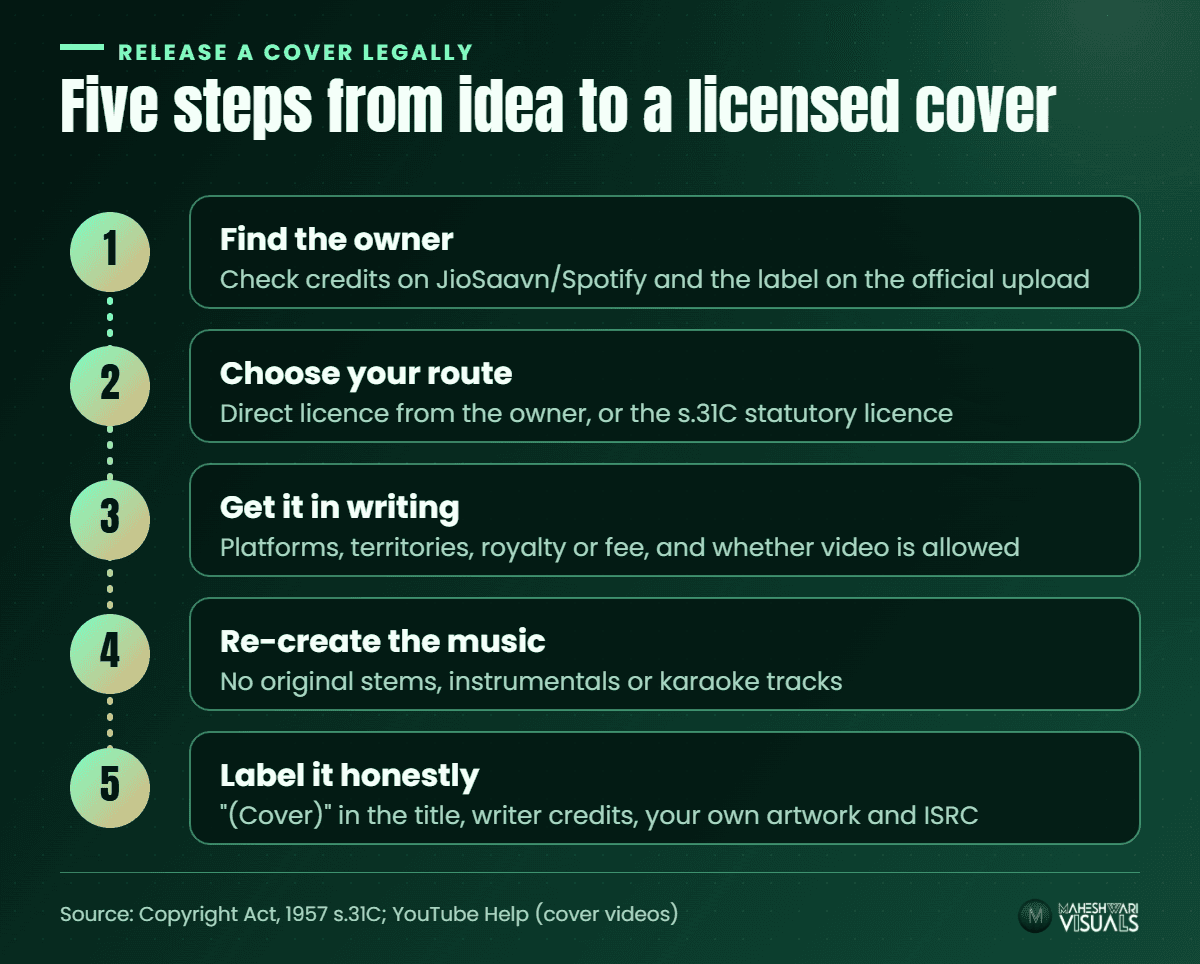
When you record a cover, you are using the composition, not the master. That is why you must never use the original track, its instrumental or a ripped karaoke version as your backing. Re-create the music yourself or with your producer.
Cover Song Licence in India: What Section 31C Says
Indian copyright law has a specific legal route for cover versions. The Copyright Act, 1957 was amended in 2012 to add Section 31C, a statutory licence for cover versions. In simple terms, it lets you record a cover of a song without negotiating, as long as you follow strict conditions:
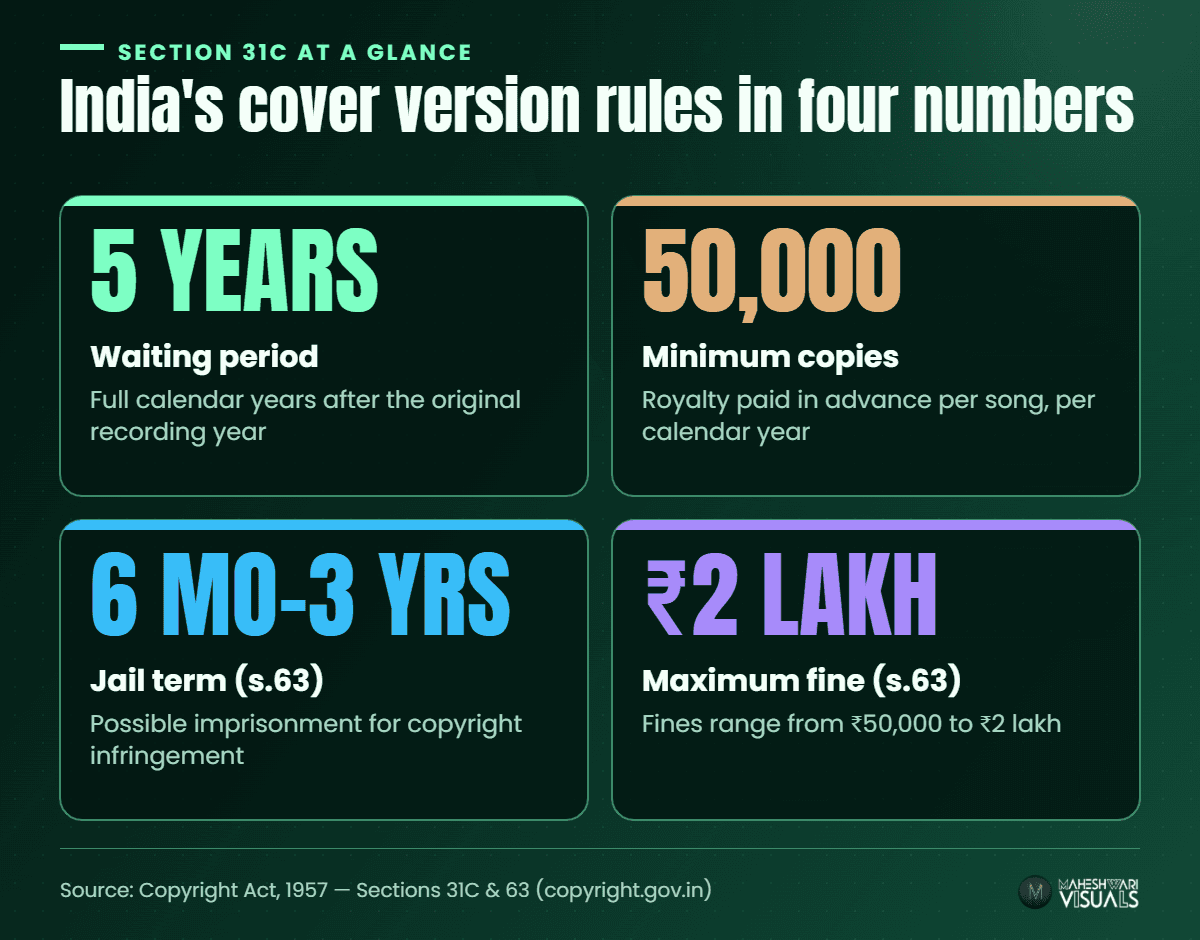
- The five-year rule: you cannot make the cover until five full calendar years have passed after the end of the year in which the original recording was made.
- Advance notice: you must notify the rights owner in the prescribed way before you record.
- Advance royalty: royalties must be paid in advance at the rate fixed by the Commercial Court, for a minimum of 50,000 copies of each song per calendar year (a lower minimum can be set for some languages or dialects).
- No changes: you cannot alter the song unless the owner already agreed to such changes or they are technically necessary.
- Clear labelling: the cover must state that it is a cover version made under Section 31C, and it must not be packaged in a way that confuses people about who made it — for example, using the original singer's name or photo.
- Records: you must keep registers and accounts and let the owner inspect them.
Why most independent artists go the direct-licence route
Section 31C was written with physical copies in mind — it even says the cover should generally use the same medium as the last recording. For a streaming release, the advance royalty on 50,000 copies and the five-year wait are big hurdles for a new artist. That is why, in practice, most artists simply ask the song's owner for a direct licence in writing.
Two Ways to Get Permission for Your Cover
Option 1: A direct licence from the owner
Find out who owns the song — the credits on JioSaavn or Spotify and the label on the official YouTube upload are good starting points. Then ask that label or publisher for a licence for an audio cover on streaming platforms, and get the terms in writing: platforms, territories, royalty share or fee, and whether a video is allowed.
Option 2: The statutory licence under Section 31C
If the song is more than five calendar years old and you are ready to pay royalties in advance, you can follow the Section 31C process. Because the notice and royalty steps have legal formalities, this is the route where a copyright lawyer is most worth the money.
How YouTube Handles Cover Songs
YouTube has its own system. According to YouTube Help, a cover video can earn money only after the music publisher that owns the composition claims it through Content ID. Once claimed, creators in the YouTube Partner Program can share the ad revenue in proportion to the claim. You will see a "Sharing ad earnings" note on the video's copyright details.
This does not replace a licence for your audio release on streaming platforms, and if the owner chooses to block covers, the video can still come down.
What Can Go Wrong With an Unlicensed Cover
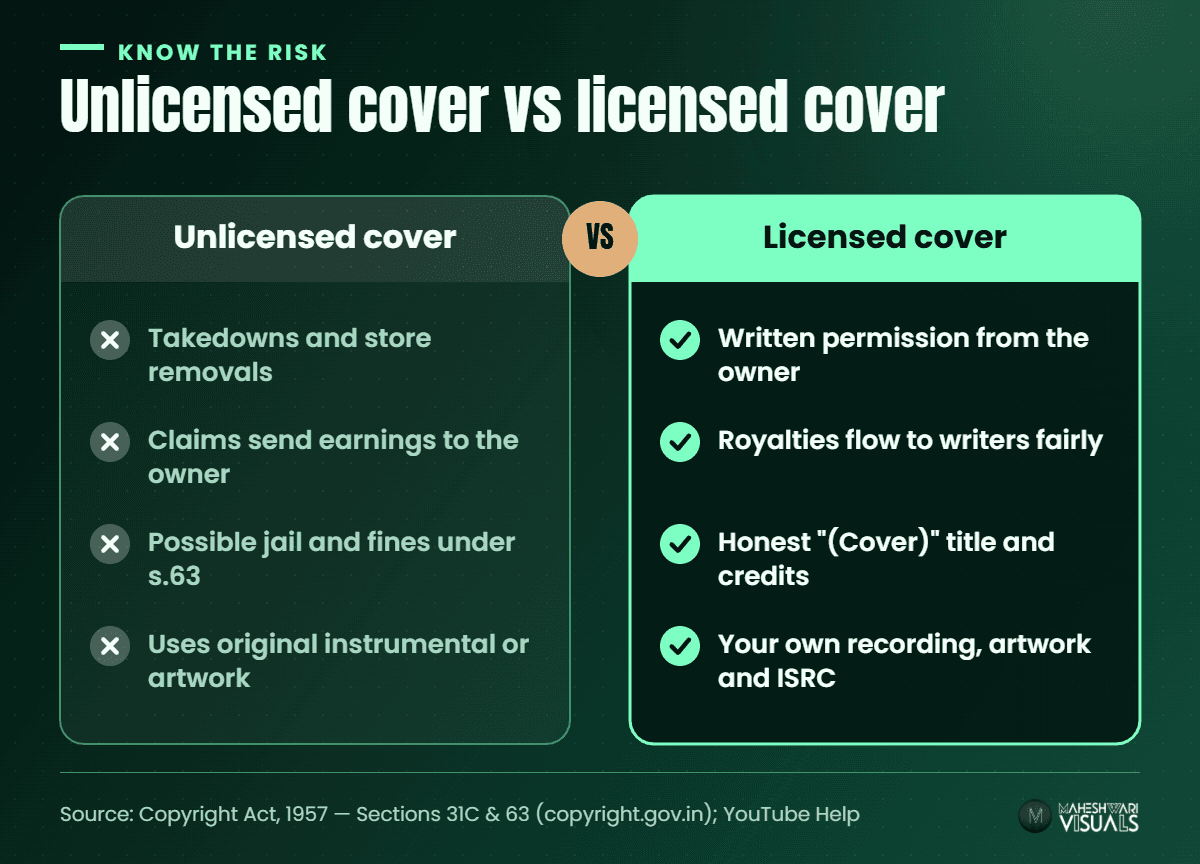
Releasing a cover without permission is copyright infringement. Under Section 63 of the Copyright Act, infringement can mean imprisonment of six months to three years and a fine of ₹50,000 to ₹2 lakh — we covered these penalties in our guide to protecting unreleased music. More often, the result is a takedown or a claim that sends your earnings to the owner.
Your Pre-Release Checklist for Covers
Before you send a cover to stores, run through this list:
- Confirm ownership: know exactly who owns the composition and who released the original.
- Get permission in writing: a direct licence email or agreement, or your Section 31C paperwork.
- Re-create the music: no samples, stems or instrumentals from the original recording.
- Credit the writers: list the original lyricist and composer in your metadata, not just yourself.
- Title it honestly: for example, "Song Name (Cover)" — never present it as the original or use the original artist's name or photo as if they performed it.
- Use your own artwork: do not copy the film poster or original single cover.
- Get your own ISRC: your cover is a new recording, so it needs its own ISRC code.
- Keep records: save every licence, email and payment receipt in one folder.
How MV Distribution Helps
Once your licence is sorted, the release itself should be the easy part. With MV Distribution, your music goes to 100+ stores including Spotify, Apple Music, JioSaavn, Amazon Music, YouTube Music and Gaana, usually live within 24 hours. You keep 100% of your rights, and our human support team replies within 24 hours if you have a question about your release details. More than 200,000 artists already trust MV with their music.
Conclusion
A great cover can introduce you to listeners who would never have found your original songs. Just remember three things: a cover uses someone else's composition, so you always need permission; in India you can get it through a direct licence or the Section 31C statutory licence; and honest metadata — writer credits, a clear "(Cover)" title and your own ISRC — protects you on every platform.
Do the paperwork once, and your cover can keep working for you for years. When you are ready to release it properly, sign up for music distribution with Maheshwari Visuals and get your music live on India's biggest platforms.
FAQs
Is it legal to upload a cover song in India?
Yes, if you have permission. You can get a direct licence from the song's owner, or use the statutory licence for cover versions under Section 31C of the Copyright Act, 1957, by following its conditions. Uploading a cover without either is copyright infringement.
Can I release a cover of a new Bollywood song?
Not under the statutory licence. Section 31C only applies once five full calendar years have passed after the year the original recording was made. For a recent song, you need a direct licence from the label or publisher.
Do I need permission to post a cover on YouTube?
YouTube lets music publishers claim cover videos through Content ID. When they choose to monetise, eligible creators can share the ad revenue. But the owner can also block the video, so a licence is still the safest option, and it is essential for streaming releases.
Who gets the royalties from my cover song?
You earn from your own recording, while the songwriters and publisher are paid for the composition — through the terms of your direct licence or the royalty paid under Section 31C. Always credit the original writers in your metadata.
Source: Copyright Act, 1957 — Section 31C (statutory licence for cover versions) and Section 63, Copyright Office of India (copyright.gov.in); YouTube Help, "Monetizing eligible cover videos" (support.google.com), accessed 2 November 2026.


