
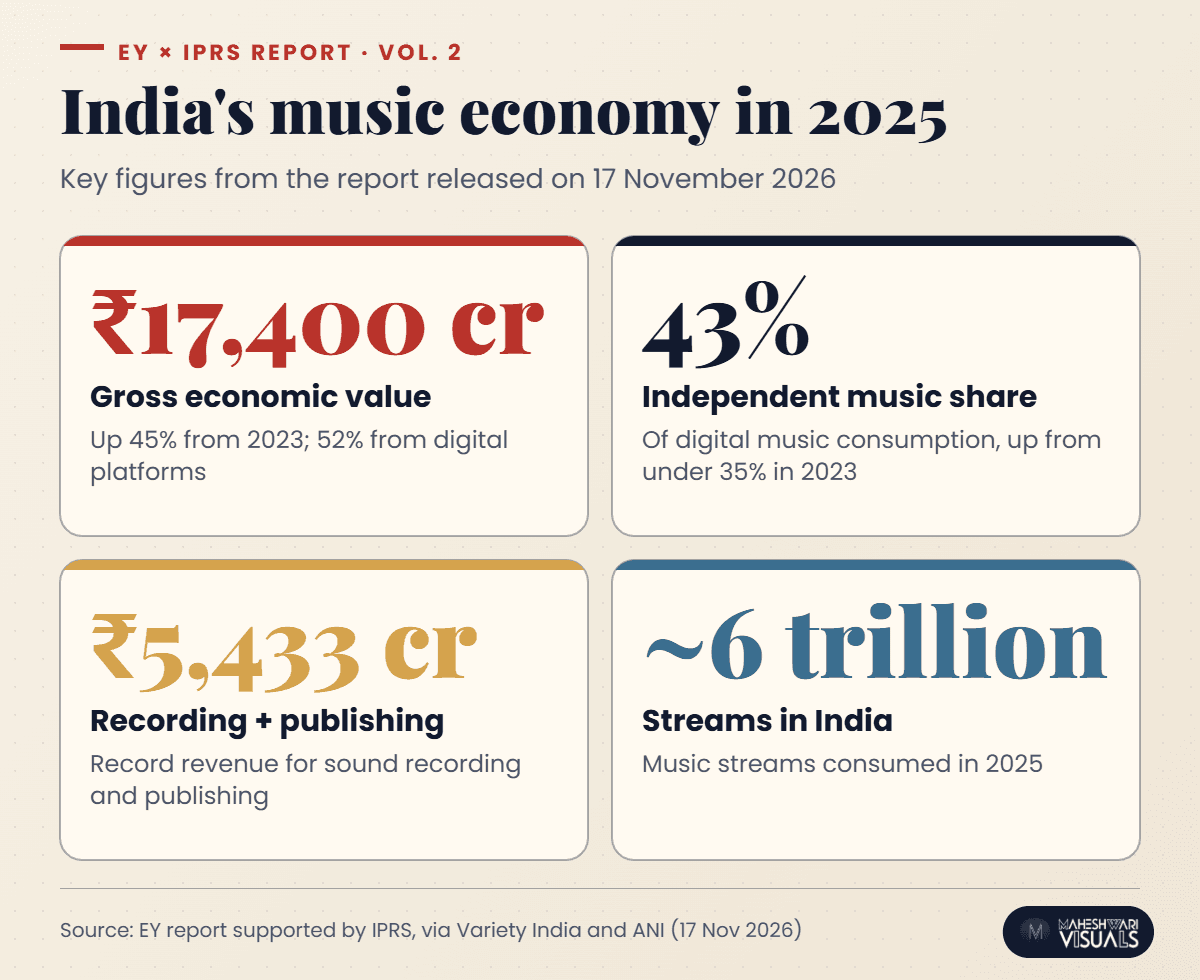
India's music economy is now worth an estimated ₹17,400 crore, and independent music accounts for 43% of everything Indians listen to on digital platforms. Those two numbers come from a new EY report supported by the Indian Performing Right Society (IPRS), released on 17 November 2026, and together they say something every independent artist should hear: the audience is already here.
The same report has a harder message too. Three in four creators say opportunities are growing, but just as many say it is getting tougher to actually earn from them. Below, we break down what the EY report found, why the independent music share matters, and the practical steps that help you turn more listening into more income.
What the EY–IPRS report found
The report, titled It is a good time to be in music: India's music creator economy report Vol. 2, estimates the gross economic value of music in India at ₹17,400 crore in 2025. That is a 45% jump over 2023. Digital consumption platforms produced 52% of that value, so streaming and short-video apps are now the centre of the business, not a side channel.
A few more headline figures from the report, as covered by Variety India and ANI:
- Sound recording and music publishing revenue reached a record ₹5,433 crore in 2025.
- Music publishing and performance revenue rose to ₹1,125 crore, up from ₹628 crore in 2023.
- Indians consumed nearly six trillion streams of music.
- Independent music made up 43% of digital music consumption, up from less than 35% in 2023.
- Organised-sector employment in music grew 50% over 2023, to an estimated 60,000–70,000 people.
- Between 22,000 and 27,000 original songs are released every year.
Why independent music at 43% is a big deal
For years, the default path in India ran through film soundtracks and big labels. A 43% independent share means listeners are now choosing non-film songs, regional artists and self-released music in huge numbers. Punjabi, Haryanvi, Bhojpuri and Tamil independents are not a niche anymore; they sit in the same playlists and feeds as film hits.
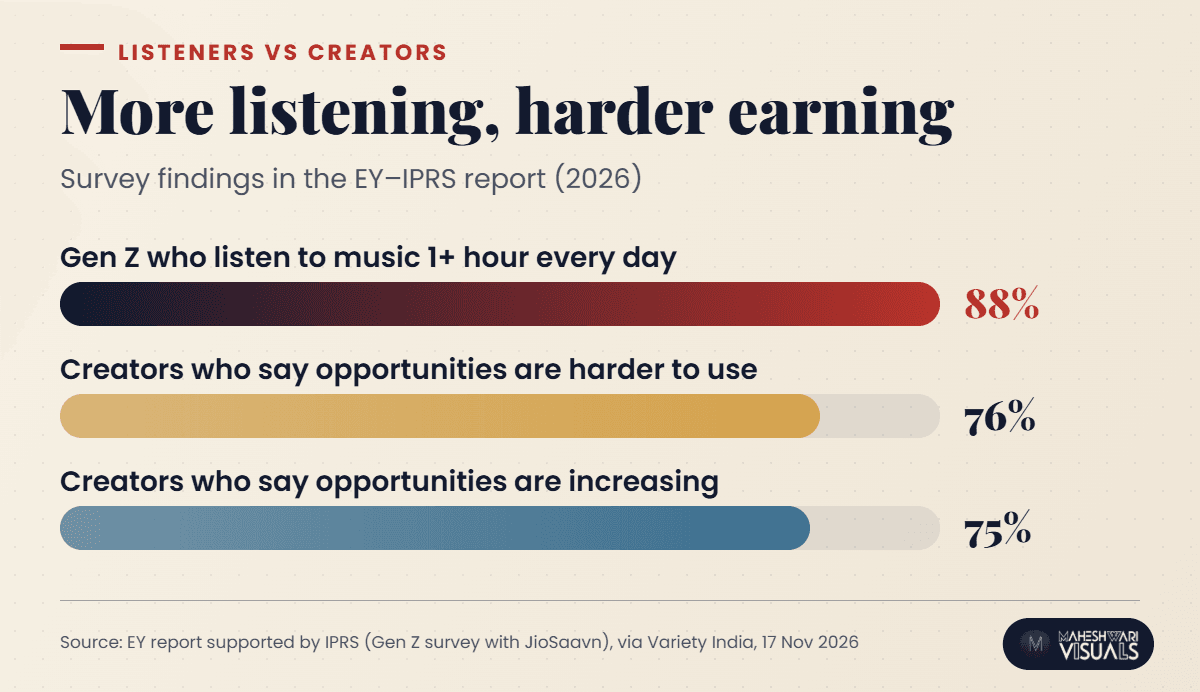
Gen Z is a big reason. A survey in the report, run with JioSaavn, found that 88% of Gen Z listeners play at least an hour of music every day. They listen while travelling (85%), relaxing (76%) and working (56%), which means your song can find a place in someone's routine, not just a one-time viral moment.
The catch: more listeners, harder to earn
Here is the part of the report that every artist should read twice. 75% of creators surveyed believe opportunities are increasing, yet 76% feel it is becoming harder to take advantage of them. The report lists the reasons creators gave:
- Uncertain income from month to month.
- Pressure to get discovered among thousands of new releases.
- Complicated rights administration, so money goes uncollected.
- Rising marketing costs.
- New risks from AI.
To close that gap, the report recommends better royalty tracking, more businesses using licensed music, teaching creators how to protect their IP, promoting Indian music worldwide and setting up an export promotion council for music. Some of that is policy work. A lot of it, though, starts with how you release and register your own songs.
What independent artists should do now
You can't control the market, but you can make sure every stream of your music is counted, credited and paid. Here is a practical checklist.
Get on every platform your listeners use
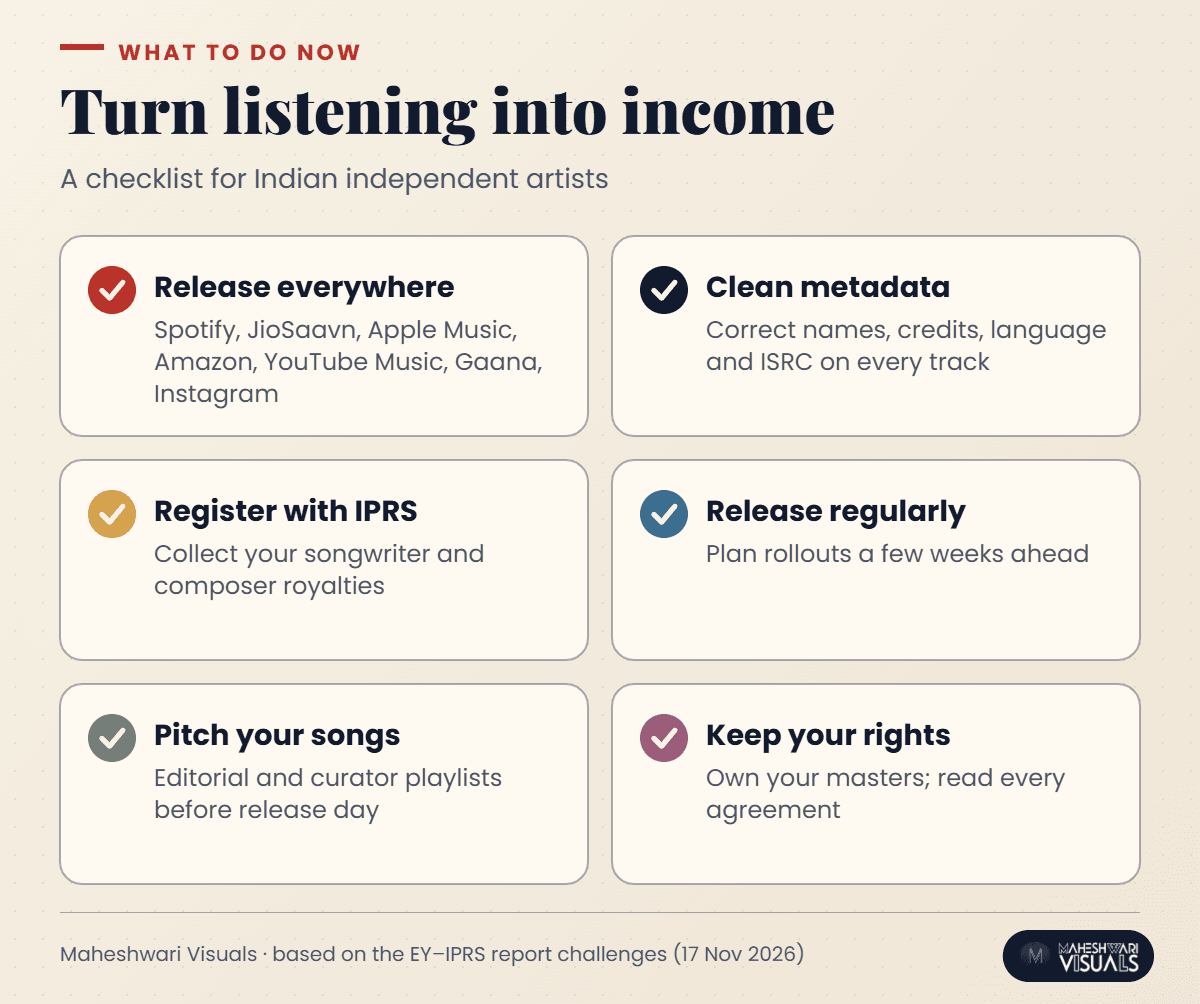
With digital platforms producing 52% of the value, your songs need to be live on Spotify, JioSaavn, Apple Music, Amazon Music, YouTube Music, Gaana and Instagram, not just one or two. Our guides on uploading your song to Spotify from India and getting verified on JioSaavn walk you through both.
Fix your metadata before release
Correct artist names, songwriter and composer credits, language and ISRC codes are how platforms and collecting societies know who to pay. Messy metadata is one of the quiet reasons "complicated rights administration" eats into income.
Collect both sides of your royalties
Publishing and performance revenue grew from ₹628 crore to ₹1,125 crore in two years. If you write your own songs, register as a member with IPRS so your share as a songwriter or composer can be collected. Your distributor handles the sound recording side; IPRS covers the songwriting side.
Release regularly and plan your rollout
With 22,000–27,000 original songs a year, consistency helps you stay visible. Plan releases a few weeks ahead, pitch to editors where platforms allow it, and use our playlist pitching tools to reach curators.
Keep your rights
As AI and new licensing deals reshape the market, ownership of your masters matters more than ever. Read every agreement and avoid deals that take your rights away for a small upfront fee.
We explain where the money from big view counts actually goes in our short video below.
▶ Watch on YouTube: A Million Views. Where's the Money?
How MV Distribution helps independent artists earn
MV Distribution is built for exactly the artists driving this 43% share. We deliver your music to 100+ stores including Spotify, Apple Music, JioSaavn, Amazon Music, YouTube Music, Gaana and Instagram, usually live within 24 hours. You keep 100% of your rights, and real human support replies within 24 hours when you need help with metadata, credits or a release issue.
More than 200K artists already trust us with their releases. If you are working in a regional language, our Bhojpuri song distribution guide shows how the same steps apply to any genre.
Conclusion
The EY–IPRS report confirms what many independent artists already feel: India is listening to you. Independent music now makes up 43% of digital consumption, the music economy has grown 45% in two years, and Gen Z listens every single day. The challenge is turning that attention into steady income, and that comes down to wide distribution, clean metadata, registered songwriting rights and keeping ownership of your work.
The next big independent hit in India could be yours. Put your music where listeners are and make sure every stream counts. Sign up for music distribution with Maheshwari Visuals and release your next song today.
FAQs
What is the size of India's music industry in 2025?
According to the EY report supported by IPRS, released on 17 November 2026, the gross economic value of India's music economy was an estimated ₹17,400 crore in 2025, up 45% from 2023.
How much of India's streaming is independent music?
The report says independent music made up 43% of digital music consumption in India in 2025, up from less than 35% in 2023.
Why is it hard for independent artists in India to earn from streaming?
Creators surveyed for the report pointed to uncertain income, pressure to get discovered, complicated rights administration, rising marketing costs and new AI risks. Wide distribution, clean metadata and registering your songwriting rights help close the gap.
Do I need to join IPRS as an independent artist?
If you write or compose your own songs, registering with IPRS lets your songwriter and composer royalties be collected. Your distributor handles your sound recordings, so the two work together.
How can I release my song on Spotify and JioSaavn from India?
Independent artists release through a distributor such as MV Distribution, which delivers your song to Spotify, JioSaavn and 100+ other stores, usually live within 24 hours, while you keep 100% of your rights.
Source: EY report supported by IPRS, It is a good time to be in music: India's music creator economy report Vol. 2, as reported by Variety India (17 November 2026), Medianews4u (17 November 2026) and ANI via Punjab Kesari (17 November 2026).
Comments
Related Articles

Streaming Fraud Crackdown: What IMPALA's Call Means for Indian Independent Artists

False YouTube Copyright Claim on Your Song? What One Musician's Case Teaches Indian Artists
