
Saregama, the label that owns one of India's oldest music catalogues, has decided it does not want its live business to depend on star tours alone. On its Q2 FY27 earnings call on 4 November 2026, managing director Vikram Mehra said the company is consciously moving from artist-led concerts towards live formats it owns itself, and the shift was reported by Music Ally and Multibagg on 12 November 2026. For Indian independent artists, this is about more than one company's event calendar. It shows how a major label thinks about owning your music IP and control, and it opens a new kind of stage that needs fresh acts.
Here is what happened, why it matters, and what you can do about it this month.
What Saregama announced about owned live music IPs
Saregama's live vertical now runs several formats it controls: Carvaan Live (a premium seated concert series in Mumbai, Delhi and Bengaluru), UN40 (a music festival), HaHaKaar (a stand-up comedy festival) and Krishna, a devotional concert format with Manoj Muntashir. In Q2 alone the company ran 54 Carvaan Live shows for around 10,000 people, 17 devotional shows, and an 11-city Ilaiyaraaja tour in the US that drew 20,000 fans.
Mehra's reasoning was simple. Artist concerts can look more profitable in the short run, but relying only on them leaves the company with less control over its future. Owned IP, he said, brings pricing power. Saregama will keep doing artist tours, but it wants them balanced with its own formats. One clear example: a Diljit Dosanjh India season will not go ahead in FY27 because the economics did not work out.
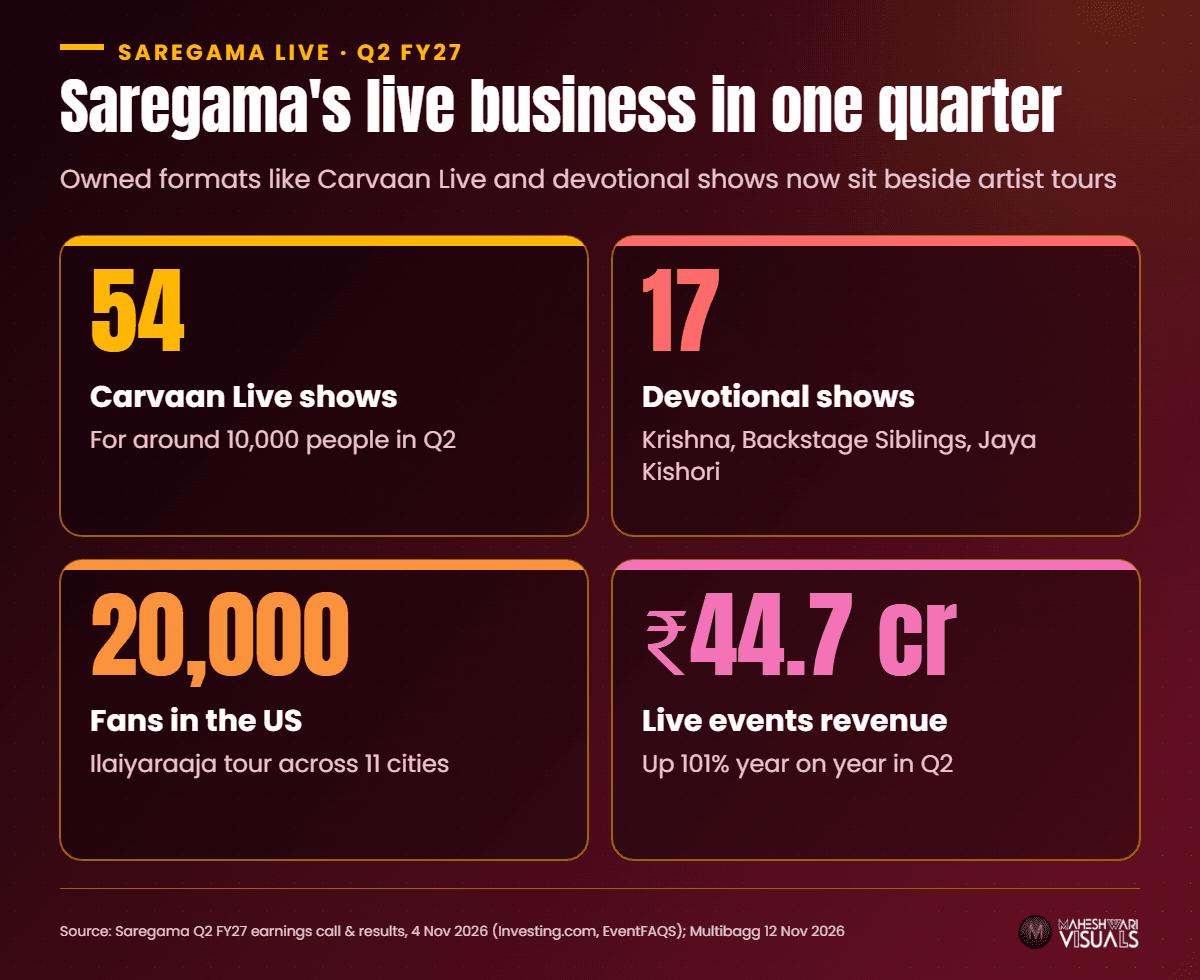
The numbers behind it are real. Saregama's Q2 FY27 results (announced 4 November 2026) showed live events revenue of ₹44.7 crore, up 101% year on year, as we covered in our Sony Music Q3 and live revenue explainer.
Why this matters for independent artists
Owned formats need a steady supply of performers
A star tour is built around one name. A format like Carvaan Live, which ran 54 shows in a single quarter, needs many performers, city after city. Devotional formats need singers and musicians who can carry bhajans and kirtans live. Festivals like UN40 need full lineups, not just headliners. When a company commits to running its own formats, it has to keep finding acts that fit them.
That is good news for artists who are not yet household names but are reliable, well-prepared and easy to discover.
The bigger lesson: control beats one big payday
Saregama's real point was about control. A company with 180,000+ songs and a roster of 340 artists still decided that depending on other people's tours was too risky. Independent artists face the same choice every day, at a smaller scale. If you sign away your masters or your publishing for a quick advance, you may get a bigger cheque now but lose control of your music for years.
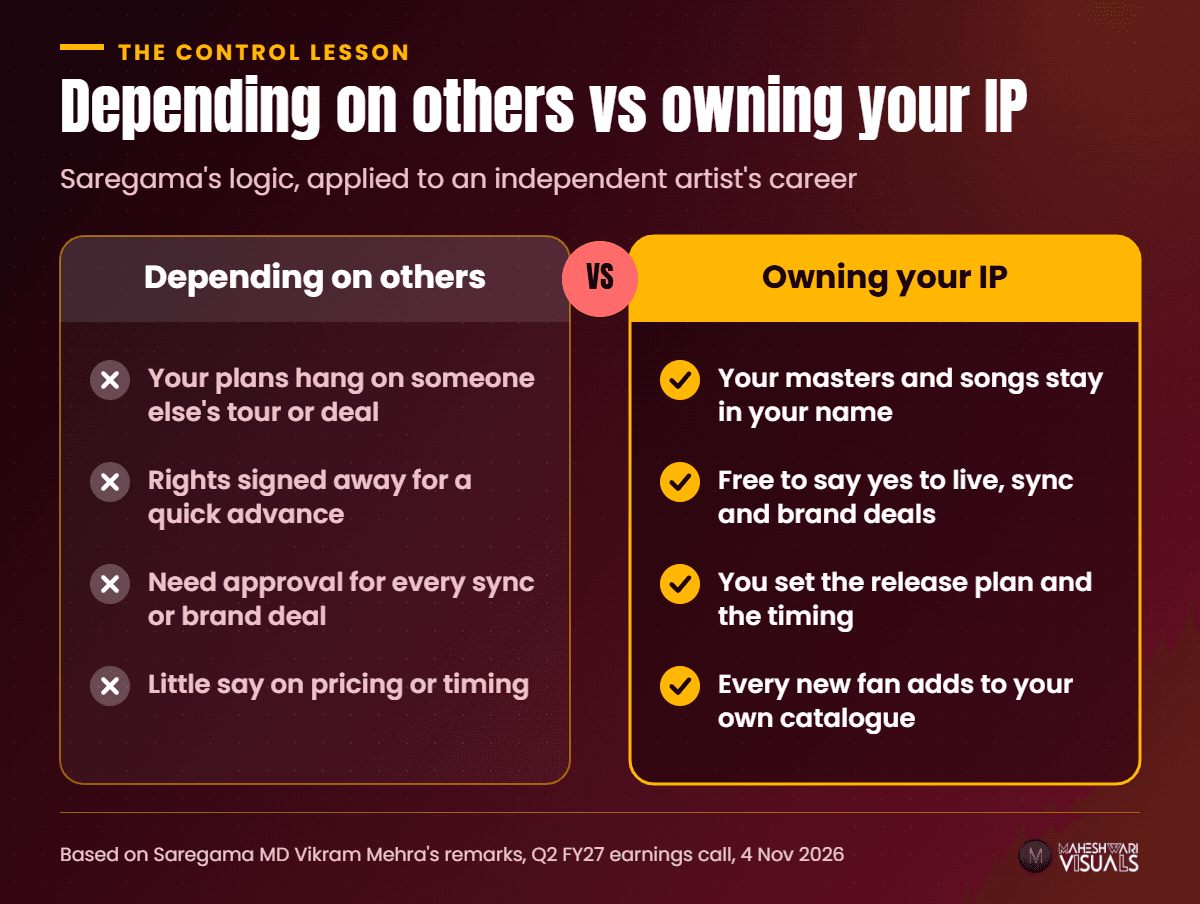
Owning your recordings and keeping your rights clean is what lets you say yes to new opportunities, whether that is a live format, a sync deal or a brand partnership.
Ticketing platforms are part of the picture
Mehra said Saregama sells through BookMyShow and District by Zomato, which charge a nominal fee, while the rest of each event's profit and loss stays with the company. For artists, this means the event organiser carries the risk and the reward. Your job is to make yourself the easy, low-risk act to book.
What Indian independent artists should do now
Curators for owned formats look at the same things fans do: your streams, your social following, your live clips and how professional your releases look. Here is a practical checklist.
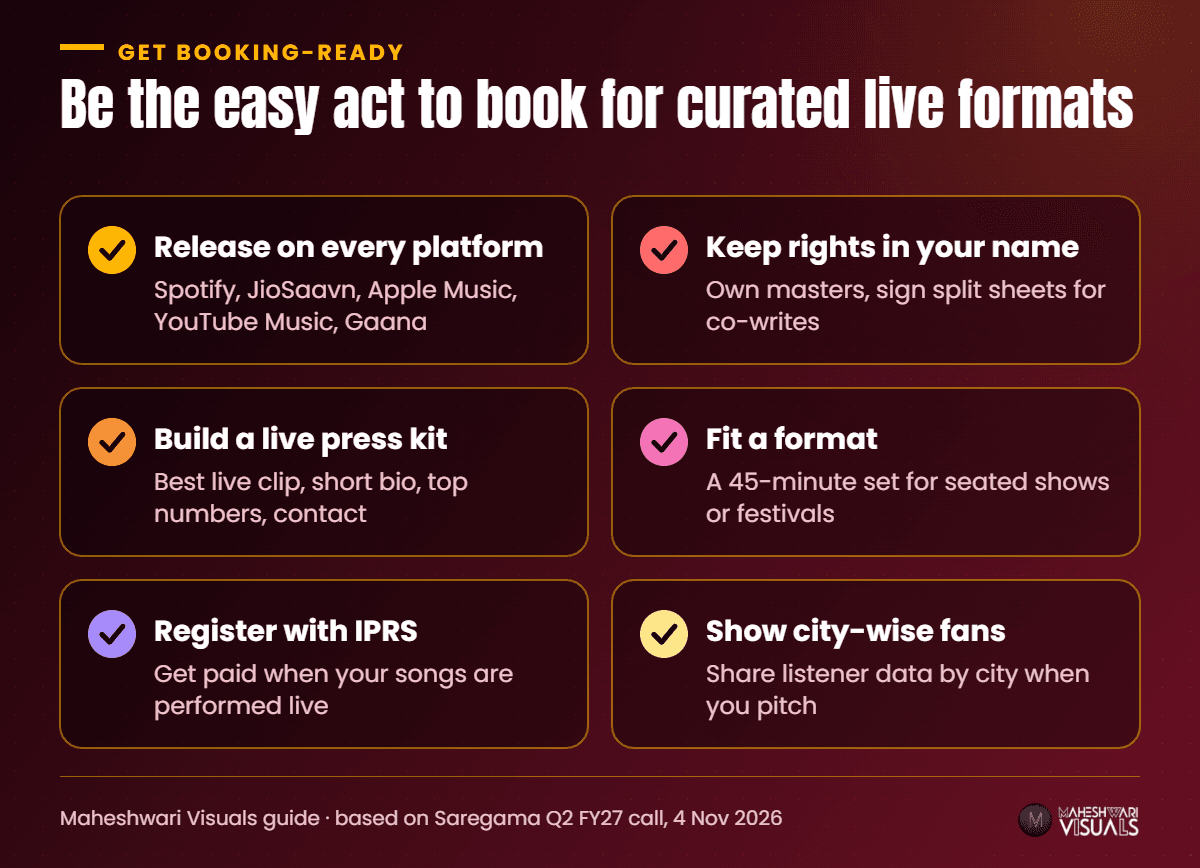
- Release consistently on every major platform. A curator who hears about you will check Spotify, JioSaavn, Apple Music, YouTube Music and Gaana. If your songs are missing from half of them, you look less ready.
- Keep your rights in your own name. Make sure you own your masters, have split sheets for co-writes, and know who your publisher is (if any). Clean rights make you easier to book, film and promote.
- Build a live-ready press kit. One page with your best live clip, a short bio, your top streaming numbers and a contact email. Keep it updated after every release.
- Fit a format. If you sing devotional music, ghazals, retro covers or regional folk, shape a 45-minute set that fits a seated concert or a festival slot. Formats book acts that slot in easily.
- Register with IPRS if you write songs. When your songs are performed at ticketed events, the venue or organiser's licence is how songwriters get paid. Our guide on live show royalties and One Arena explains how this works.
- Show your fan base. Organisers price shows on demand. Share city-wise listener data from Spotify for Artists or YouTube Analytics when you pitch.
If you want a quick reminder of why knowing your deal terms matters so much, we cover it in a short video on our channel below.
▶ Watch on YouTube: 50 Years. One Music Deal. Do You Know Your Terms?
How MV Distribution helps you stay in control
Saregama's strategy works because it owns its catalogue. You can build the same foundation for your own music. With MV Distribution, your songs go to 100+ stores including Spotify, Apple Music, JioSaavn, Amazon, YouTube Music, Gaana and Instagram, usually live within 24 hours. You keep 100% of your rights, so your masters stay yours when a live booking, sync request or brand deal comes along.
You also get human support that replies within 24 hours, which helps when you are preparing a release around a show. More than 200K artists already trust Maheshwari Visuals with their music.
Conclusion
Saregama's move towards owned live music IPs tells us three things. First, live formats like Carvaan Live and devotional concerts need a steady flow of performers, not just stars. Second, even a major label sees control as more valuable than a single big payday. Third, the artists who get booked are the ones who are easy to find, easy to check and easy to say yes to.
You do not need a famous name to benefit from this shift. You need your music everywhere, your rights in order and a clear story about who you are on stage. Start with the foundation: sign up for MV Distribution and release your next song with your rights fully in your hands.
FAQs
What is Saregama Carvaan Live?
Carvaan Live is Saregama's own premium seated concert series, held in Mumbai, Delhi and Bengaluru. In Q2 FY27 the company ran 54 Carvaan Live shows for around 10,000 people, according to its 4 November 2026 earnings call.
Why is Saregama moving away from artist-led concerts?
Saregama's MD said owned formats give the company pricing power and more control over its future, while relying only on artist tours leaves it dependent on others. It will still run artist concerts, but balanced with its own IPs such as UN40, HaHaKaar and Krishna.
How can an independent artist get booked for concerts in India?
Release music consistently on all major platforms, keep a live-ready press kit with a strong live clip, shape a set that fits a specific format (devotional, retro, regional, festival), and share city-wise listener data when you pitch to organisers.
Do I need to own my masters to perform live?
You can perform without owning your masters, but owning them gives you far more freedom. You can sell live recordings, license songs for sync and sign brand deals without needing anyone else's approval.
Do songwriters get paid when their songs are performed at concerts in India?
Yes. Public performance of songs at ticketed events is licensed, and registered songwriters and composers receive royalties through IPRS. Register your works so your live performances can be tracked.
Sources: Saregama Q2 FY27 earnings call, 4 November 2026 (Investing.com transcript); Music Ally, 12 November 2026; Multibagg, 12 November 2026; Saregama Q2 FY27 results, 4 November 2026 (via EventFAQS, 5 November 2026).
Comments
Related Articles

Streaming Fraud Crackdown: What IMPALA's Call Means for Indian Independent Artists

False YouTube Copyright Claim on Your Song? What One Musician's Case Teaches Indian Artists
