
A concert can sell out, the crowd can sing every word, and the person who wrote those words may still have no idea what the show earned or when the money will arrive. A growing network of music rights societies is now trying to close that gap, and its latest move is a useful wake-up call for Indian songwriters.
On 2 November 2026, Digital Music News reported that Canada's SOCAN has joined One Arena, the live performance royalties network founded by Germany's GEMA. India is not part of this network today. Even so, the story raises a question every working artist should be able to answer: who collects the royalties when your song is performed on a stage?
This guide covers what changed, why live performance royalties matter in India, who actually gets paid, and what to sort out before the December–January show season. It also explains where MV Distribution fits in, and where it doesn't.
What happened: SOCAN joins One Arena
One Arena began with seven European collecting societies: GEMA (Germany), SUISA (Switzerland), AKM (Austria), Buma/Stemra (Netherlands), KODA (Denmark), TONO (Norway) and OSA (Czech Republic). SOCAN is the newest member and takes the network beyond Europe.
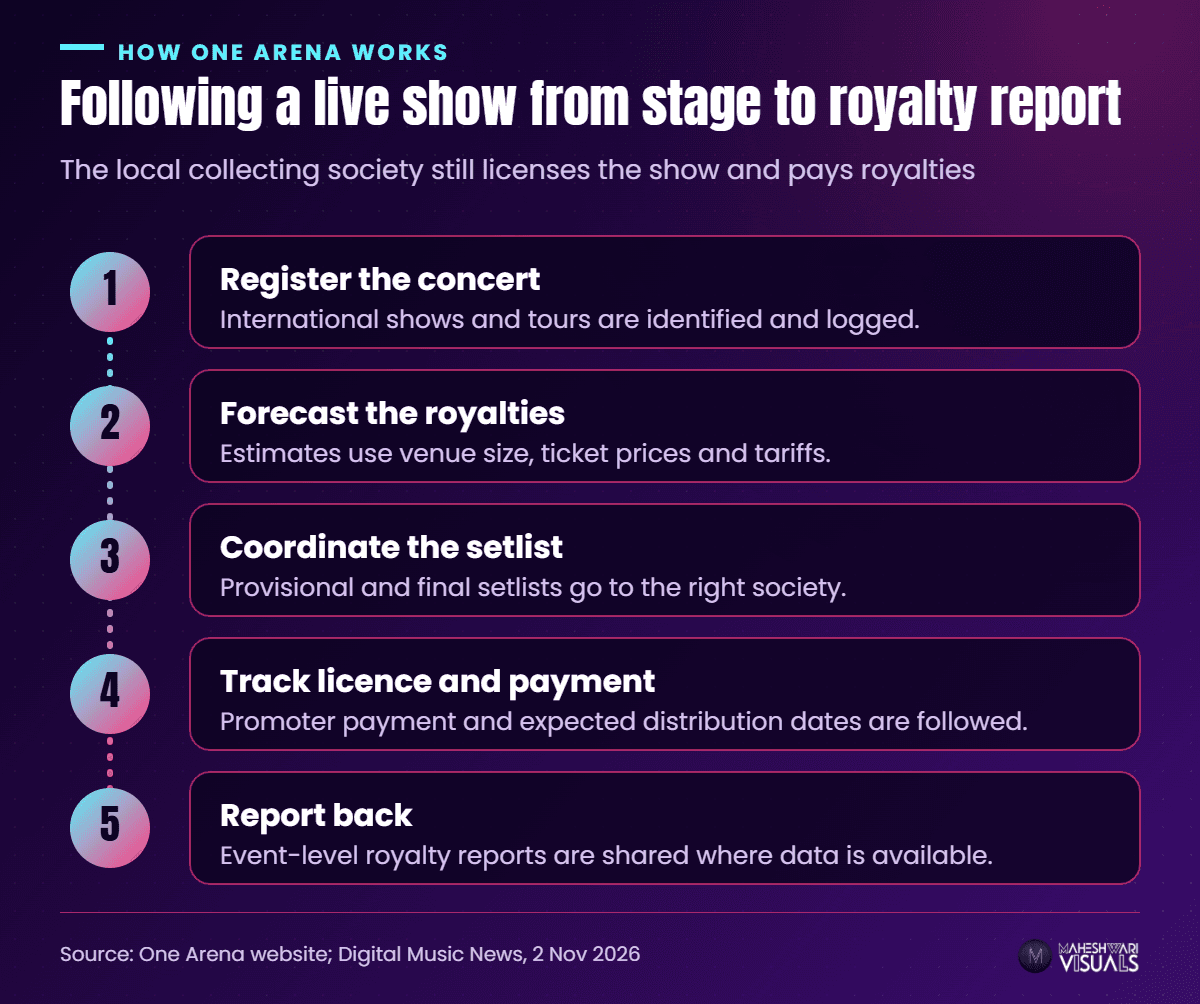
The important detail is what One Arena does not do. According to its own website, it does not set tariffs, issue licences, collect money or pay anyone. Those jobs stay with each local society. What it adds is information and coordination across borders, so that a songwriter on an international tour can see what is coming.
Its services include registering international concerts, forecasting royalties from venue size, ticket prices and tariffs, coordinating setlists, and tracking licensing and payment dates. The site says royalties can arrive within 30 days or less after the promoter pays, but it describes that as indicative, not a guarantee.
Why live performance royalties matter for Indian artists
Streaming dominates the Indian conversation, and the numbers show why. CISAC's Global Collections Report 2025 put India's creator collections at €80.5 million in 2024, up 40.5% in a year, as reported by Music Plus. Digital made up 82.7% of that total.
Live and background use made up just 14% of India's collections, though it crossed €10 million for the first time. Worldwide, that share is about 26%: CISAC reports €3.60 billion out of €13.97 billion in 2024.
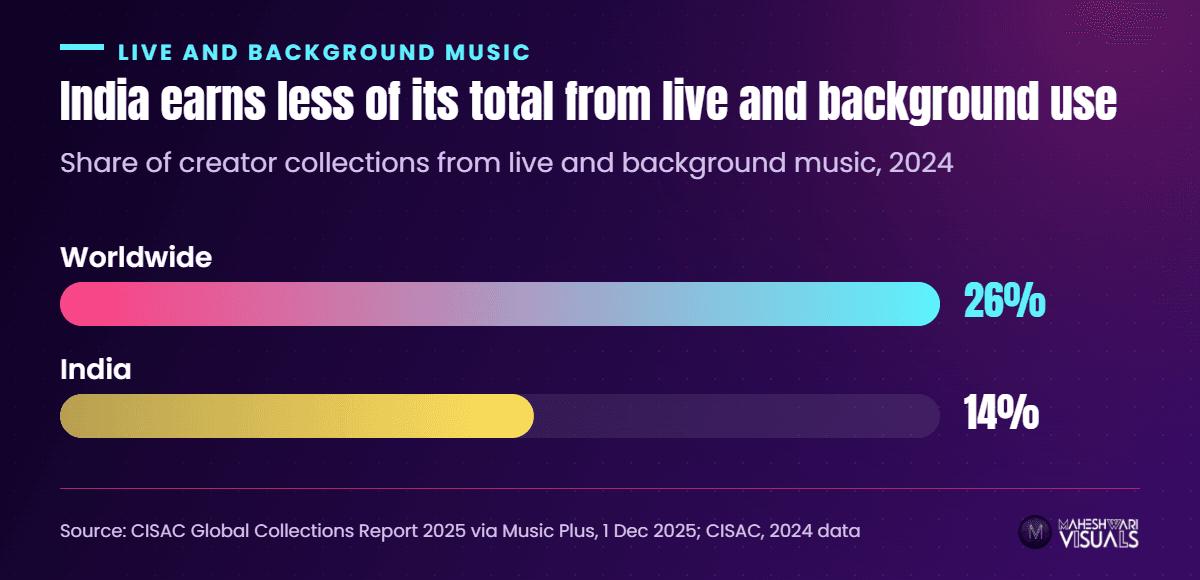
Those two figures don't prove that Indian writers are owed a specific amount. They do show how heavily India's creator income leans on one source. IPRS's own results tell a similar story: in FY 2024–25, total collections were ₹741.6 crore, with public performance at ₹101.7 crore. IPRS CEO Rakesh Nigam put it plainly: "Digital platforms cannot be the sole driver of creator income."
The timing matters too. IPRS has described December to January as one of its busiest periods for public performance, and this season's calendar is filling up. New festivals such as HOME in Goa on 29–30 December are promising 30+ Indian artists, including independent acts.
Who actually gets paid for a live performance?
This is where many artists get confused, because a live show can involve several different kinds of money.
Your performance fee
This is what the organiser pays you to perform. It comes from your booking deal and has nothing to do with collecting societies.
The performing right royalty
This belongs to the song, not the singer. IPRS is a society for authors, composers and music publishers. If you wrote your song, you may have a claim as its writer. If you sing someone else's song, the royalty for that song belongs to its writers and publisher, even though you were the one on stage.
The organiser's licence
The money has to start somewhere. In a December 2025 notice, IPRS said a standard annual licence does not cover festive parties and that its Christmas and New Year events need a separate, event-specific licence. If a venue skips that step, the people who wrote the songs can be left out.
If you share a song with a co-writer or producer, agree the split in writing early. Our guide to producer royalties and split agreements is a good place to start.
What should you do before your next show?
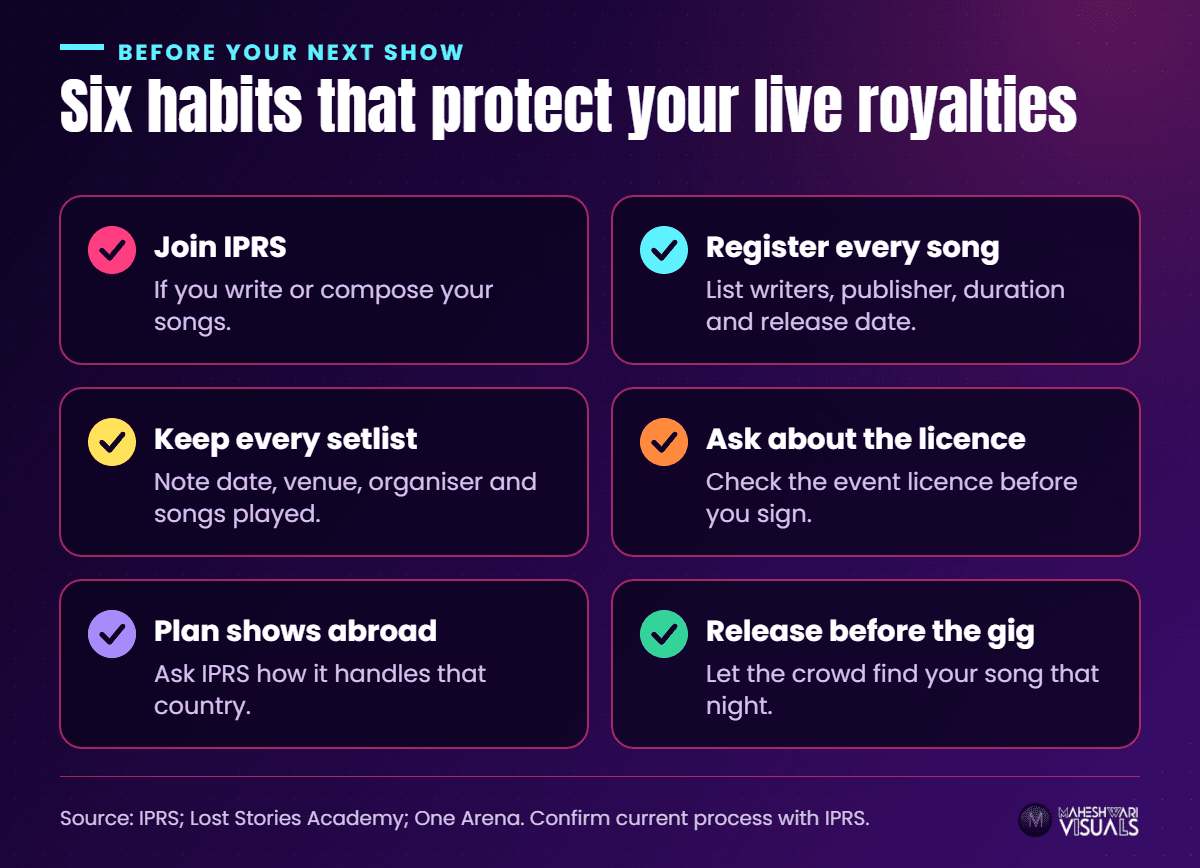
You don't need a legal team for this. A few simple habits put you in a far stronger position:
- Join IPRS if you write songs. Membership is open to authors and composers, and publishers can join too. Check the current requirements and fees with IPRS directly.
- Register every original song. Lost Stories Academy's guide walks through work registration in the member portal, with composers, lyricists, publisher, duration and release date.
- Keep a setlist for every show. Note the date, venue, organiser and the exact songs you played. The same guide advises submitting setlists after gigs, and One Arena's process also relies on setlists. Ask IPRS for the current way to submit yours.
- Ask the organiser about licensing. A polite question before you sign protects you and your fellow writers.
- Plan ahead for shows abroad. Writing to IPRS before you travel lets you ask how it handles royalties from that country.
Why does that last step work without joining a society in every country? Collecting societies commonly use reciprocal agreements. As Singapore's COMPASS explains, its members can be paid through COMPASS for performances in partner territories. Coverage and timing vary, so confirm the details for your destination.
How MV Distribution fits in
Let's be clear about the roles. IPRS handles performing rights for its members. MV Distribution handles the other side of your music's life: getting your recordings to listeners.
That side still feeds your live career. Someone who discovers your song at a show will look for it afterwards on Spotify, Apple Music, JioSaavn, Amazon Music, YouTube Music or Gaana. With MV, your music can reach 100+ stores and go live within 24 hours, you keep 100% of your rights, and human support replies within 24 hours.
So time your release with your calendar. Put the song out before the show, not after it, so that the crowd can find it the same night. You can also read how regional artists turn loyal fans into revenue, then use MV Marketing when you're ready to promote the release around your dates.
Conclusion
One Arena's growth shows where live performance royalties are heading: more tracking, more forecasting and fewer unanswered questions about when money will arrive. India's numbers show there is still room for live and background income to grow next to streaming. And the most useful steps are in your hands today: register your songs, keep your setlists and know the difference between a fee and a royalty.
You've already done the hard part by writing songs people want to sing back to you. Make sure the paperwork keeps up with the music. When your next release is ready, sign up with Maheshwari Visuals for music distribution and get it out in time for your next stage.
FAQs
What are live performance royalties?
They are royalties paid for the public performance of a song at events such as concerts and festivals. Organisers obtain licences from collecting societies, which then pay the songwriters and publishers whose works were used.
Do singers get IPRS royalties for live shows?
IPRS represents authors, composers and publishers. A singer who also wrote the song may have a claim as its writer. A singer who only performs someone else's song would normally earn a performance fee rather than that song's royalty.
What is One Arena?
One Arena is an alliance of collecting societies founded by GEMA. It shares information on concerts, forecasts, setlists and payment tracking across borders. Licensing and payment stay with each local society.
Is IPRS a member of One Arena?
IPRS is not among the members listed on One Arena's website or in the 2 November 2026 Digital Music News report. Check with IPRS for its current arrangements with societies abroad.
Does a music distributor collect live performance royalties?
A distributor delivers your recordings to streaming stores and handles the related release process. Live performance royalties for songwriters are handled by collecting societies such as IPRS, so you should sort out both.
Source: Digital Music News, "GEMA Hooks Canada's SOCAN Into Its Growing One Arena Live Collective", 2 November 2026; One Arena website; CISAC Global Collections Report 2025; Music Plus, 1 December 2025; IPRS notice, December 2025.
Comments
Related Articles

Billboard Will Count Free Streams More From 2027: What It Means for Indian Artists

Gully Gang Launches Fifty Nine Records: What It Means for Regional Independent Artists
