
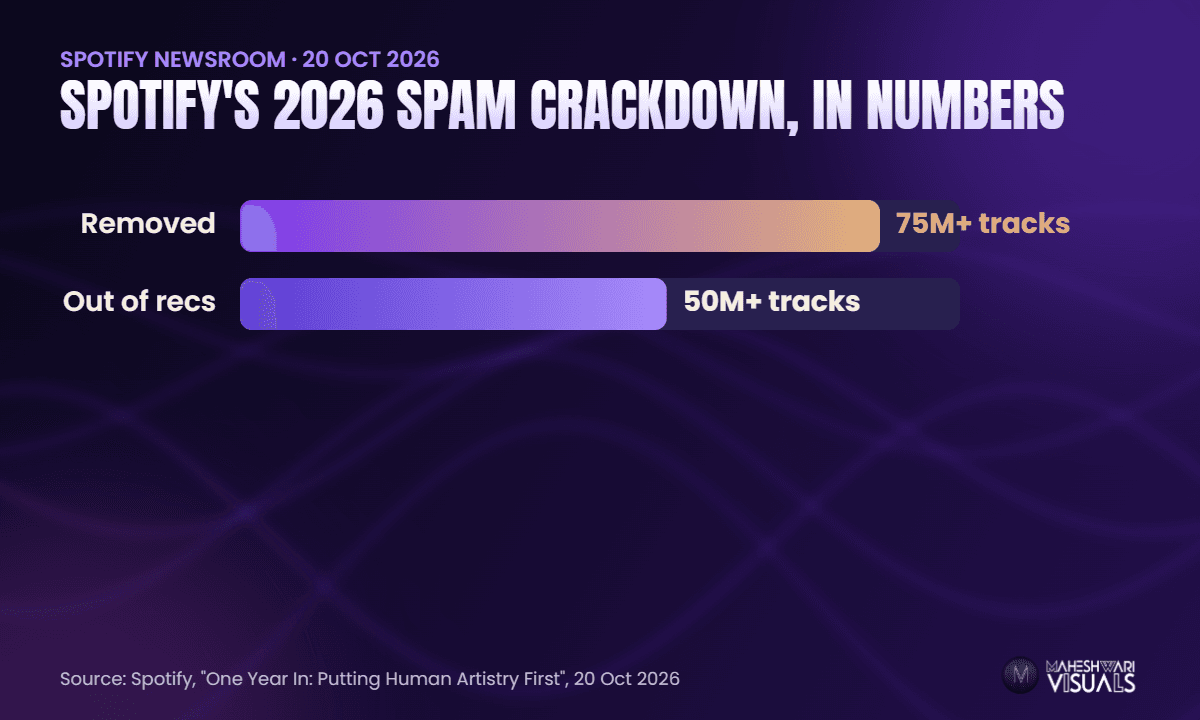
Fifty million. That is how many "slop and spam" tracks Spotify says it has pulled out of listener recommendations so far in 2026 — and that's on top of more than 75 million spammy uploads it has removed from the platform entirely. For independent artists, this is not just a headline about AI. It's a clear signal of what Spotify's algorithm now rewards, and what it quietly buries.
On 20 October 2026, Spotify published a one-year update on its plan to put "human artistry first". It explains the signals it uses to spot spam, how its new artist badges work, and a profile-protection tool that will reach every artist by the end of this year.
If you release music on Spotify from India — Hindi, Punjabi, Bhojpuri, Tamil or anything else — here's what Spotify's spam crackdown means for you, and the simple habits that keep your real music in front of real listeners.
What Spotify Announced on 20 October 2026
In its newsroom post "One Year In: Putting Human Artistry First on Spotify", the company shared these numbers and updates:
- 50M+ tracks out of recommendations this year, identified as slop or spam.
- 75M+ spammy tracks removed from the platform altogether for serious or repeated rule violations.
- 300,000+ artists now carry "Verified by Spotify", covering more than 99% of what listeners search for — and over 70% of them are independent.
- AI Credits, launched in April 2026, now see tens of thousands of submissions a day, showing which roles or instruments used AI.
- AI Persona badges label AI-generated artist identities, and by default those personas are kept out of editorial and algorithmic recommendations unless a listener follows them.
- Artist Profile Protection, now in beta, lets artists review releases that list them before they go live — rolling out to all artists by the end of 2026.
Spotify also said its editors do not programme content identified as slop or spam, and that listener complaints about it have dropped markedly since it updated the recommendation system over the past six months.
How Spotify's Spam Filter Decides What to Bury
This is the part every independent artist should read twice. Spotify says it doesn't rely on one signal. It combines listener engagement and feedback, upload patterns, metadata and third-party AI-detection tools — and admits AI detection has limits.
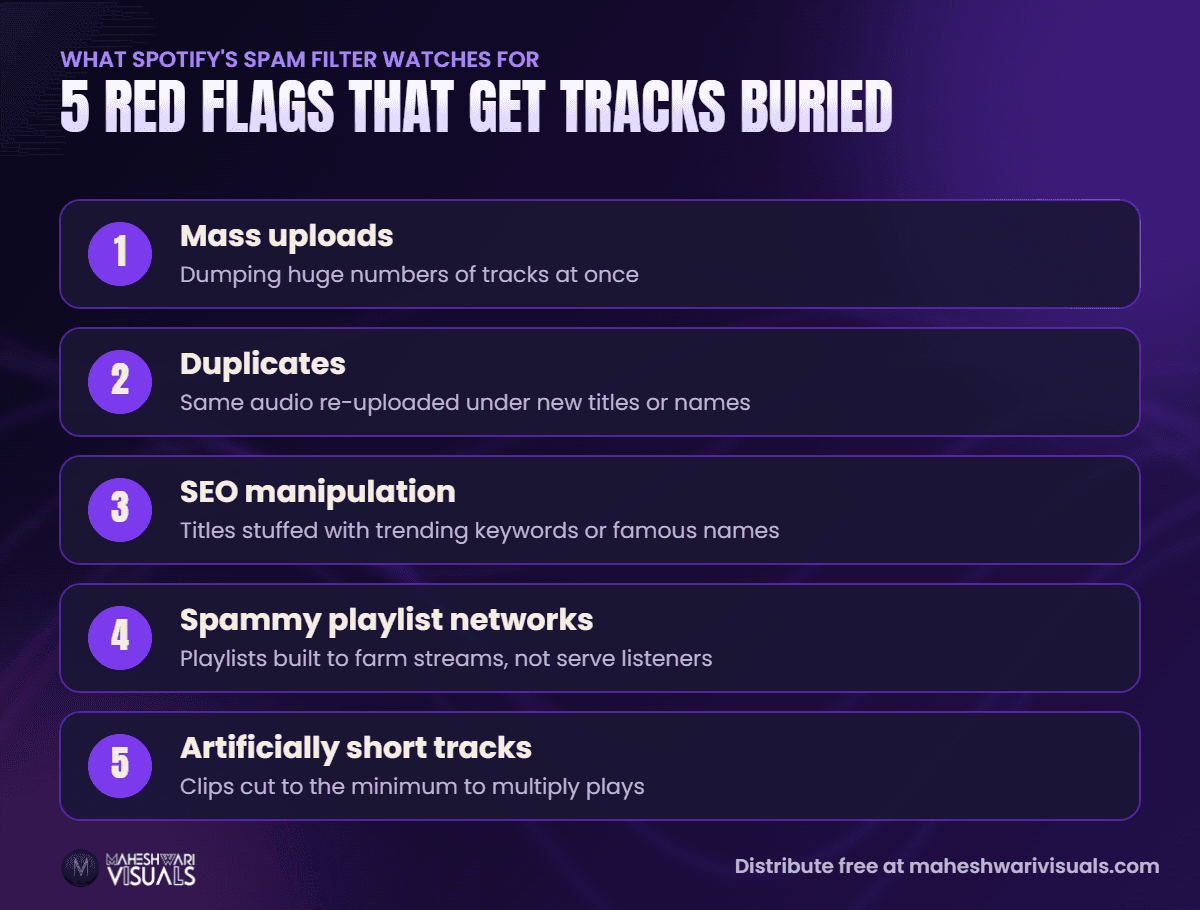
The tactics it is actively hunting are:
- Mass uploads — dumping huge numbers of tracks at once.
- Duplicates — the same audio uploaded again under new titles or artist names.
- SEO manipulation — titles and artist names stuffed with trending keywords or famous names.
- Spammy playlist networks — playlists built to farm streams rather than serve listeners.
- Artificially short tracks — clips cut to the bare minimum to multiply plays.
Notice that most of these are not about AI at all. A human artist who uploads the same song five times with different titles, or names a track "Lofi Bollywood Sad Song Arijit Style Remix", sends the same signals a spam farm does. The filter judges behaviour, not intentions.
Spotify also found that the tracks listeners skipped, ignored or flagged as unwanted were consistently the ones it identified as slop or spam. In plain terms: listener reaction is part of the verdict.
Why This Matters for Indian Independent Artists
Less noise means more room for real music
Every spam track pulled from recommendations is one less track competing with yours in Discover Weekly, Release Radar and autoplay. For a regional artist with a loyal but small audience, a cleaner algorithm is an opportunity — as long as your release doesn't look like spam.
The 1,000-stream threshold now has a sharper edge
Since 2024, a track needs at least 1,000 streams in a year to earn recorded-music royalties on Spotify. Spotify now calls that threshold a "first line of defence", and says tracks showing a high probability of AI generation are 10x more likely to fall below it. Honest releases that build steady listening are the ones that cross it.
Impersonation is finally getting a fix
Indian artists know the problem: a stranger's song turns up on your profile, or a fake "remix" borrows your name. Artist Profile Protection lets you review any release listing you as an artist before it goes live. When it opens to everyone by the end of 2026, switch it on.
Being upfront about AI is now normal
If you use AI anywhere in your process — a backing vocal, a generated beat, a mastering tool — AI Credits are how Spotify expects you to say so. YouTube Music started labelling AI-generated songs this month too; we covered what Indian artists must declare on YouTube Music.
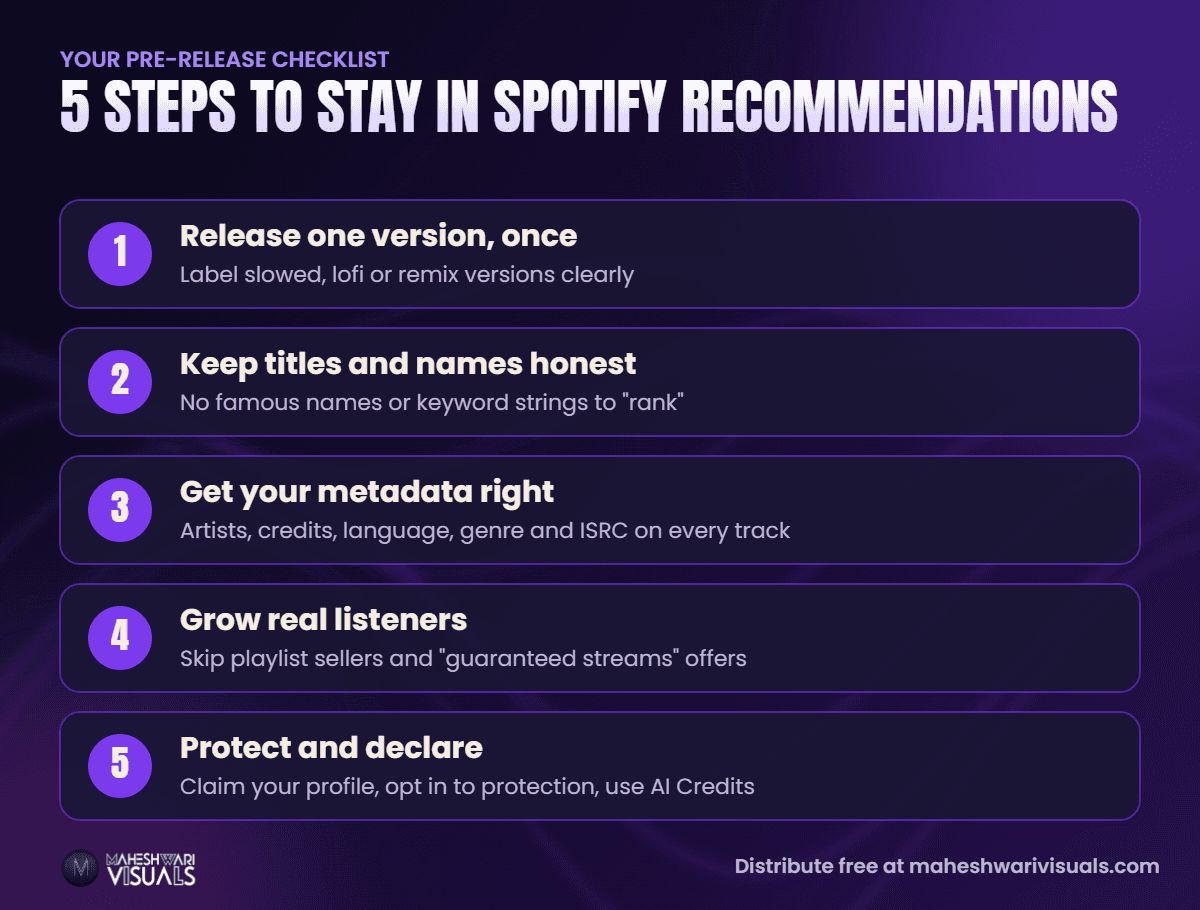
What You Should Do Before Your Next Release
None of this needs a big budget. It needs clean habits.
- Release one version, once. Don't re-upload the same audio under new titles. If you have a slowed + reverb or lofi version, release it as a clearly labelled version of the original.
- Keep titles and artist names honest. Your song title should be the song's title. Never add famous artists' names or keyword strings to "rank".
- Get your metadata right. Correct primary and featured artists, language, genre, songwriter and producer credits, ISRC on every track. Clean metadata is one of the signals Spotify reads.
- Grow real listeners, not numbers. Avoid playlist sellers and "guaranteed streams" offers — spammy playlist networks are on Spotify's list, and we've written about how streaming fraud now carries real penalties.
- Claim and protect your profile. Set up Spotify for Artists, aim for the Verified badge, and opt in to Artist Profile Protection when it reaches you.
- Declare AI honestly. If AI played a role, disclose it through AI Credits. Transparency protects you if a detection tool flags your track.
How Maheshwari Visuals Helps
Getting this right starts at distribution. When you release with MV Distribution, your music reaches 100+ stores — Spotify, Apple Music, JioSaavn, Amazon Music, YouTube Music, Gaana and more — usually live within 24 hours, with the metadata, credits and ISRCs set up properly from day one.
You keep 100% of your rights, and a real person on our support team replies within 24 hours if something looks wrong on your profile. When you're ready to reach listeners the honest way, our playlist pitching service focuses on genuine curators, not stream farms. More than 200K artists already trust Maheshwari Visuals with their releases.
Conclusion
Spotify's spam crackdown is good news for artists who make real music. Three things to remember: the filter judges behaviour — duplicates, keyword-stuffed titles, mass uploads and fake playlist plays — not just AI; listener engagement helps decide what stays in recommendations; and new tools like Verified badges, AI Credits and Artist Profile Protection give human artists a clearer, safer place on the platform.
Release cleanly, credit honestly and build real fans, and Spotify's algorithm is now on your side. Ready to put your next song out the right way? Sign up for free music distribution with Maheshwari Visuals and release with confidence.
FAQs
Will Spotify remove my song if I used AI to make it?
Not simply for using AI. Spotify targets slop and spam — mass uploads, duplicates, keyword manipulation and similar tactics. If AI played a role, disclose it through AI Credits so listeners and Spotify can see it.
Why did my song disappear from Spotify recommendations?
Spotify combines engagement, upload patterns, metadata and AI detection to decide what to recommend. Duplicate uploads, misleading titles, very short tracks or streams from spammy playlists can all count against a release. Check your metadata and promotion methods first.
What is the Spotify 1,000-stream rule?
Since 2024, a track needs at least 1,000 streams in the previous 12 months to earn recorded-music royalties on Spotify. Spotify says tracks likely to be AI-generated are 10x more likely to fall below it.
How do I protect my Spotify artist profile from fake releases?
Claim your profile on Spotify for Artists and opt in to Artist Profile Protection, which lets you review releases that list you before they go live. Spotify says it will be available to all artists by the end of 2026.
Does this change affect JioSaavn or other Indian platforms?
This announcement is about Spotify only. But other services are moving the same way — YouTube Music now labels AI-generated songs and Deezer is building an AI filter — so clean releases help everywhere.
Sources: Spotify Newsroom — "One Year In: Putting Human Artistry First on Spotify", 20 October 2026; Digital Music News, 20 October 2026; Gizmodo, 20 October 2026.
Comments
Related Articles

Producer Sues Sony Over Half-Rate Royalties: What Indian Artists Should Check

Spotify Q3 2026 Results: 788M Listeners, 38% in Rest of World — What It Means for Indian Artists
