
Every Reel a brand posts with a trending song is a small business decision: it either pays for that music, or it uses it for free and hopes nobody notices. This week, one of the world's biggest record companies showed what happens when somebody does notice.
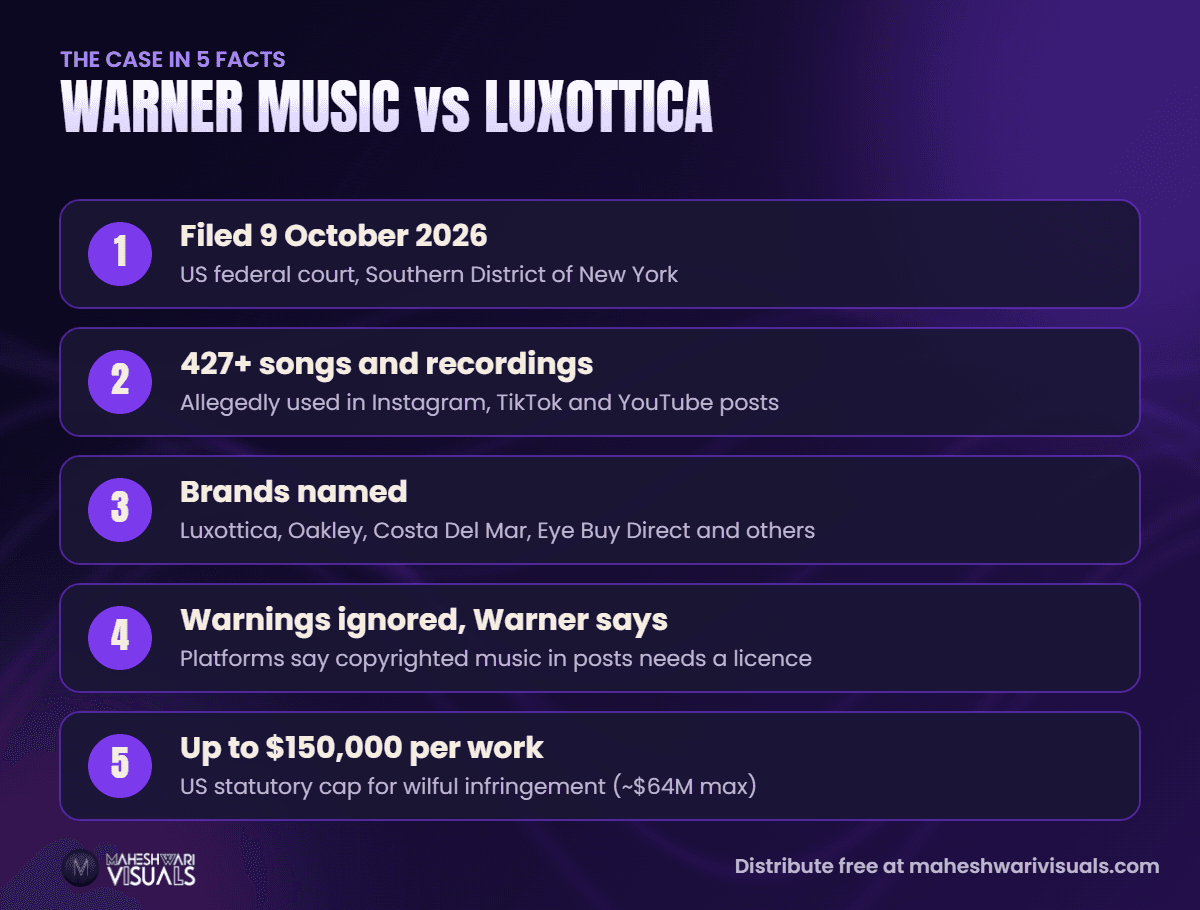
On 9 October 2026, Warner Music Group's labels and its publishing arm Warner Chappell filed a lawsuit in a New York federal court against eyewear giant Luxottica (the company behind Ray-Ban and Oakley) and several related brands. The claim: their Instagram, TikTok and YouTube marketing used at least 427 Warner songs and recordings without a licence. The case was reported on 12 October by Music Business Worldwide and Digital Music News.
It sounds like a fight between giants. But the lesson is very much about unlicensed music on social media — and why Indian independent artists should treat their own songs as assets worth protecting. Here's what happened, why it matters, and the steps you can take this week.
What Happened: Warner Music vs Luxottica in Plain Words
According to the reports, 23 Warner companies are plaintiffs, including Atlantic, Warner Records, Elektra and Warner Chappell. The defendants include Luxottica, Oakley, Costa Del Mar and Eye Buy Direct. The complaint says the brands, and influencers they worked with, put Warner music into promotional posts across social platforms.
Three details stand out:
- Warnings were ignored, Warner says. The complaint points out that Instagram, TikTok and YouTube all tell users that copyrighted music in posts needs a licence. Digital Music News reports that two cease-and-desist letters, sent in December 2025 and May 2026, did not settle the matter.
- The numbers are big. US law allows statutory damages of up to $150,000 per wilfully infringed work. Music Business Worldwide calculates the theoretical maximum here at about $64 million. Warner's lawyers have not named a final figure.
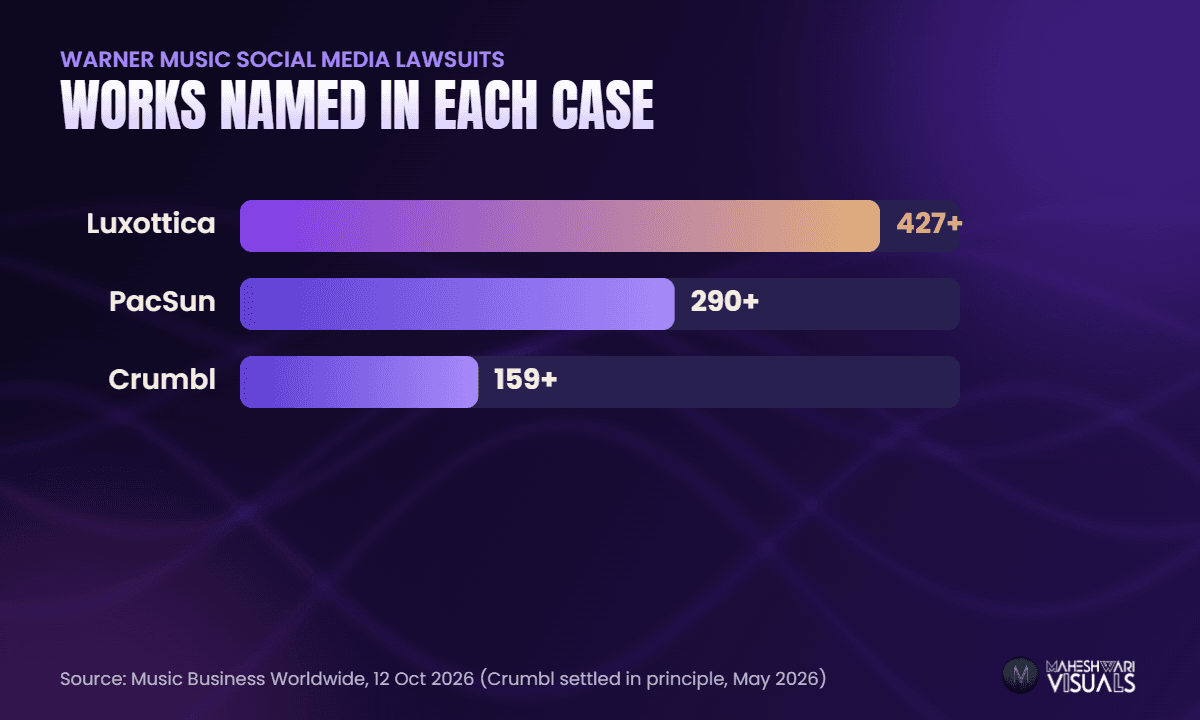
- It's a pattern, not a one-off. Warner has brought similar cases against US retailers PacSun (290+ works) and Crumbl (159+ works); the Crumbl case reached a settlement in principle in May 2026, with terms undisclosed.
Luxottica had not commented publicly when the story was reported, and none of the claims have been tested in court yet.
Why Unlicensed Music on Social Media Is a Big Deal
Most creators assume that if a song is in the Instagram or YouTube music library, it's free to use anywhere. It isn't that simple. Platforms license music for everyday personal posts. When a business uses a song to sell sunglasses, shoes or cookies, that's advertising — and advertising music usually needs a separate licence, often called a sync licence.
That gap is exactly what the major labels are now chasing. And it creates two very different lessons for independent artists.
Lesson 1: Your music has commercial value
When a brand wants a song in its ad, it is paying for attention, emotion and culture — things your music creates. That value doesn't disappear just because you're independent. A Punjabi track trending on Reels or a Bhojpuri song blowing up on YouTube Shorts is worth something to a brand, and you are entitled to ask for a licence fee.
Lesson 2: You can only enforce rights you can prove
Warner can sue because it knows exactly which recordings and compositions it owns, with clean data behind every one. Many Indian independent artists can't say the same. Missing ISRCs, unclear songwriter credits and no written agreement with the producer make it very hard to claim money — or even send a takedown — when someone misuses your work.
What It Means for Indian Independent Artists
India's own Copyright Act, 1957 treats a song as more than one work. There's the sound recording (the master) and the underlying musical and literary works (the composition and lyrics). Different people can own each part, and each can be licensed separately. Warner's suit uses the same idea: the labels claim the recordings, while Warner Chappell claims the compositions.
For you, this means three practical things:
- Know who owns what. If you wrote and recorded the song yourself, you may hold both. If a producer, lyricist or composer worked with you, write the splits down before release.
- Register your songwriting. In India, IPRS represents authors, composers and music publishers. Membership helps you collect when your compositions are performed or used.
- Release with clean metadata. Every track needs an ISRC and accurate credits. Our guide on what an ISRC code is and why you need one explains the basics.
There's also a flip side. If you run a small music business, a studio page or a label account, don't drop someone else's hit into your paid promotions. The same rules apply to you.
Your 5-Step Protection Plan
You don't need a legal team to start protecting your catalogue. You need good habits.
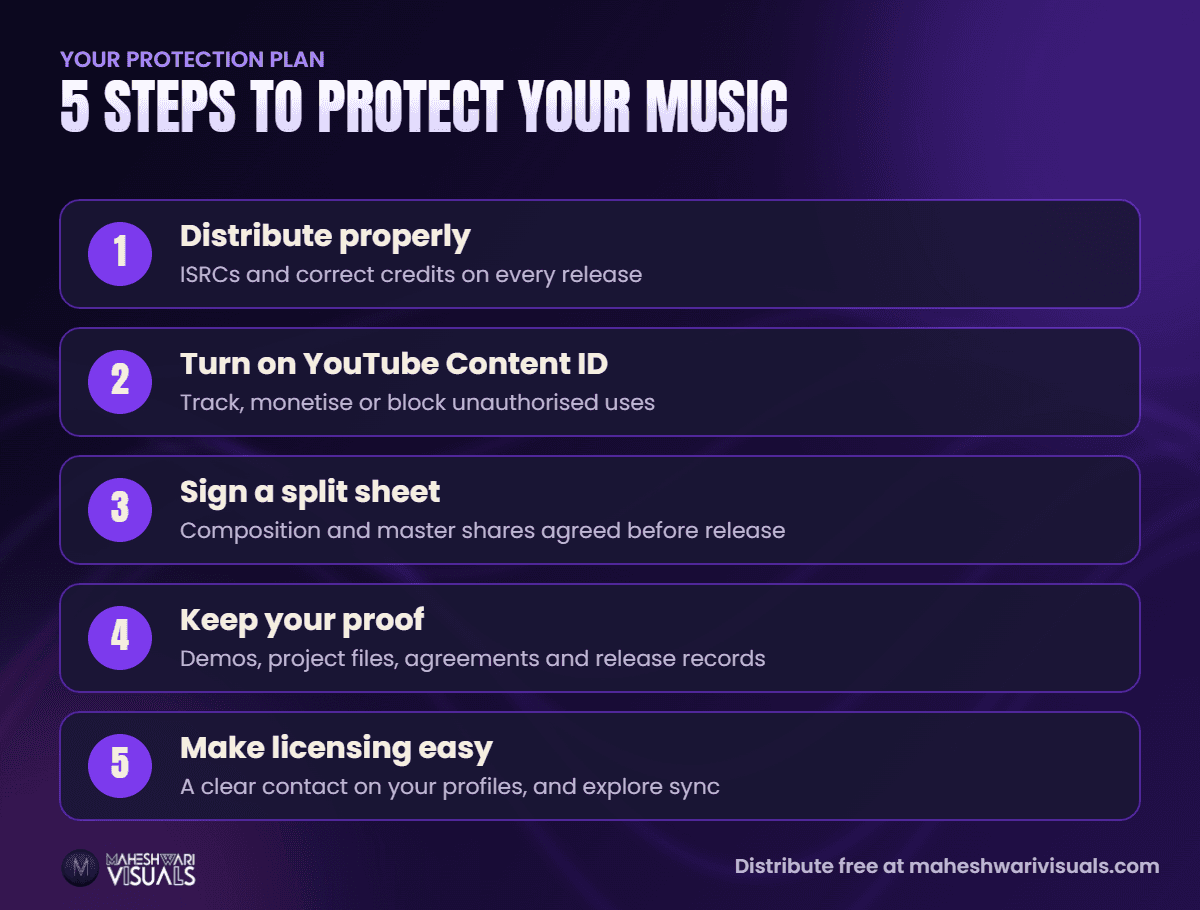
- Distribute properly. Release through a distributor that assigns ISRCs and delivers correct credits to Spotify, JioSaavn, Apple Music, Amazon Music, YouTube Music and the rest. Clean data is your proof of ownership.
- Turn on YouTube Content ID. Content ID scans uploads for your recordings, so you can track, monetise or block videos that use your music without permission.
- Sign a split sheet for every song. Write down who owns what percentage of the composition and the master, and get everyone to sign before release day.
- Keep your proof. Save project files, dated demos, agreements and your release records in one place.
- Make licensing easy. Brands often use music without permission because asking feels hard. Put a clear contact on your profiles, and consider sync — getting your music placed legally in ads, films, web series and OTT shows. Learn how it works on our sync page.
How Maheshwari Visuals Helps You Protect and Earn
With MV Distribution, your music goes live on 100+ stores — including Spotify, Apple Music, JioSaavn, Amazon Music, YouTube Music and Gaana — usually within 24 hours. Every release carries proper codes and credits, YouTube Content ID support is available, and you keep 100% of your rights.
When you're ready to grow, MV Marketing can help with playlist pitching and sync opportunities, so brands pay to use your music instead of borrowing it. More than 200K artists already trust Maheshwari Visuals, and our human support team replies within 24 hours.
Conclusion: Treat Every Song Like an Asset
The Warner Music vs Luxottica lawsuit is a reminder that unlicensed music on social media has a real cost, and that rights holders with clean data are the ones who can act. Three takeaways: your songs have commercial value to brands; you can only protect what you can prove, so ISRCs, credits and split sheets matter; and licensing — not free use — is how artists get paid when brands want their sound.
You don't need a major label behind you to run your music like a business. Start with a proper release and a clear record of what you own. When you're ready, sign up free for music distribution with Maheshwari Visuals and put your next release on the right footing from day one.
FAQs
Can a brand use my song in an Instagram Reel without permission?
Generally, no. Platform music libraries are licensed for everyday personal posts, while commercial promotion usually needs a licence from the rights holders. If a brand uses your song in an ad without permission, you may be able to request a takedown or a licence fee.
Is Instagram's music library free for business accounts?
Not in the way many people think. Business and brand accounts often get a more limited selection of commercially cleared tracks, and the platforms themselves tell users that copyrighted music needs a licence. When in doubt, a brand should ask the rights holder directly.
How do I prove that I own my song?
Keep your release records (ISRC, release date, distributor confirmation), signed split sheets, agreements with producers or lyricists, and dated project files or demos. Registering your compositions with IPRS adds another layer of documentation.
What is a sync licence?
A sync licence gives permission to pair music with visual media such as an ad, film, web series or social video. It's one of the main ways artists earn when brands want their music, and it is separate from streaming royalties.
Does YouTube Content ID protect my music on Instagram?
No. Content ID works on YouTube. It helps you track and monetise uses of your recordings there, which makes it an important part of protecting your catalogue alongside clear ownership records.
Sources: Music Business Worldwide, 12 Oct 2026; Digital Music News, 12 Oct 2026; Shopifreaks on the WMG–Crumbl settlement, 27 May 2026.
Comments
Related Articles

Deezer's New AI Music Filter: What It Means for Indian Independent Artists

MTV Hustle 5 Winner Dhadkan Takes ₹1 Crore: What It Means for India's Independent Rappers
