
Your song is ready. The mix sounds right, the master is done, and you're about to release it to the world. But here's a question most artists never think to ask before hitting publish — how will the platforms know this recording belongs to you?
That's exactly what an ISRC code does. It is the fingerprint of your recording — a unique identifier that follows your music across every streaming platform, every country, every playlist, and every royalty payment. Without it, your music exists in the system without a reliable identity. Royalties can go uncollected. Ownership becomes difficult to prove. And as your career grows, the problem compounds.
This guide breaks down exactly what an ISRC code is, how it works in the Indian music ecosystem, and why securing one for every release is non-negotiable — whether you're dropping your first single or your fifth album.
What Does ISRC Actually Stand For?
ISRC stands for International Standard Recording Code. It is a globally recognised identifier managed by the International Federation of the Phonographic Industry (IFPI) and adopted by music platforms, collecting societies, and distributors worldwide.
Think of it like an Aadhaar number — but for your song. Just as your Aadhaar is linked to your identity across government systems, an ISRC is linked to your recording across the global music infrastructure.
Every ISRC code is 12 characters long and contains four pieces of information:
- Country code — the country of registration (e.g., IN for India)
- Registrant code — a unique code assigned to the rights holder or distributor
- Year of reference — the last two digits of the year the code was issued
- Designation code — a 5-digit serial number for the specific recording
So a code like IN-MV1-25-00001 tells the music industry: this is an Indian recording, registered by a specific entity, issued in 2025, and it is the first unique recording in that sequence.
Why Is It So Important for Streaming Royalties?
This is where it gets critical for your income as an artist.
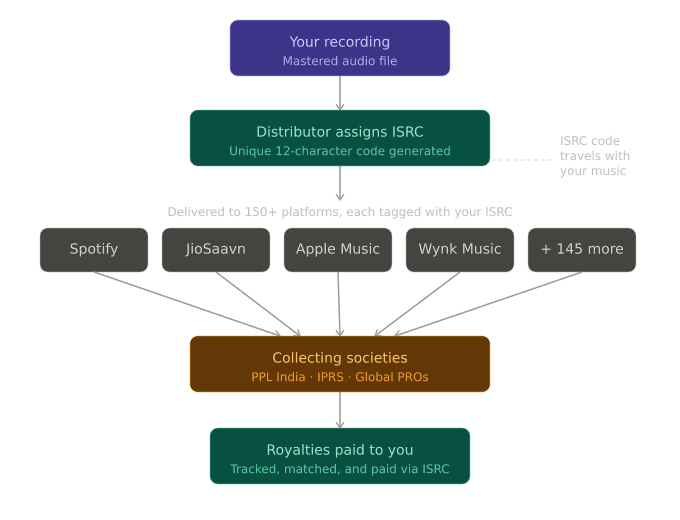
When your song plays on Spotify India, JioSaavn, Wynk Music, Gaana, Apple Music, or YouTube Music, those platforms generate royalty data. That data is tied to a specific recording — identified by its ISRC code. The code is how streaming platforms communicate with Phonographic Performance Limited (PPL India), IPRS, and other collecting societies to track plays and trigger payments.
Without a valid ISRC code, your song may still stream. But the royalty trail becomes blurred. If your music is picked up by a second aggregator, re-uploaded, or used in content across platforms, tracking which royalties belong to which version of your recording becomes an administrative nightmare.
[Image suggestion: Infographic showing how an ISRC code links a recording to royalty payouts across multiple platforms] Alt text: "Diagram showing how ISRC code connects a music recording to royalty payments on Spotify, JioSaavn, Apple Music, and other platforms"
A Real-World Example
Imagine you release a song through one distributor, and a cover version of the same track is uploaded by another artist. If your recording does not have a properly registered ISRC, there is a real risk that streams — and royalties — get attributed to the wrong recording. The ISRC is the line that separates your earnings from someone else's.
ISRC vs UPC — What Is the Difference?
Artists often confuse these two codes, so let's set it straight once and for all.
Code
What It Identifies
Assigned To
ISRC
A specific recording
Individual tracks
UPC
A release or product
Albums, EPs, singles as a whole
Your single has one UPC (for the release) and one ISRC (for the audio recording itself). If your EP has five tracks, it has one UPC and five separate ISRC codes — one per track.
Both are essential. The UPC helps platforms catalogue your release as a product. The ISRC identifies each recording within that product for rights tracking and royalty allocation.
[Link: Learn more about UPC codes and how they work → what-is-upc-code-music-distribution]
Does Every Track Need Its Own ISRC Code?
Yes — every unique recording requires its own ISRC. This includes:
- Original recordings — your studio master
- Live recordings — a live version of the same song is a different recording
- Remixes — a remix is legally a new recording and needs its own ISRC
- Re-masters — if you re-master an existing track and release it, the new master gets a new ISRC
- Acoustic or alternate versions — any version released separately to platforms
A common mistake is assuming that alternate versions of the same song can share an ISRC. They cannot. Each version is a distinct recording with its own identity.
How Do Artists Get an ISRC Code in India?
Through Your Music Distributor
This is the most common and straightforward method for independent artists. When you distribute through a registered distributor like MV Distribution, ISRC codes are generated and assigned to your recordings automatically as part of the distribution process. You do not need to apply for them separately.
This is why choosing the right distribution partner matters. MV Distribution handles ISRC assignment for every release — so your recordings are correctly identified and royalty-ready from day one.
[Link: How music distribution works in India — a complete guide → how-to-distribute-music-india]
What Happens If You Release Music Without an ISRC Code?
Releasing music without an ISRC is not a hard block — your music will often still appear on platforms. But the consequences accumulate over time:
- Royalties from collecting societies like PPL India and IPRS may go uncollected
- If your song is synced in a film, ad, or web series, proving ownership of the specific recording becomes complicated
- Neighbouring rights payments — which are separate from songwriter royalties — require a valid ISRC to be tracked accurately
- If your music is re-released, remastered, or picked up by a second distributor, the absence of a consistent ISRC creates gaps in your royalty history
The longer your catalogue goes without proper ISRC assignment, the harder it becomes to reclaim lost earnings.
[Image suggestion: Independent Indian artist reviewing royalty statements on a laptop, focused expression] Alt text: "Indian independent artist reviewing music royalty statements linked to ISRC tracking"
Conclusion
Three things every artist should take away from this:
First, an ISRC code is not a technicality — it is the foundation of your music's identity in the global streaming system. Every platform, every collecting society, and every royalty payment depends on it.
Second, every unique recording needs its own ISRC. Alternate versions, remixes, live takes, and re-masters are all separate recordings and must be treated as such.
Third, the easiest way to ensure your releases are correctly coded is to work with a distributor who handles it as part of the process — so you can focus on the music.
Your recordings deserve to be properly identified and properly paid for. If you want to make sure every release is distributed with the right codes in place, MV Distribution takes care of ISRC assignment, platform delivery, and royalty tracking — from your first release to your hundredth.
Frequently Asked Questions
Is an ISRC code free? When you distribute through a registered distributor, ISRC codes are typically generated at no additional cost as part of the distribution service. If you apply for a registrant code directly through PPL India to generate your own, there may be a registration fee involved.
Can I use the same ISRC code on multiple platforms? Yes — in fact, that is exactly the point. The same ISRC code should be used across every platform where your recording is distributed. It is a universal identifier, which is what makes cross-platform royalty tracking possible.
Do I need an ISRC code for a music video? An ISRC code applies to the audio recording specifically. Music videos use a different identifier called an ISAN (International Standard Audiovisual Number). However, the audio within your music video is still identified by its ISRC.
What if my old releases don't have ISRC codes? If you have previously released music without ISRC codes, it is worth reaching out to your distributor to see if codes can be retroactively assigned. In some cases, royalties from collecting societies can be reclaimed for past periods once a valid ISRC is on record.
Can two different songs have the same ISRC code? No. ISRC codes are unique by design — no two recordings should share the same code. If there is ever a duplication error (which can happen with some low-quality distribution services), it creates serious royalty tracking problems. This is one reason why working with a reliable distributor matters.


