
A Tamil soundtrack from 2012 is still earning money in 2026. That, in one line, is why one of the world's biggest record companies has just gone shopping in South India.
On 16 October 2026, Warner Music India announced a set of catalogue deals and long-term partnerships across Tamil and Malayalam music. Warner is paying for songs that keep getting streamed years after the film has left cinemas.
If you make music in Tamil, Telugu, Malayalam, Kannada or any regional language, this news is worth more than a quick scroll. Below, we break down what happened, why catalogue music has become so valuable, and the practical steps independent artists can take so their own songs build long-term value. We'll also explain how MV Distribution helps you release regional music while keeping 100% of your rights.
What Warner Music India Announced
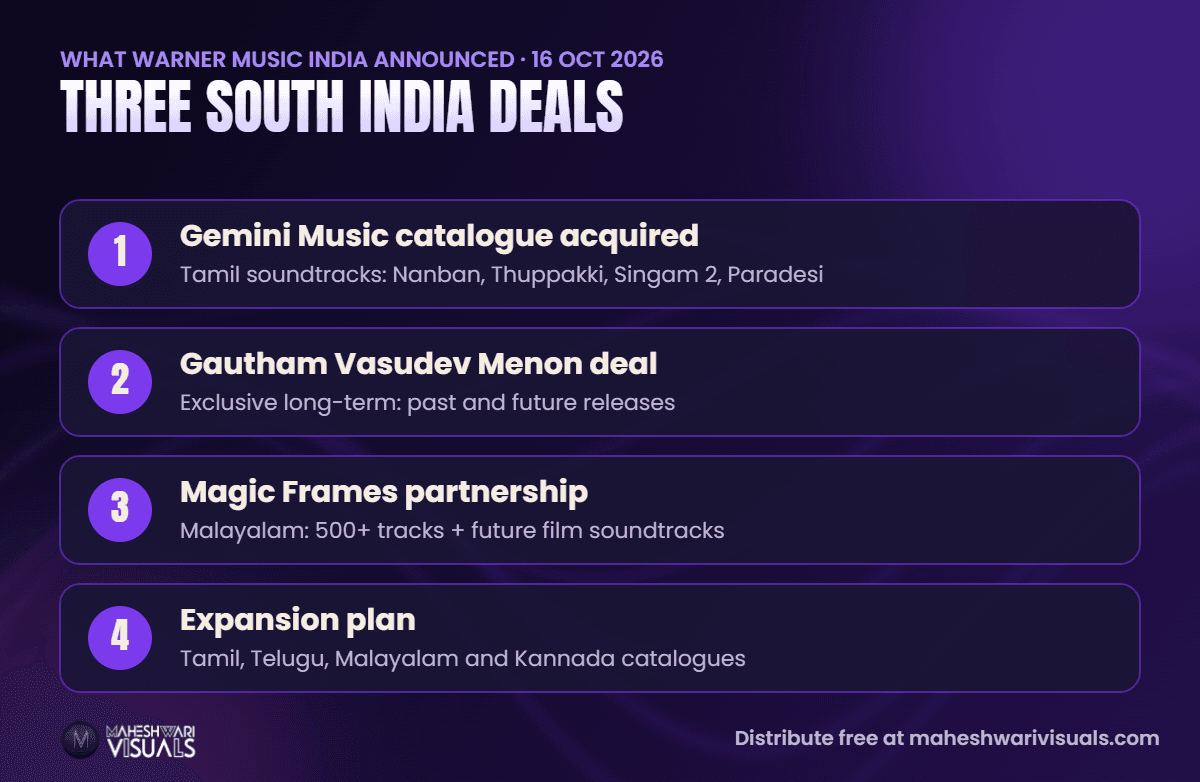
According to Digital Music News and Music Week, the announcement has three main parts:
- Gemini Music catalogue acquisition: Warner is buying a library of Tamil film soundtracks, including music from Nanban, Thuppakki, Mayakkam Enna, Singam 2 and Paradesi, with composers such as Harris Jayaraj, G. V. Prakash Kumar and Devi Sri Prasad.
- Gautham Vasudev Menon deal: an exclusive long-term agreement with the filmmaker that covers his past and future releases: film soundtracks, independent singles and upcoming titles.
- Magic Frames partnership: an exclusive long-term deal with the Malayalam production and distribution house led by Listin Stephen. It covers more than 500 tracks from films like Kaduva, Jana Gana Mana and Driving Licence. Warner will also be the global release partner for future soundtracks and music videos from films Magic Frames produces, acquires or distributes.
These deals build on a majority investment Warner made in a South Indian music company in 2023. Warner says the plan now is to invest in established catalogues and grow across Tamil, Telugu, Malayalam and Kannada music. No deal values were disclosed.
Why Catalogue Music Is So Valuable Right Now
A catalogue is simply a collection of songs that have already been released. For years, the industry focused on new releases. Streaming changed that. Every time someone plays an old favourite on Spotify, JioSaavn, YouTube Music or Amazon Music, the rights owner earns again.
Warner's own executives made this point. Ashok Parwani, who leads music for South India at Warner Music India, said South Indian film music keeps finding new audiences long after release. Jay Mehta, who runs Warner's recorded music and publishing for India and SAARC, called the region's markets "central" to a sustainable music business in India.
The numbers behind the bet
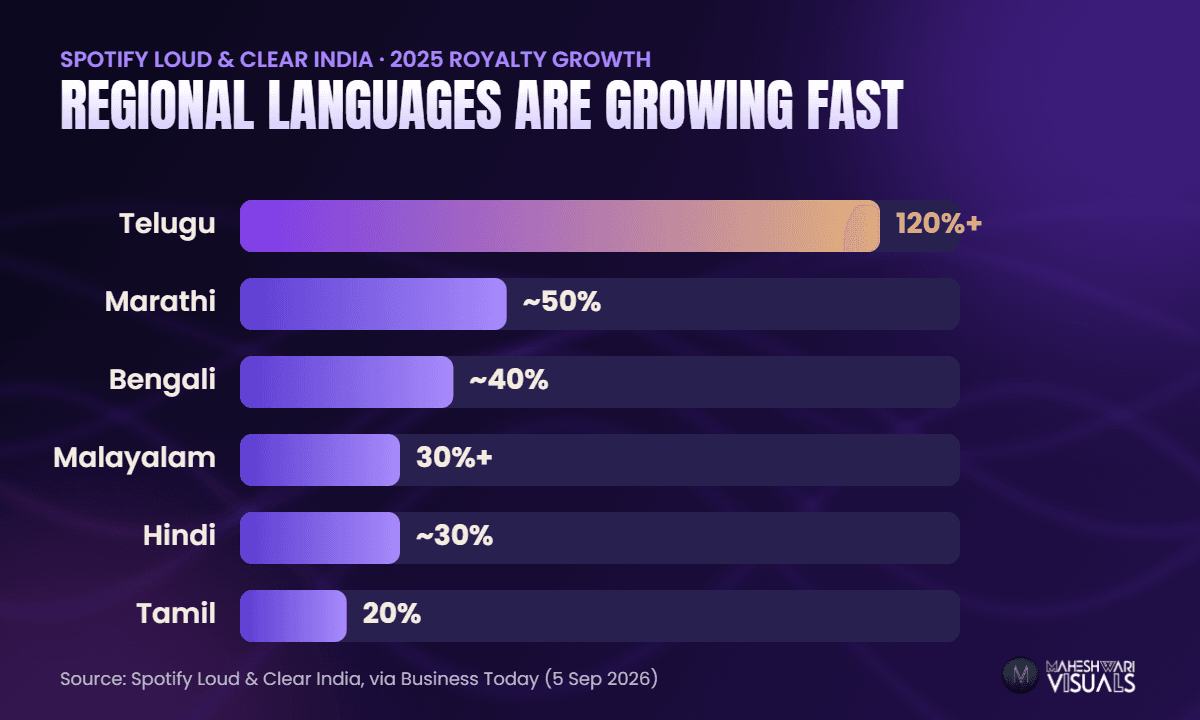
Spotify's Loud & Clear India report shows how fast regional music is growing. Royalties earned by Indian artists on Spotify grew 29% in 2025, according to Indian Television. By language, as reported by Business Today on 5 September 2026:
- Telugu royalties grew more than 120%
- Malayalam grew over 30%
- Tamil grew 20%
- More than 40% of Indian artists' royalties came from listeners outside India
That last number matters. A good regional song is no longer limited to one state, or even one country.
What This Means for Regional Independent Artists
When a major label spends money buying old songs, it tells you one thing clearly: the people who own the music own the long-term value. For independent artists, that is both a warning and an opportunity.
Your songs are assets, not just releases
Many artists treat a release as a one-week event. But a song you release today can be streamed for the next ten or twenty years. If you own the master recording, every one of those plays can pay you. If you sign it away for a small upfront fee, someone else collects.
Regional is no longer "niche"
Warner is betting on Tamil, Telugu, Malayalam and Kannada because audiences are big and growing. You don't need to switch to Hindi or English to build a career. Singing in your own language can be your biggest strength, especially with strong demand from the diaspora.
Clean data decides who gets paid
Catalogues are bought and valued on their data: who wrote the song, who owns the recording, which ISRC belongs to which track, and how the money is split. If your metadata is messy, your music is harder to monetise, harder to license and worth less. If you're unsure what an ISRC is, our guide on why every artist needs an ISRC code is a good place to start.
5 Steps to Build a Catalogue That Grows in Value
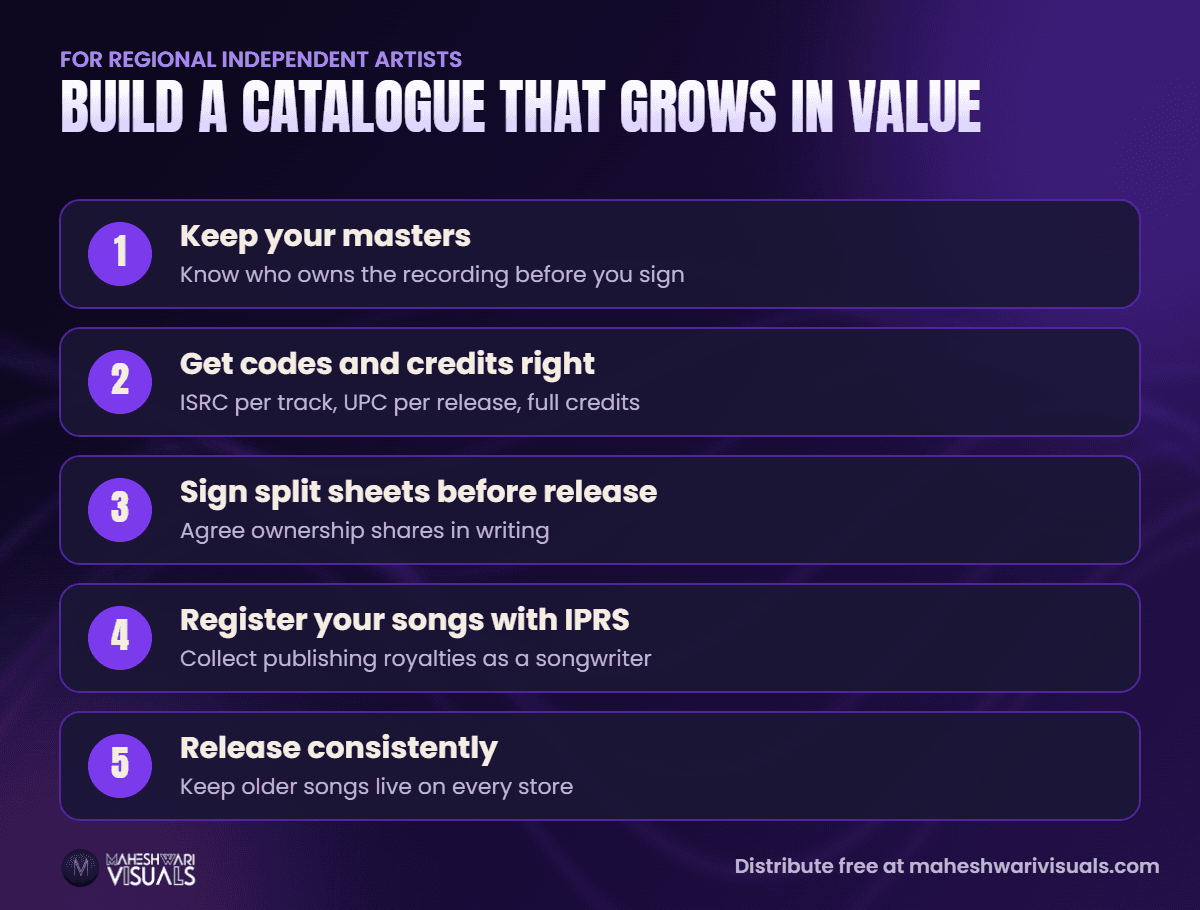
You don't need a major label to think like one. Here's what you can do starting with your next release:
- Keep your masters. Read every contract carefully before you sign. Know who will own the recording, and for how long.
- Get your codes and credits right. Every track needs its own ISRC, and every release needs a UPC. Add correct songwriter, composer, lyricist and producer names.
- Sign split sheets before release. Agree in writing who owns what share of the song. It avoids fights later and makes your catalogue easier to license.
- Register your songs with IPRS. If you write songs, registering with the Indian Performing Right Society helps you collect publishing royalties that streaming payouts alone don't cover.
- Release consistently and think long-term. A steady catalogue of 10–20 well-tagged songs is worth far more than one viral moment. Keep releasing, and keep your older songs live on every store.
How Maheshwari Visuals Helps
At Maheshwari Visuals, we work with independent artists across India, and we believe your catalogue should work for you. With MV Distribution:
- Your music goes to 100+ stores, including Spotify, Apple Music, JioSaavn, Amazon Music, YouTube Music and Gaana
- Releases can go live within 24 hours
- You keep 100% of your rights, so your masters stay yours
- Real humans in our support team reply within 24 hours
Want your songs heard beyond your home state? Explore MV Marketing for promotion and sync opportunities for film and ad placements.
Conclusion: Own Your Music, Own Your Future
Warner Music India's South India deals show that regional film and independent music has real, lasting value. Three takeaways stand out. First, songs keep earning for years, so every track you release is a long-term asset. Second, Tamil, Telugu, Malayalam and Kannada music is growing fast in India and abroad. Third, ownership and clean metadata decide who benefits from that growth.
The good news? You don't have to wait for a big label to value your music. You can build your own catalogue, one well-planned release at a time, and keep every right that comes with it.
Ready to release your next regional song the right way? Sign up for music distribution with Maheshwari Visuals and start building a catalogue you'll be proud to own.
Frequently Asked Questions
What did Warner Music India announce in October 2026?
On 16 October 2026, Warner Music India announced it is acquiring the Gemini Music catalogue of Tamil film soundtracks, signed an exclusive long-term deal with filmmaker Gautham Vasudev Menon, and formed an exclusive partnership with Malayalam production house Magic Frames covering more than 500 tracks.
What is a music catalogue and why do labels buy them?
A music catalogue is a collection of songs that have already been released. Labels buy catalogues because, in the streaming era, popular older songs keep earning royalties every time they are played, often for many years.
Should independent artists sell their song rights?
It depends on the deal, but think carefully before giving up ownership. If you keep your masters, you keep earning from every future stream. Always read contracts fully and, if needed, get advice from a music lawyer before signing.
How can I earn more from my Tamil or Telugu songs?
Release consistently on all major stores, make sure your metadata and ISRC codes are correct, register as a songwriter with IPRS, and promote to fans both in India and abroad, since a large share of Indian artists' royalties now comes from overseas listeners.
Can I distribute regional-language music with Maheshwari Visuals?
Yes. MV Distribution releases regional-language music to 100+ stores, and you keep 100% of your rights.
Sources: Digital Music News, "Warner Music India Strengthens Presence in South India" (15 Oct 2026, US time); Music Week (16 Oct 2026); Indian Television (16 Oct 2026); Business Today on Spotify Loud & Clear India (5 Sep 2026).
Comments
Related Articles

Producer Sues Sony Over Half-Rate Royalties: What Indian Artists Should Check

Spotify Q3 2026 Results: 788M Listeners, 38% in Rest of World — What It Means for Indian Artists
