
A song written in 1962 and signed away a year later has just come home to its writer, and the change covers the whole world, not only America. On 19 October 2026, the US Supreme Court left in place a ruling that gives songwriter Cyril Vetter worldwide ownership of "Double Shot (Of My Baby's Love)". BMG, Universal, Sony and Warner had all lined up against him.
The case was decided in an American court under American law. The lesson behind it still reaches every artist in India: copyright rights you sign away do not always stay gone, and the wording of your contract decides a lot. Below, we explain what happened, why the music business is paying attention, how Indian copyright law treats song assignments, and five things you can check in your own agreements this week.
What the Supreme Court did on 19 October
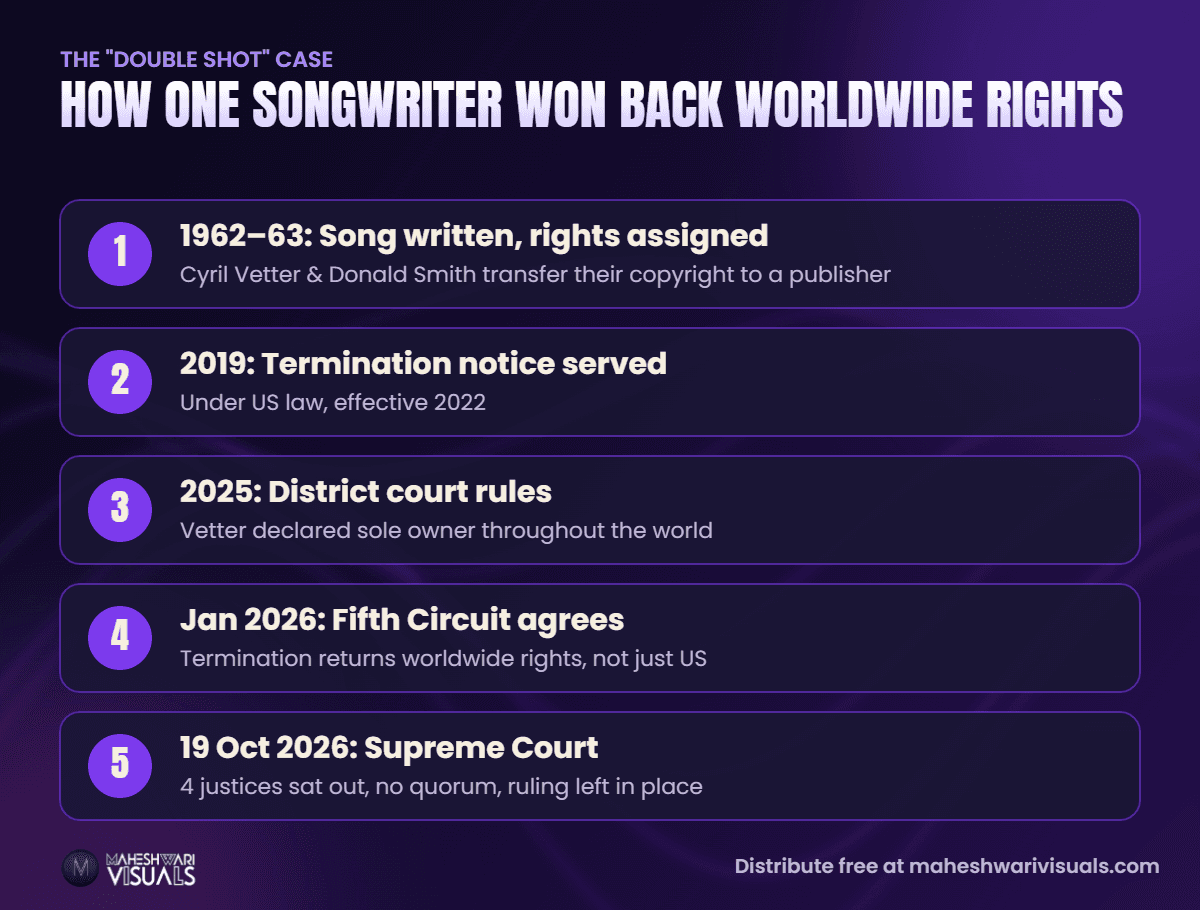
Vetter and co-writer Donald Smith wrote "Double Shot" in 1962. In 1963 they transferred their copyright interests to a publisher. US law lets authors terminate older transfers after a set number of years, so Vetter served a termination notice in 2019 that took effect in 2022.
The publisher's later owner argued that termination only returns the US rights and that it still held the song everywhere else. A district court disagreed in 2025 and declared Vetter the sole owner "throughout the world". In January 2026, the Fifth Circuit Court of Appeals agreed.
BMG and the three majors bought the publisher's interest and asked the Supreme Court to review the case. Then four of the nine justices took no part. Digital Music News reports that this left the Court short of the six-justice quorum, so it issued an order that affirms the lower ruling as if the Court were equally divided.
What it does and doesn't mean
- The Supreme Court did not decide the legal question itself. It simply left the Fifth Circuit's ruling standing.
- The ruling binds courts in Texas, Louisiana and Mississippi. Courts elsewhere in the US, including New York and California, could still reach a different view.
- Courts outside the US are not required to recognise the transfer back and would usually apply their own national law.
Why labels and publishers are worried
Catalogues are bought and sold on the promise of income that keeps coming for decades. If a writer can take back worldwide rights, part of a buyer's foreign income could disappear. That's why all three majors joined the challenge, while the Songwriters Guild of America called the outcome a win for songwriters.
As commentator Michael Whalen notes in a Digital Music News analysis, the US rules come with limits. Works made for hire are generally excluded. Taking back a composition does not take back the master recording. Notices also have to be served within strict time windows.
The bigger shift is one of attitude. Writers who once assumed a signature was forever are now re-reading old paperwork, and buyers are checking ownership chains more carefully before they pay.
Does this apply to Indian artists?
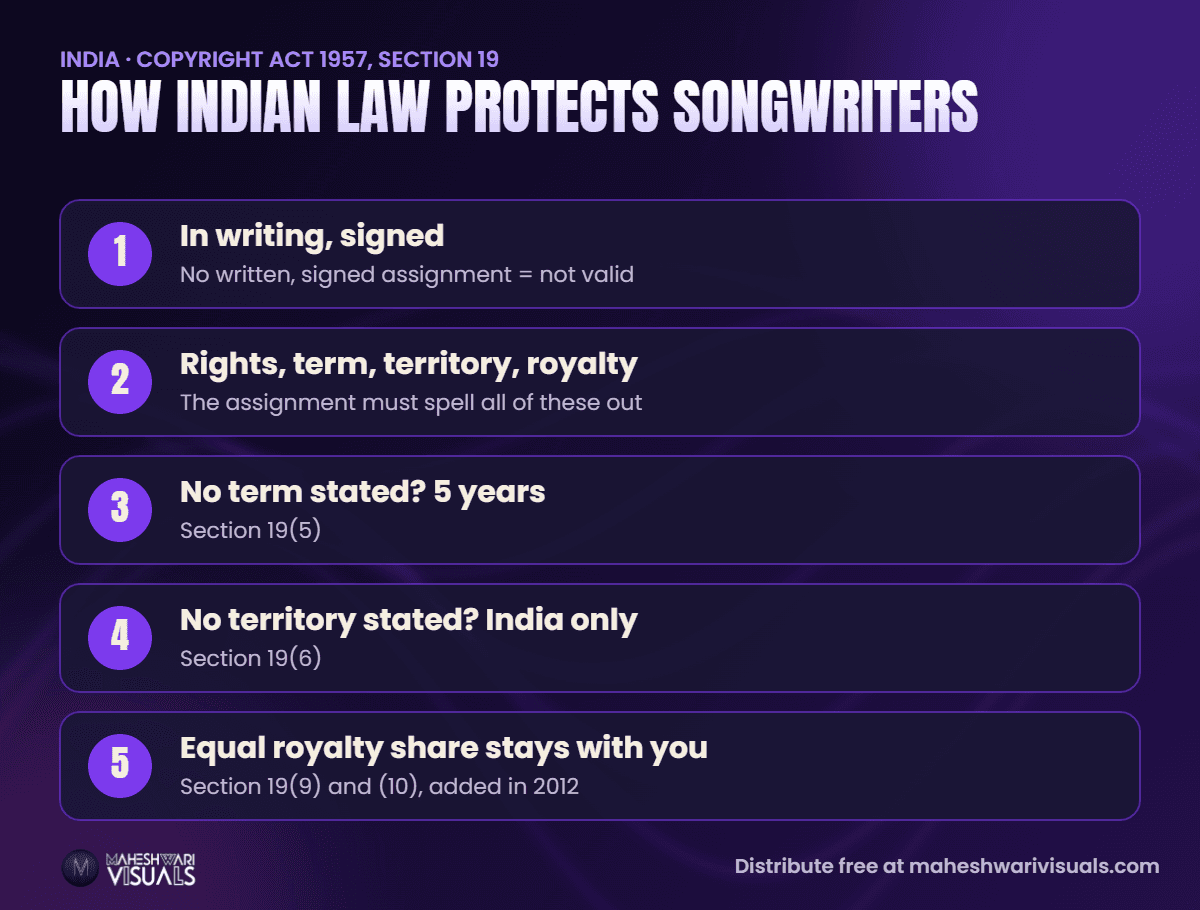
India has no 35-year "take it back" rule like America's, so you can't copy Vetter's exact move here. But the Indian Copyright Act, 1957 already protects writers in ways many independent artists never use. Section 19 sets clear rules for any assignment of copyright:
- It must be in writing and signed by the person giving away the rights.
- It must name the work, the rights being transferred, the duration, the territory and the royalty or other payment.
- If no duration is stated, the assignment is treated as lasting five years.
- If no territory is stated, it is presumed to cover India only.
- If the buyer doesn't use a right within one year, that part of the assignment is deemed to lapse, unless the contract says otherwise.
The royalty share you cannot sign away
The 2012 amendments added sub-sections (9) and (10) to Section 19. When a lyricist or composer assigns a work to make a sound recording (outside a film), they keep the right to claim an equal share of royalties from any use of that recording. For film songs, the same applies to uses other than screening in a cinema hall. In 2023, the Bombay High Court backed these rights in IPRS v. Music Broadcast Ltd, as reported by Bar & Bench. Bodies like IPRS exist to collect this money for writers.
So "worldwide, forever, for a one-time fee" is not something to accept without reading. The law already sets limits, and a good contract should spell out exactly what you are giving and for how long.
5 things to check in your contracts this week
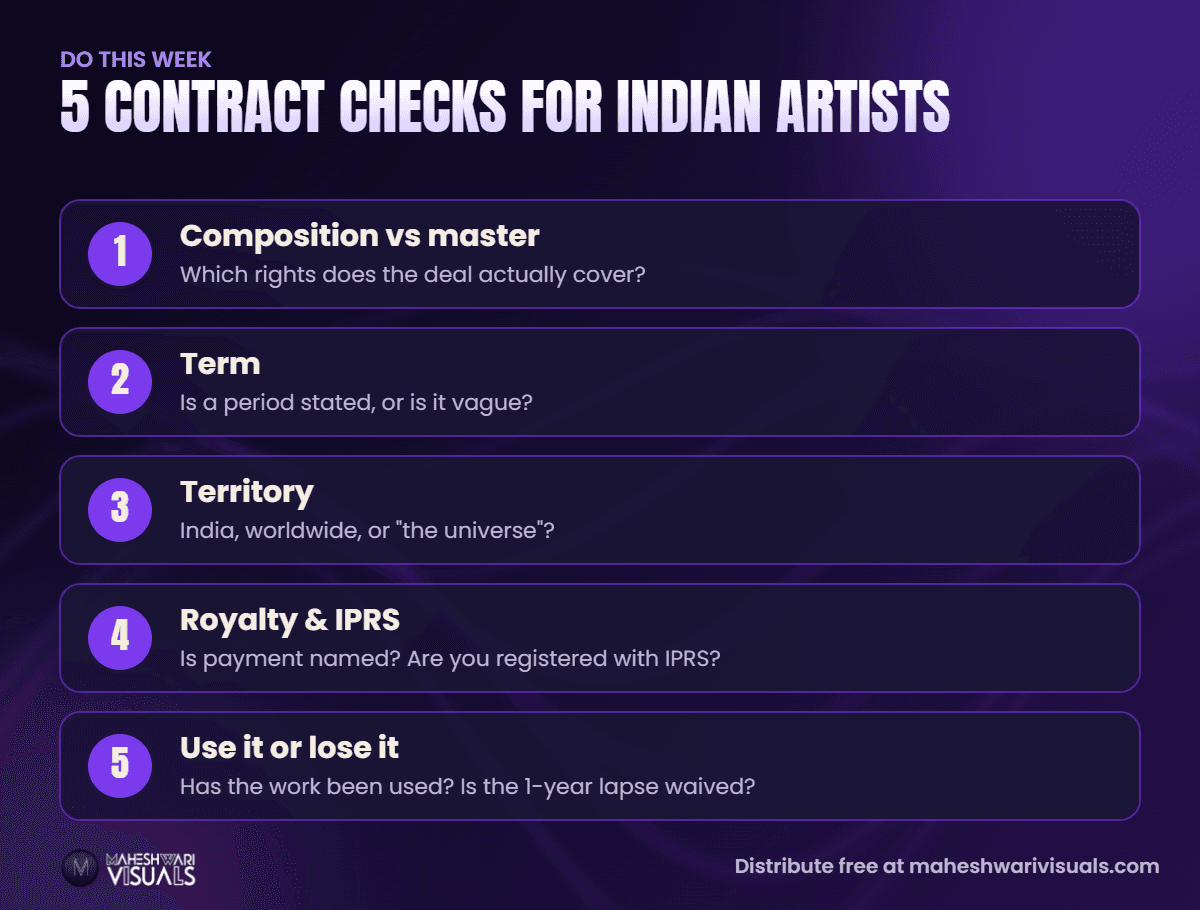
You don't need a lawyer to start. Pull out every agreement you have signed for your songs and look for these points. Then talk to a music lawyer before acting on anything you find.
- Composition vs master: Does the deal cover the song (lyrics and music), the recording, or both? They are separate rights with separate income.
- Term: Is a period stated? A blank or vague term matters under Section 19(5).
- Territory: Does it say "India", "worldwide" or "the universe"? If it says nothing, the default is India.
- Royalty and payment: Is a royalty or fee clearly named, as Section 19(3) requires? Are you registered with IPRS to collect your writer's share?
- Use-it-or-lose-it: Has the rights holder actually used your work? Check whether the contract waives the one-year lapse rule.
Keep a simple rights sheet for every release: writers, splits, who owns the master, contract dates and territory. When a dispute or a sync offer comes, you'll have the answers ready. Our guide on what Warner's lawsuit over unlicensed music teaches Indian artists explains split sheets and master vs composition in more detail.
Where MV Distribution fits in
The easiest way to protect your rights is to never give them away just to get your music heard. With MV Distribution, artists keep 100% of their rights. Your songs go live on 100+ stores, including Spotify, Apple Music, JioSaavn, Amazon Music, YouTube Music and Gaana, usually within 24 hours. Every release gets clean metadata with the correct writer and owner credits, which is the paper trail you'll want if ownership is ever questioned.
You can see what each plan includes on our pricing page. If something in an older deal looks unclear, our human support team replies within 24 hours and can help you understand what your distribution setup covers.
Conclusion
The Vetter case shows three things. Copyright signed away can come back to its writer. The exact words of a contract (term, territory, payment) decide what you actually gave. And Indian law already sets real limits on song assignments, including a royalty share writers cannot sign away.
You don't need a big label or a court case to protect your music. You need clear contracts, organised paperwork and a distribution partner that never asks for your rights. If you're ready to release on your own terms, sign up with Maheshwari Visuals for music distribution and keep every right to the songs you create.
FAQs
What did the US Supreme Court decide in the Double Shot copyright case?
On 19 October 2026, the Court left in place the Fifth Circuit's ruling that songwriter Cyril Vetter's termination returned worldwide rights in "Double Shot (Of My Baby's Love)" to him. Four justices didn't take part, so there was no quorum. The Court didn't rule on the legal question itself.
Can Indian artists take back song rights after 35 years?
No. The US 35-year termination right doesn't exist in Indian law. But Section 19 of the Copyright Act, 1957 says an assignment with no stated duration lasts five years, one with no stated territory covers only India, and unused rights can lapse after one year.
Do lyricists and composers in India still get royalties after assigning a song?
Yes. Since the 2012 amendments, writers keep the right to an equal share of royalties when their work is used in a sound recording, and for film songs when used outside cinema halls. IPRS collects these royalties for its members.
Does MV Distribution take ownership of my music?
No. Artists who distribute with Maheshwari Visuals keep 100% of their rights. We deliver your music to 100+ stores and you stay the owner.
Source: Supreme Court Decides Against Hearing BMG v. Vetter (Digital Music News, 19 October 2026); The Supreme Court and worldwide music copyright termination (Digital Music News, 19 October 2026); Hoodline (19 October 2026); Copyright Act, 1957, Section 19; Bar & Bench (September 2023). This post is general information, not legal advice.
Comments
Related Articles

Producer Sues Sony Over Half-Rate Royalties: What Indian Artists Should Check

Spotify Q3 2026 Results: 788M Listeners, 38% in Rest of World — What It Means for Indian Artists
