
Free always sounds like the smart choice — until it isn't.
When you're an independent artist preparing your first release, the number of distribution options available can feel overwhelming. And right at the top of the decision is a question that trips up almost every emerging artist in India: should I go with a free distributor or pay for distribution?
The honest answer isn't as simple as "free is bad" or "paid is always better." Both models exist for a reason, and both serve different kinds of artists at different stages of their career. What matters is understanding exactly what you are — and aren't — getting with each option, so you can make a decision that protects your music, your royalties, and your long-term growth.
This guide breaks down the real differences between free and paid music distribution — no jargon, no fluff — so you can choose the model that actually fits where you are right now.
What Free Music Distribution Actually Means
When a distributor offers free distribution, it means there is no upfront cost to get your music onto streaming platforms. Platforms like Spotify, Apple Music, JioSaavn, Wynk Music, Gaana, and others are accessible without you spending a rupee at sign-up.
That sounds straightforward. But "free" is rarely without a trade-off, and in music distribution, the trade-off almost always comes from one of two places: your royalties, or your service quality.
The Revenue Share Model
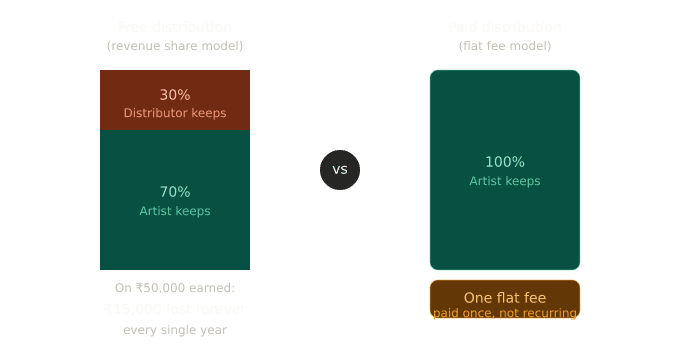
Most free distributors operate on a revenue share model. Instead of charging you upfront, they take a percentage cut of the royalties your music earns. Common splits sit between 15% and 40% depending on the platform, though this varies significantly.
For an artist earning ₹500 a month from streams, a 30% cut might not feel like much. But as your streams grow — across Spotify India, JioSaavn, YouTube Music, and international markets — that percentage compounds into a meaningful amount of money leaving your pocket every single month, indefinitely.
The Freemium Tier Model
Some distributors offer a genuinely free tier with basic functionality and charge for features like priority support, faster release scheduling, detailed analytics, or additional platform coverage. This is a more transparent model, but artists often find themselves needing the paid features fairly quickly once their releases gain traction.
[Image suggestion: Side-by-side comparison graphic of a free distributor royalty split vs a 100% royalty retention model] Alt text: "Infographic comparing free music distribution royalty split versus paid distribution with full royalty retention for Indian artists"
What Paid Music Distribution Offers
Paid distribution models charge a flat fee — either per release or annually — and in exchange, you retain 100% of your royalties. Every rupee your music earns on every platform goes directly to you.
This is the model that most serious independent artists and labels gravitate towards once they understand the long-term maths.
Flat Fee Per Release
You pay once to release a single or album, and that's it. Your music earns without any ongoing deduction. This works well for artists who release music infrequently or want full control over each project without committing to a subscription.
Annual Subscription
Some paid distributors charge a yearly fee that covers unlimited releases. For artists who release consistently throughout the year, this often works out to the best per-release value.
What Paid Distribution Typically Includes That Free Doesn't
- Full royalty retention (100% goes to you)
- ISRC and UPC code assignment included
- Wider platform coverage including regional Indian platforms
- Detailed streaming analytics and royalty reporting
- Priority customer support
- Release scheduling with more lead-time flexibility
- Pitch submissions to editorial playlists on select platforms
[Link: What Is an ISRC Code and Why Does Every Artist Need One? → what-is-isrc-code-why-every-artist-needs-one]
The Real Cost of "Free" Over Time
Let's put some numbers to this — without fabricating figures, but using realistic scenarios.
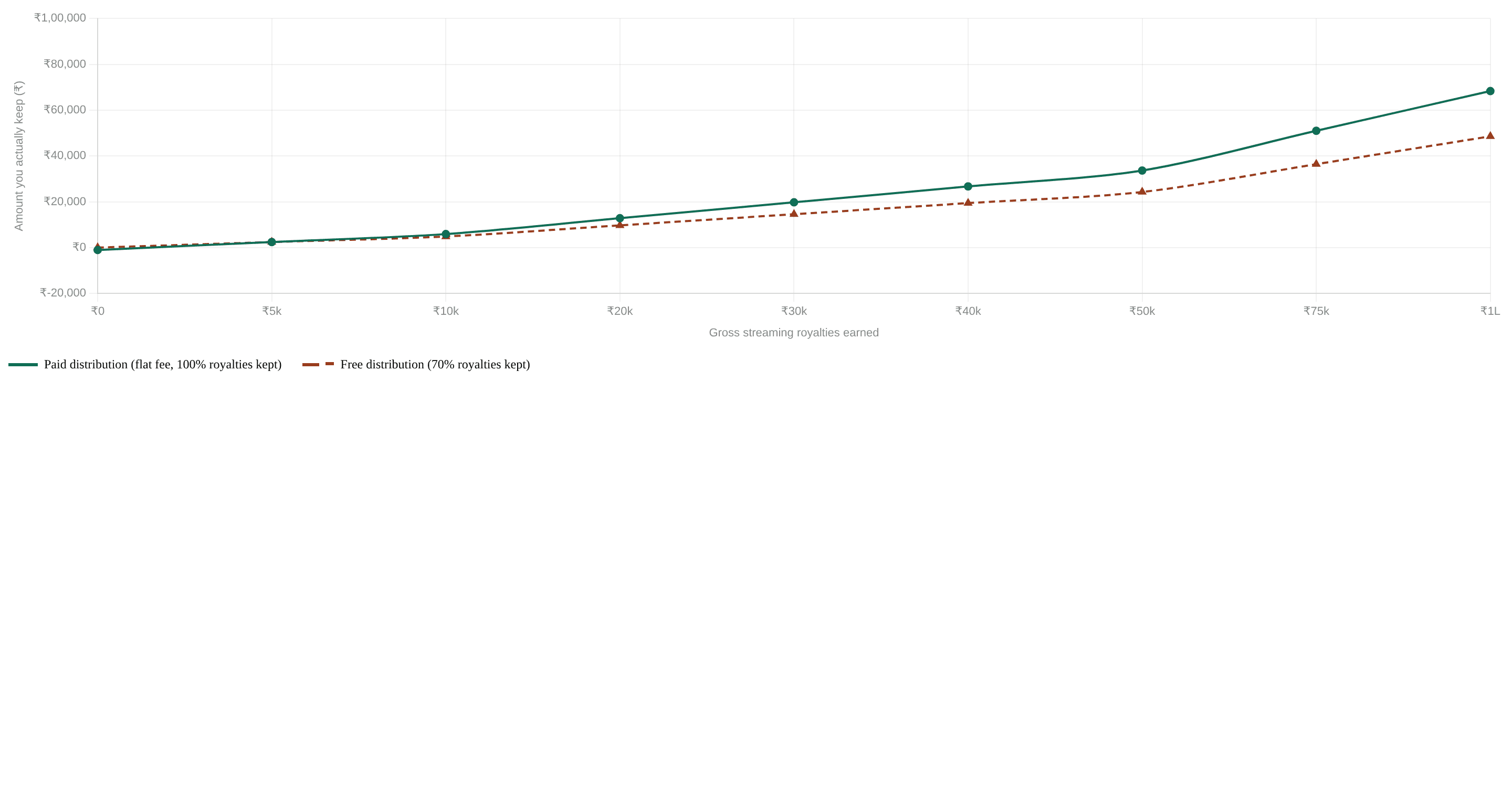
Imagine your catalogue earns ₹10,000 in streaming royalties in a year. A free distributor taking a 30% revenue share means ₹3,000 goes to them. A paid distributor charging ₹1,500 as a flat annual fee means you keep ₹8,500 — and your total outgoing is just ₹1,500 once.
Now imagine your streams grow. At ₹50,000 in annual royalties, that 30% cut becomes ₹15,000 going to the distributor. Your paid flat fee is still ₹1,500.
The crossover point — where paid distribution becomes mathematically more beneficial than free — arrives sooner than most artists expect. And unlike the flat fee, the revenue share never stops. It scales with every success you have.
[Image suggestion: Simple line graph showing royalty earnings under revenue-share vs flat-fee distribution as streams increase over time] Alt text: "Graph showing how paid flat-fee music distribution becomes more cost-effective than free revenue-share distribution as streaming royalties grow"
What to Look for Beyond the Price Tag
Whether you choose free or paid, the price model is only one part of the evaluation. Here are the factors that genuinely matter for Indian independent artists:
Platform Coverage
Does the distributor deliver to Indian platforms — JioSaavn, Wynk Music, Gaana, Hungama, Resso, and YouTube Music India — not just Spotify and Apple Music? A significant portion of streams in India happen on regional platforms, and a distributor that ignores them is leaving real listeners and real royalties behind.
ISRC and UPC Code Assignment
Every legitimate distributor should assign ISRC and UPC codes to your releases. If a free distributor does not include this — or charges extra for it — that is a red flag. These codes are not optional; they are how your royalties get tracked and collected.
Royalty Reporting and Transparency
How clearly does the distributor show you where your streams are coming from and what you've earned? Good reporting matters, especially as you start releasing music more seriously. Opaque dashboards with delayed or unclear royalty breakdowns make it very difficult to understand how your music is actually performing.
Support and Reliability
When something goes wrong — a release gets delayed, a track appears incorrectly on a platform, a takedown happens in error — how responsive is the distributor? Free services often have limited or no direct support. For artists, a bad release window caused by a support failure can mean lost momentum on an important drop.
[Link: How to Schedule a Music Release for Maximum Impact → how-to-schedule-music-release-india]
So Which Model Is Right for You?
There is no universal answer, but here is a practical way to think about it:
Consider free distribution if you are:
- Releasing casually, without a specific career or revenue goal attached
- Testing the waters with your very first release and want zero financial commitment
- Comfortable with the revenue share trade-off at low stream volumes
Consider paid distribution if you are:
- Serious about building a music career and treating releases as a business
- Already earning or expecting to earn meaningful royalties from streams
- Releasing music regularly and want to maximise what you keep from every stream
- Concerned about ownership, ISRC assignment, and long-term rights management
Most artists who start with free distribution eventually switch to paid once they see how the revenue share adds up. Starting on the right foot from your first serious release saves you the hassle of migrating your catalogue later.
At MV Distribution, the focus is on giving independent artists and labels the infrastructure to distribute properly — to 150+ platforms including Indian platforms — with full ISRC assignment and transparent royalty reporting. If you're weighing your options, it's worth understanding exactly what you're getting before you commit to any model.
Conclusion
Three things worth holding on to from this:
First, free distribution is not inherently bad — but the revenue share model means your distributor earns more as you earn more. That trade-off works for casual releases, but becomes costly for artists who are serious about growing their income from music.
Second, the real comparison isn't about price upfront — it's about what percentage of your royalties you keep over the full life of your catalogue. Flat-fee paid distribution almost always wins that calculation once your streams reach meaningful volume.
Third, platform coverage, ISRC assignment, royalty transparency, and support quality matter just as much as cost. A distributor that saves you money upfront but fails on these fundamentals can cost you far more in lost royalties and missed opportunities.
Your music is worth distributing properly. If you're ready to make your next release count, MV Distribution is built for exactly that.
Frequently Asked Questions
Is free music distribution really free? It depends on the model. Some free distributors take a percentage of your royalties — typically 15%–40% — instead of charging upfront. Others offer a genuinely free basic tier but charge for important features. Always read the royalty terms carefully before choosing a distributor.
Do free distributors give you 100% of your royalties? Not typically. Most free distribution services retain a share of your streaming royalties as their fee. Paid distributors generally offer 100% royalty retention in exchange for a flat upfront fee.
Which platforms do Indian music distributors cover? Coverage varies significantly. Look for a distributor that includes Indian platforms — JioSaavn, Wynk Music, Gaana, Hungama, Resso, and YouTube Music India — alongside global platforms like Spotify, Apple Music, and Amazon Music. Many free distributors focus primarily on Western platforms and have limited Indian platform reach.
Can I switch from a free to a paid distributor later? Yes, but it involves taking your existing releases down and re-uploading them through the new distributor, which can result in loss of streaming history, playlist placements, and algorithm momentum. It's better to choose the right distributor from the start than to migrate an established catalogue.
Does my distributor own my music? No legitimate distributor — free or paid — should claim ownership of your recordings. Your music is yours. However, always read the terms of service carefully. Some free distributors include licensing clauses that grant them broader usage rights than artists realise. If in doubt, ask your distributor directly before signing up.
Comments
Related Articles

Deezer's New AI Music Filter: What It Means for Indian Independent Artists

Warner Music Sues Ray-Ban Owner Over Unlicensed Music on Social Media: What Indian Artists Should Learn
