
A festival that sells out in minutes has just gone to court over T-shirts. On Tuesday, 24 November 2026, Coachella and its organiser Goldenvoice sued Walmart in a US federal court, accusing the retail giant of selling unlicensed Coachella merch — tees, sweatshirts, mugs and more — for close to a decade. For Indian independent artists, the Coachella Walmart merch lawsuit is a sharp reminder: the moment your name starts selling, someone else may try to sell it too.
This explainer covers what Coachella says happened, why brand owners fight fake merch so hard, and the practical steps you can take in India to protect your artist merch before it becomes a problem. If you'd rather not run a merch business yourself, we'll also show how Music Merch Company keeps your official merch in one trusted place.
What happened: Coachella vs Walmart
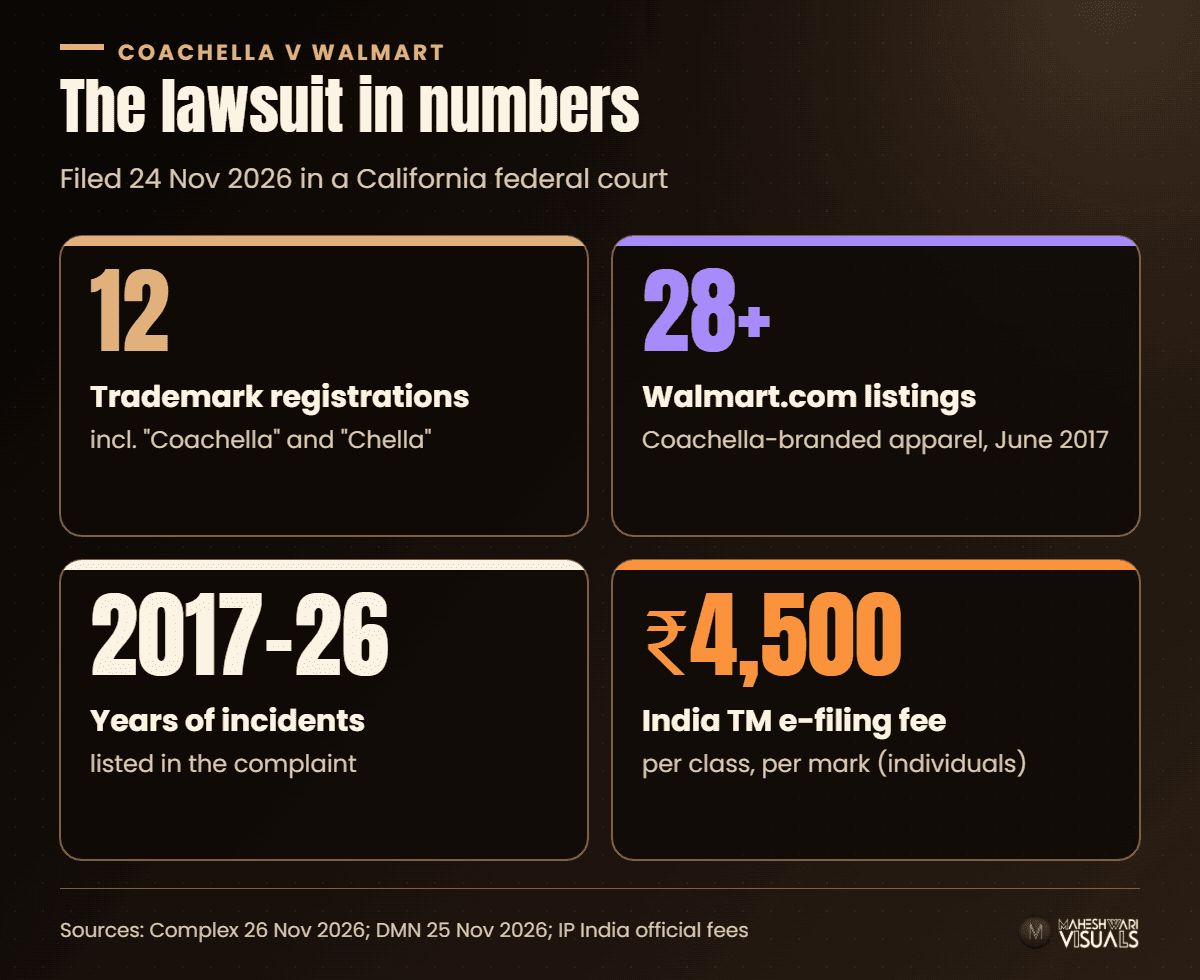
According to Digital Music News (25 November 2026) and Complex (26 November 2026), Coachella Music Festival LLC and Goldenvoice filed a complaint of roughly 28–30 pages against Walmart Inc. and its e-commerce arm in the US District Court for the Central District of California.
The festival says Walmart "sold, and allowed others to sell" goods carrying Coachella trademarks. Complex reports the complaint cites 12 trademark registrations — including "Coachella" and "Chella" — plus the festival's look, such as its Ferris wheel and palm-tree silhouettes.
The filing lists a long history, as reported by both outlets:
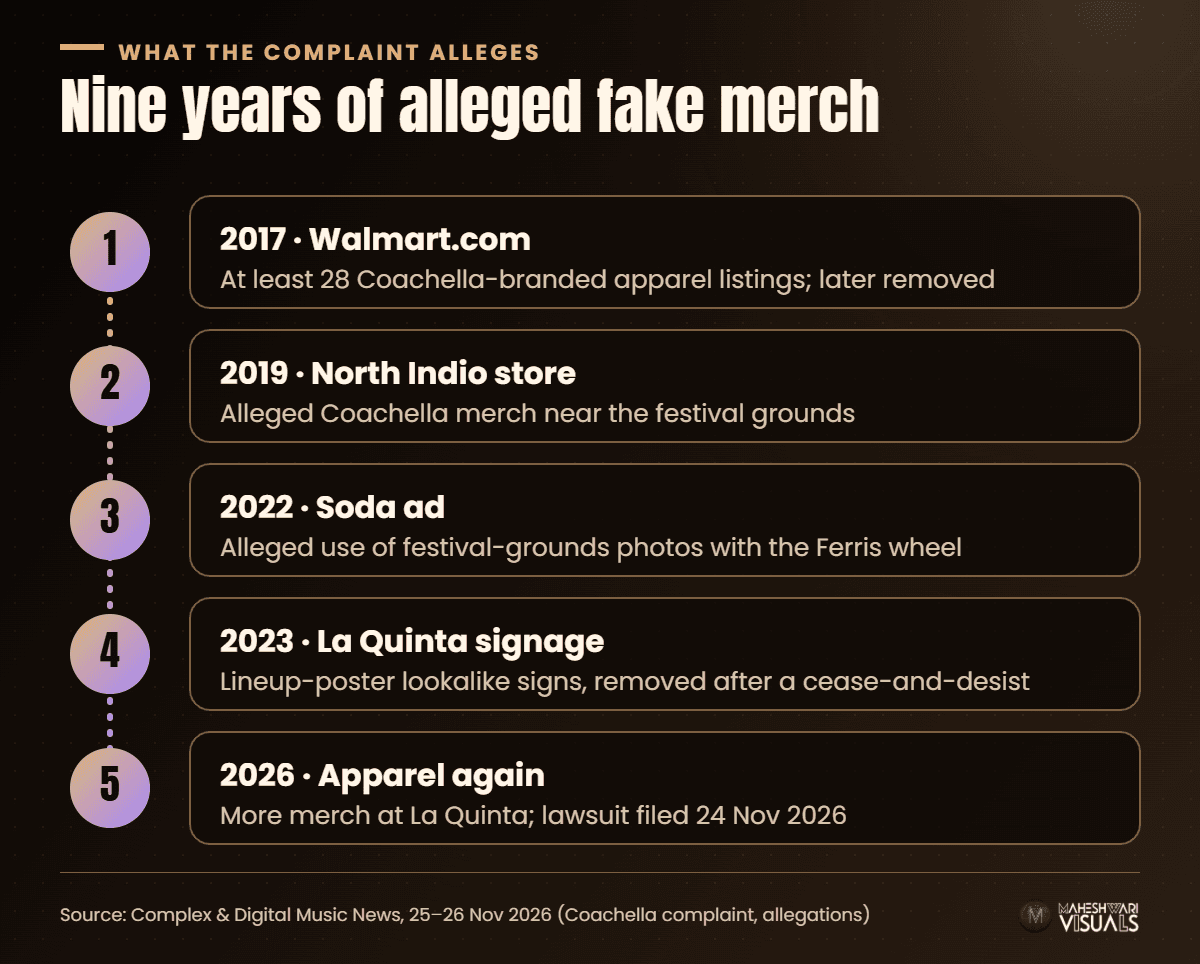
- 2017: Walmart.com listed at least 28 Coachella-branded apparel items (Complex), which were later removed.
- 2019: Alleged Coachella merch at Walmart's North Indio store, near the festival grounds.
- 2022: A soda ad that allegedly used photos of the festival grounds and its Ferris wheel.
- 2023: Store signage in La Quinta that allegedly copied lineup-poster designs, taken down after a cease-and-desist letter.
- 2026: More apparel at the La Quinta store, displayed near a Ferris-wheel sign.
Coachella is asking for damages, Walmart's profits, corrective-advertising costs and court orders to stop the sales. The complaint calls Walmart a "serial infringer". Walmart told DMN it will "respond appropriately in Court" once served. These are allegations; nothing has been decided yet.
Why this matters for Indian artists' merch
Coachella's case shows something every artist eventually learns: a name that fans love is a valuable asset — and a target. Fake merch hurts in three ways.
It takes money out of your pocket
Every unofficial T-shirt sold outside your show or on a marketplace is a sale you didn't make. For independent artists, merch is often one of the few income streams with healthy margins, so leakage hurts more than it does for a big festival.
It damages fan trust
Fans who buy a faded print or a shirt that shrinks after one wash often blame the artist, not the seller. Bad quality attached to your name can make fans hesitate before your next drop.
Waiting makes it harder
Notice how Coachella's complaint stacks up years of incidents. Brand owners keep records because a pattern helps their case. If you ignore copies today, you may struggle later to show when the problem started — and how often it happened.
How to protect your artist merch in India
You don't need a festival-sized legal team to start. These steps cost little but put you in a far stronger position. (This is general information, not legal advice — talk to a trademark attorney for your situation.)
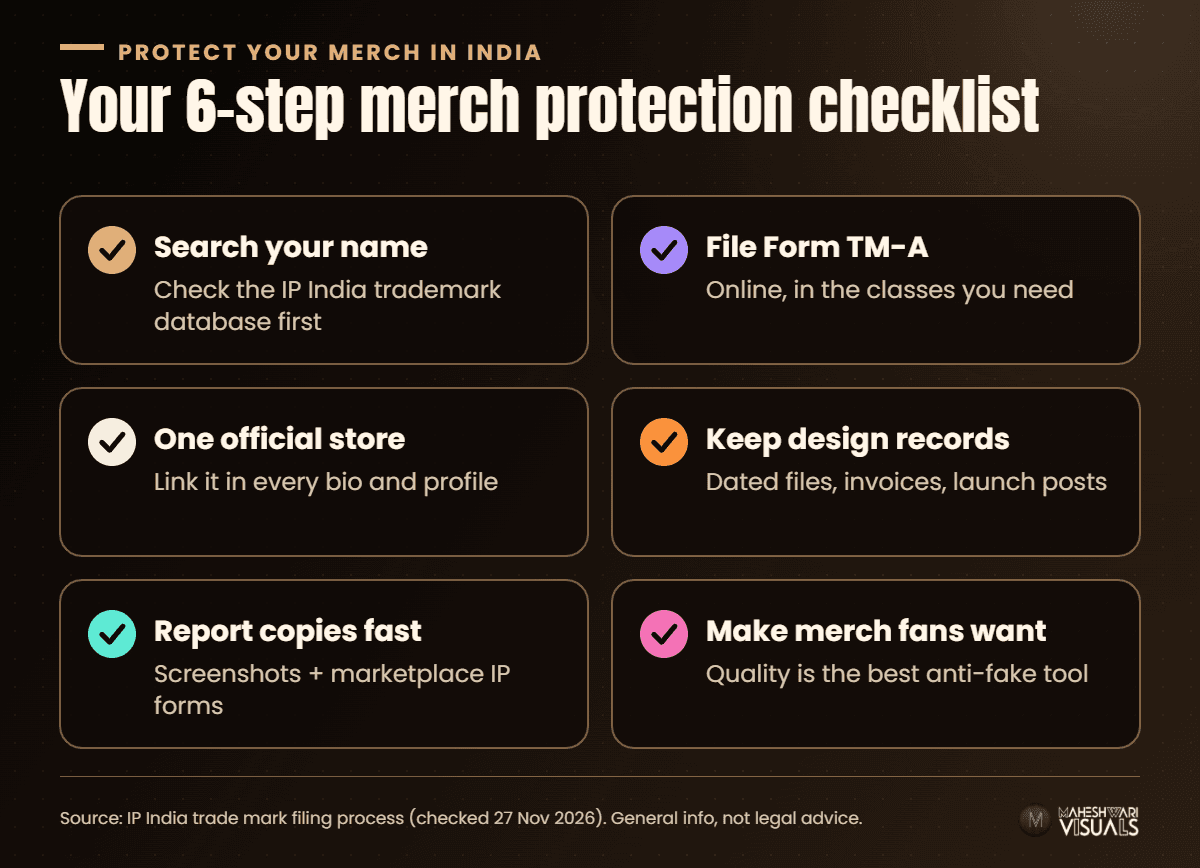
1. Check and file a trademark for your artist name
Coachella's case leans on its registered marks. In India, trademarks are filed with the Trade Marks Registry through IP India. The official IP India filing process starts with a search to check your name isn't already taken, then class selection, then Form TM-A filed online.
The official fee schedule lists ₹4,500 for e-filing (₹5,000 on paper) when the applicant is an individual, startup or small enterprise, and ₹9,000 (₹10,000 on paper) in other cases. The fee is charged for each class and each mark — so pick classes carefully. Clothing and accessories sit in a different class from music recordings and live shows, so ask your attorney which ones fit your plans.
After examination, your mark is published in the Trade Marks Journal, and IP India says third parties can oppose it within four months.
2. Use one official store and say so everywhere
Make it easy for fans to know what's real. Link one official merch store in your Instagram bio, YouTube channel, Spotify and JioSaavn artist profiles, and your fan link page. A line like "Only our official store sells genuine merch" goes a long way.
3. Keep a record of every design
Save dated design files, printer invoices and launch posts. If a copy turns up, this paper trail shows the design is yours and when you first used it.
4. Report copies quickly
Most online marketplaces have intellectual-property reporting forms. Take screenshots, note the seller name and date, and file a report. For repeat or large-scale copying, a lawyer's cease-and-desist letter — like the one Coachella sent in 2023 — is often the next step.
How MV helps you sell real merch — without the hassle
Protecting merch is easier when your official merch is easy to find and good enough that fans want it. That's where Music Merch Company comes in. We handle the store, inventory, warehousing, order fulfilment and shipping on your behalf — you don't invest in stock or run a warehouse, and you earn a commission on every item sold.
We walk through applying for your own merch store in our MV Dashboard tutorial below.

▶ Watch on YouTube: Merch Store Kaise Apply Karein? | Sell Your Own T-Shirts, Hoodies & Mugs | MV Dashboard
Merch works best when your music keeps reaching new fans. With MV Distribution, your releases go to 100+ stores including Spotify, Apple Music, JioSaavn, Amazon Music, YouTube Music and Gaana, usually live within 24 hours, and you keep 100% of your rights. Want the bigger picture on why merch matters? Read our posts on why every artist needs a merchandise line and Sony Music's record merch and live growth.
Conclusion: protect your name before it's copied
The Coachella Walmart merch lawsuit is still at an early stage, but its lesson for artists is already clear. First, your name is a brand — a trademark search and filing in the right classes is the foundation. Second, a single, well-promoted official store protects fans from fakes and protects your income. Third, records and quick reporting turn a messy dispute into a clear case.
You don't need to be a festival to think like one. Build the music, build the name, and let the right partners handle the heavy lifting. Ready to release your next song to 100+ stores and grow the fanbase that buys your merch? Sign up for MV Distribution for free and start today.
FAQs
Why did Coachella sue Walmart?
Coachella and Goldenvoice say Walmart sold, and allowed others to sell, unlicensed merch carrying Coachella trademarks, with incidents going back to 2017. The complaint was filed on 24 November 2026 in a California federal court. Walmart says it will respond in court.
How do I trademark my artist name in India?
Search the IP India trademark database, choose the right classes, and file Form TM-A online through the IP India e-filing portal. Your application is examined and then published in the Trade Marks Journal, where others can oppose it within four months. A trademark attorney can help with classes and objections.
How much does a trademark cost in India for an artist?
IP India's official fee for e-filing is ₹4,500 per class, per mark, for individuals, startups and small enterprises (₹5,000 for physical filing). Other applicants pay ₹9,000 for e-filing. Attorney fees, if you use one, are extra.
What should I do if someone sells fake merch with my name?
Collect screenshots, links, seller details and dates, then use the marketplace's intellectual-property report form. Tell fans where your official store is. For repeated copying, speak to a lawyer about a cease-and-desist letter or other action.
Can I sell artist merch without buying stock?
Yes. With Music Merch Company, the store, inventory, warehousing and shipping are handled for you, and you earn a commission on every sale — no upfront stock or warehouse needed.
Sources: Digital Music News, "Coachella Slaps 'Serial Infringer' Walmart With Trademark Action Over Unauthorized Merch" (25 November 2026) — digitalmusicnews.com; Complex, "Coachella Takes Walmart to Court Over Unauthorized Festival Merch" (26 November 2026) — complex.com; IP India trade mark filing process and official fees (checked 27 November 2026) — ipindia.gov.in.
Comments
Related Articles

Roblox Signs Music Licensing Deal with PRS for Music: What It Means for Indian Songwriters

1 Billion Music Subscribers by 2028: What UMG's Forecast Means for Indian Artists
