
Streaming has made music more accessible than at any point in history. A listener in Pune can discover a folk artist from Himachal Pradesh and stream their album ten times in a week without spending a single rupee. That's genuinely beautiful — and genuinely terrible for the artist's income at the same time.
The economics of streaming are brutal for independent musicians. A single stream on most platforms pays a fraction of a paise. Building a meaningful income purely from streaming royalties, for an artist without millions of monthly listeners, is a slow and often discouraging journey.
But there is a revenue stream that most independent artists in India are sitting on without realising it — one that doesn't require millions of streams, doesn't depend on algorithm favour, and pays out in amounts that actually feel like money. That stream is merchandise.
This is not a guide about selling T-shirts to die-hard fans at a concert hall. It's about understanding why artist merch works, why the timing has never been better for independent musicians in India, and how you can launch a merch line without spending a single rupee upfront.
Why Streaming Alone Is Not a Business Model
Let's be honest about the numbers — not to discourage you, but because clarity is the first step to building something real.
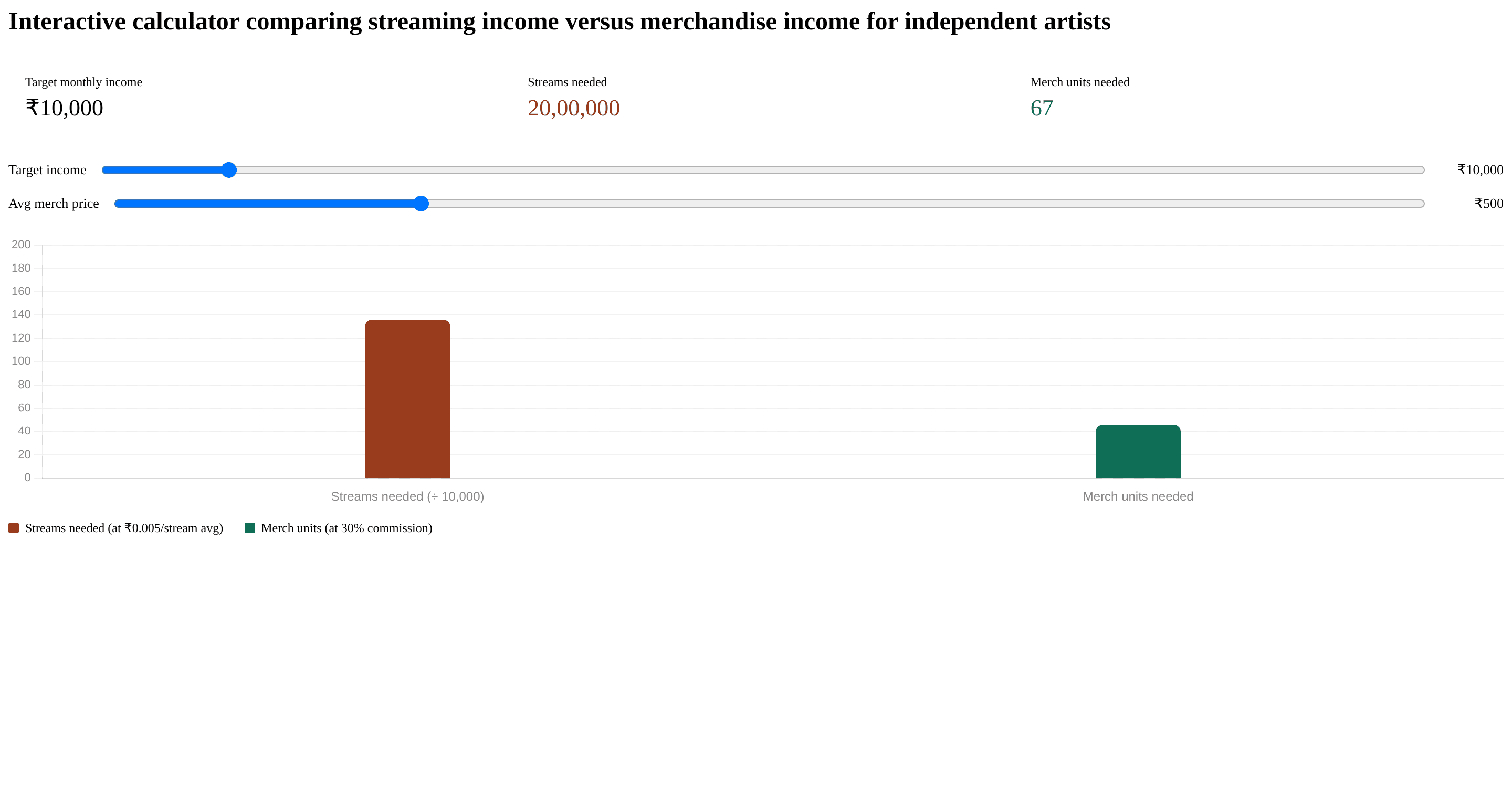
The average per-stream payout across major platforms sits somewhere between ₹0.003 and ₹0.007, depending on the platform, the listener's country, and the subscription tier. To earn ₹10,000 from streaming royalties alone, you would need roughly 1.5 to 3 million streams. In a single month.
For an established artist with a large following, that's achievable. For an independent artist building their catalogue and audience — which describes the vast majority of musicians in India — it's not a realistic monthly income target.
This isn't a criticism of streaming. Streaming is how people discover your music, how your audience grows, and how your catalogue builds long-term value. But it is not, for most independent artists, where you pay your rent.
The artists who build sustainable independent careers treat streaming as a discovery and catalogue engine — and monetise their audience through channels with better unit economics. Merchandise is the most natural, most scalable, and most brand-building of those channels.
[Image suggestion: Independent Indian artist wearing their own branded hoodie, casual setting, natural light] Alt text: "Independent Indian musician wearing custom branded artist merchandise hoodie"
What Artist Merchandise Actually Does for Your Career
Merch is not just a revenue stream. It's a brand-building tool, a community signal, and a physical extension of your music — all at once.
It turns listeners into visible supporters
When a fan buys your T-shirt, cap, or hoodie, they are not just spending money on fabric. They are publicly declaring their connection to your music. Every time they wear it, they become a walking ambassador for your name. This kind of organic visibility — your brand appearing in streets, colleges, gyms, and Instagram stories — is earned media that no ad budget can fully replicate.
It strengthens the artist-fan relationship
The fan who owns your merch has a tangible piece of your world. That physical connection deepens loyalty in ways that streaming cannot. A listener who streams your music has a passive relationship with your work. A fan who owns your hoodie has an active, personal one. Merch is one of the most powerful tools for converting casual listeners into genuine, long-term supporters.
It provides income that doesn't expire
A stream pays out once. A piece of merch, sold at the right price, can generate a meaningful return that covers creative costs, funds your next recording, or simply gives you breathing room as an independent artist. And unlike streaming royalties — which are tied to platform algorithms and playlist placements — merch sales are driven by your community, which you own and control.
[Link: How Independent Artists Can Build Multiple Revenue Streams in India → how-independent-artists-build-multiple-revenue-streams-india]
The Myth That Stops Most Artists from Starting
Here is the most common reason independent artists in India don't have a merch line: "I'd need to buy stock upfront, handle orders, deal with shipping, manage inventory — I don't have the time or money for that."
This was a legitimate barrier a decade ago. It is not anymore.
The traditional merch model — ordering 100 T-shirts in bulk, warehousing them, packing orders yourself, and hoping you don't end up with 60 unsold units — is not the only model. It hasn't been for years. And for independent artists, it is not the right model at all.
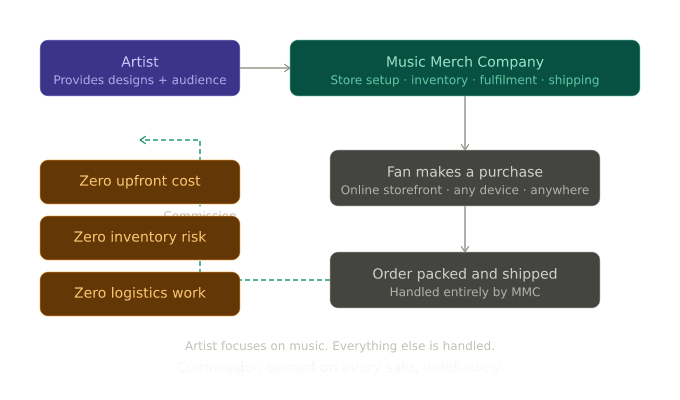
The smarter model is commission-based: a merch partner handles the store setup, inventory, warehousing, fulfilment, and shipping entirely on your behalf. You provide the designs and the audience. Every time something sells, you earn a commission. No upfront cost. No warehouse. No logistics headache. No risk of holding unsold stock.
This is exactly how Music Merch Company works. Artists and labels don't need to set up their own store, purchase inventory, or manage a single order. The entire operation is handled — from storefront to doorstep. You focus on making music. They handle everything else.
What Merch Actually Sells for Independent Artists
You don't need to be playing arenas for merch to work. You need two things: an engaged audience, even a small one, and products that genuinely connect with your identity as an artist.
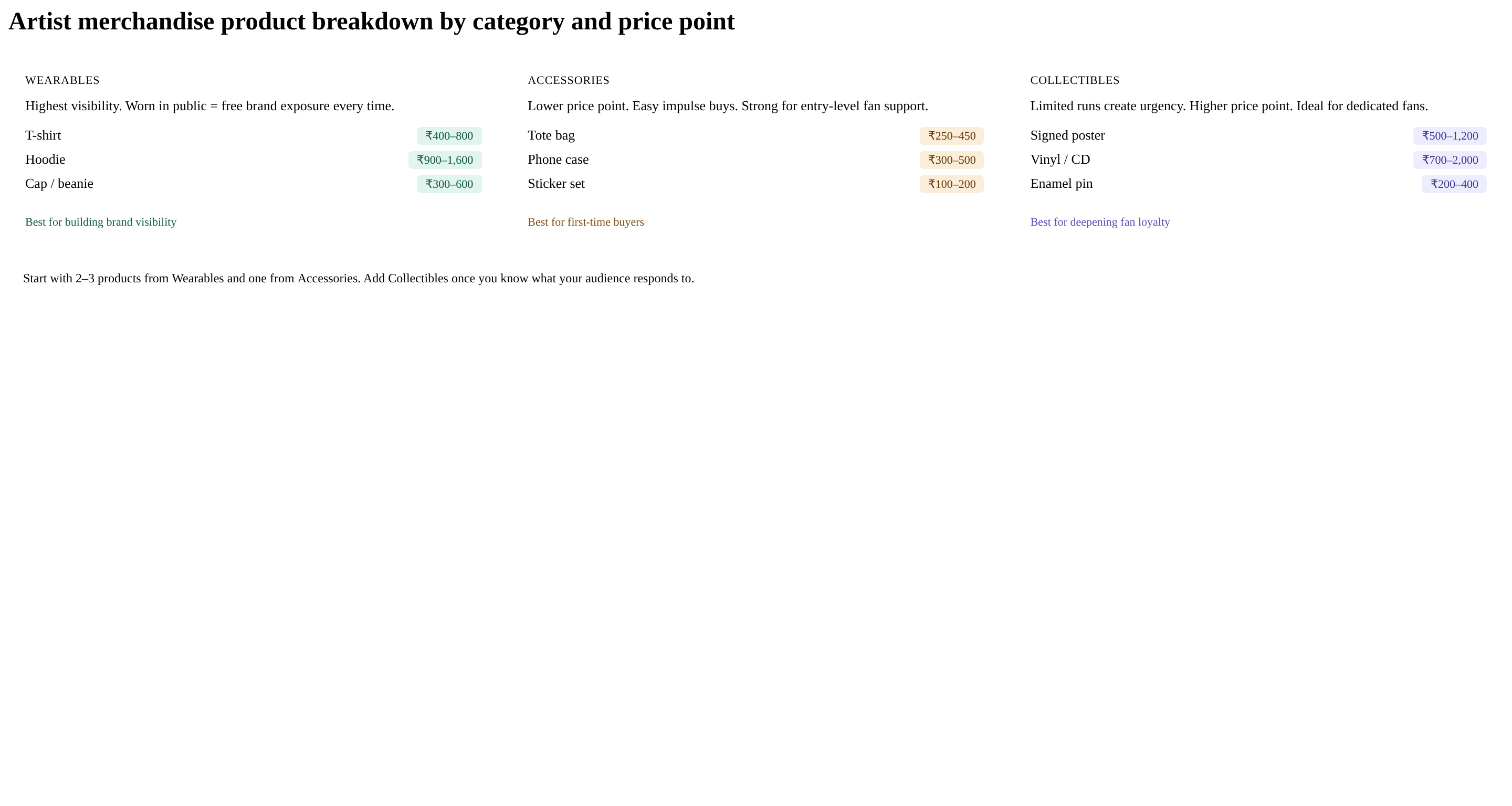
Here are the categories that consistently perform well for independent musicians:
Wearables
T-shirts and hoodies are the foundation of any artist merch line. They are the products fans are most likely to buy and most likely to wear publicly. For independent artists, a clean logo or artwork-driven design on a quality fabric often outperforms complicated graphic-heavy pieces. The simpler and more wearable, the more it gets worn — and therefore seen.
Caps and beanies work well for artists with a strong visual identity, particularly in genres where streetwear aesthetics are central — hip hop, trap, indie pop, and electronic music.
Accessories and collectibles
Tote bags, phone cases, stickers, and enamel pins have lower price points and serve as entry-level purchases for fans who want to support you without the commitment of buying a hoodie. They are also impulse buys — which matters for online stores.
For artists with a dedicated fanbase, limited-run items — numbered prints, signed posters, or exclusive vinyl — create urgency and can command significantly higher price points. Scarcity drives desire.
Regionally relevant products
India has a strong culture around certain products that translate naturally into artist merch — branded notebooks, phone accessories, and traditional-format posters carry well in specific markets. Bhojpuri artists, for instance, often find strong merch demand around festival periods and concert seasons in their home regions. Understanding when and where your audience concentrates helps time merch drops for maximum impact.
[Image suggestion: Flat-lay of artist merchandise items — T-shirt, tote bag, cap, and sticker set — arranged neatly with a music album cover visible] Alt text: "Artist merchandise flat lay including branded T-shirt, cap, tote bag, and stickers for an independent musician's merch line"
When Is the Right Time to Start?
The most common mistake is waiting. Artists tend to think: "I'll launch merch once I have more followers" or "once I have a hit song" or "once I feel established enough."
The right time is earlier than you think — and the reason is compound growth.
Every fan who buys your merch at 5,000 monthly listeners becomes a long-term advocate. Their loyalty runs deeper than the fan who discovers you at 500,000 monthly listeners, because they were there before it was obvious. Merch sold at the early stages of an artist's career carries disproportionate emotional value — both for the fan who buys it and for the artist who receives that signal of genuine support.
There is also a practical argument: launching a merch line before your career peaks means you've figured out the process, tested what sells, and built an operational rhythm before the stakes are highest. When a song breaks, you want merch ready to capture that moment — not scrambling to set it up in the middle of a viral week.
Starting lean — with two or three core products that represent your identity — is the right approach. You don't need a full catalogue. You need something real, something yours, available when fans are looking for a way to support you.
Conclusion
Three things to carry forward from this:
First, streaming royalties and merch revenue are not in competition — they serve different roles. Streaming builds your audience and your catalogue. Merch converts that audience into income, community, and brand equity. Both matter, but only one pays meaningfully at small to medium listener counts.
Second, the logistical barrier to launching artist merch no longer exists for artists who use the right partner. You don't need to buy stock, manage a warehouse, or pack a single order. The commission-based model exists precisely to remove that burden — so that making music and selling merch aren't in conflict.
Third, starting early is an advantage, not a risk. The artists who build merch into their career from the beginning create a habit of community and commerce that compounds over time. Waiting for the "right moment" usually means missing the best one.
If you're ready to launch a merch line without upfront investment or operational complexity, Music Merch Company handles everything — store setup, inventory, fulfilment, shipping — so you can focus entirely on your music.
Frequently Asked Questions
Do I need a big fanbase to sell artist merch? Not at all. Even a small, genuinely engaged audience can support a merch line. A few hundred loyal fans willing to buy a T-shirt or a tote bag is more than enough to make merch worthwhile — both financially and as a community-building tool. The size of your audience matters less than the depth of their connection to your music.
How does commission-based merch work? In a commission-based model, your merch partner handles the product sourcing, store setup, inventory, order fulfilment, and shipping. When a fan purchases an item, the partner deducts their costs and fees, and you receive a commission on each sale. You bear no upfront inventory cost and no warehouse or logistics risk. Music Merch Company operates on exactly this model.
What merch products should I start with? Start with two or three products that reflect your identity as an artist and have broad appeal — typically a T-shirt and one other item (hoodie, tote bag, or cap). Avoid over-complicating your first launch. It's better to sell out of two great products than to spread attention across ten mediocre ones. Add more products once you understand what your audience responds to.
Can I sell merch without playing live shows? Absolutely. Online merch stores operate independently of your live performance schedule. Social media, especially Instagram and YouTube, is where most independent artists in India drive their merch traffic — posting product shots, wearing items in content, and linking directly to the store. A strong online presence is more than enough to sustain a merch line without relying on live shows.
Will my fans in smaller cities actually buy merch online? Yes — and in larger numbers than most artists expect. E-commerce adoption across India has grown dramatically in Tier 2 and Tier 3 cities over the past several years. Fans who discover you through JioSaavn, YouTube, or Instagram are comfortable with online purchases. A well-promoted merch launch reaches them regardless of geography.
