
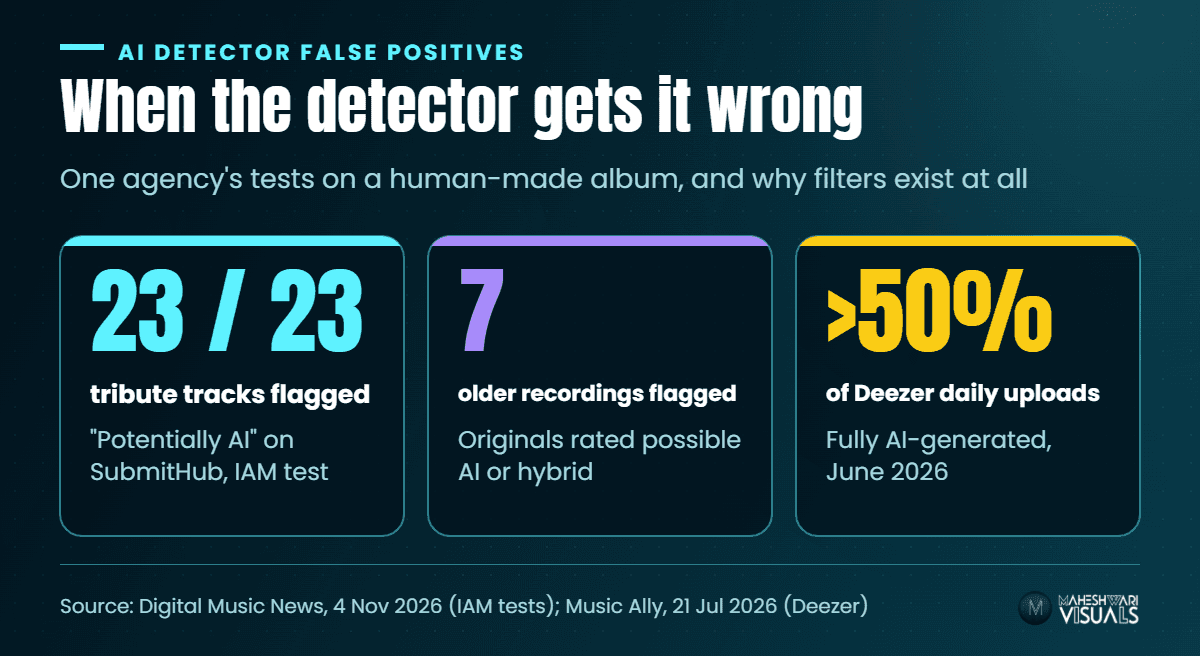
Picture recording every part of an album yourself, then watching a software tool rate all 23 tracks as potentially AI-generated. According to a Digital Music News report published on 4 November 2026, that is what happened to Hamburg musician André Grafert. The same round of testing went further: original recordings from the early 1980s, made decades before today's AI music tools existed, were flagged too.
AI detector false positives are no longer a small technical glitch. As streaming services and distributors tighten their filters against AI spam, a wrong flag can become a real problem for a human artist. And independent artists, without a label's legal team behind them, have the least room to absorb it.
This guide explains what happened, why detectors get it wrong, and what Indian independent artists can do today so a false flag never stalls a release.
What happened: AI detector false positives hit a human-made album
Grafert released DECAY / TIME, a 23-track tribute to the Swedish post-punk band Twice a Man, in June 2026. He says he played, programmed, sang and produced it himself, without generative AI.
Ines Weidemann of the agency International Artist Marketing (IAM) ran the album through SubmitHub, which rated all 23 tracks as potentially AI-generated. Other tools, including Let's Submit, TrackVerifier and ACRCloud, were reported to classify the tracks mostly as AI as well.
Then came the striking part. Weidemann tested Twice a Man's own older recordings, and SubmitHub rated seven of them as possible AI or hybrid. Two were even matched to named AI platforms, including a song from 1982.
A note of caution: these are IAM's own tests, not an independent audit, and the no-AI statement is Grafert's own. But Vice's follow-up on 5 November reports that electronic music, darkwave and post-punk have been flagged in this wave, so the concern goes beyond one album.
Why AI music detectors get it wrong
Detectors exist for a real reason. Deezer said in July 2026 that fully AI-generated tracks had crossed half of its daily uploads, so platforms are under serious pressure to filter. We covered one response in our piece on Deezer's AI music filter.
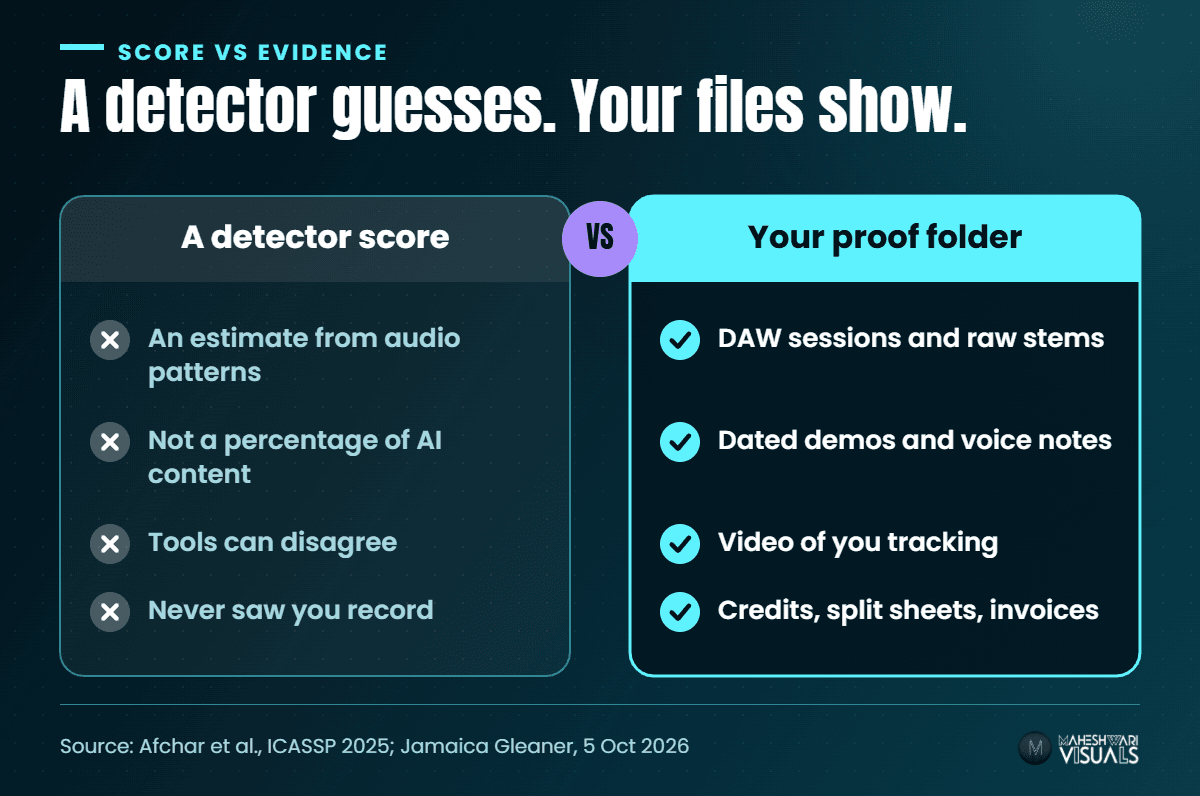
The catch is what a detector actually does. It does not watch you record. It looks for patterns in the audio and gives an estimate. Deezer's own researchers reported 99.8% accuracy on their test data, yet their 2025 paper warns that a good score is not the end of the story. They say a model's output should not be read as a "percentage of AI content". They also found performance fell sharply after pitch shifts, added noise or re-encoding, which shows how fragile these systems can be.
So a figure like "89% AI" is not a measure of how much of your song a machine wrote. It is a tool's best guess, and different tools can disagree.
Digital Music News also points to a recent study suggesting detectors may lean on technical traits such as sample rate and bitrate. It doesn't name the study, so treat that as a lead rather than a settled finding.
What a false flag can actually cost you
This isn't only about a score on a website. IAM warns that false positives can lead to blocked accounts, stopped releases and withheld royalties.
There is already a real example. The Jamaica Gleaner reported in October that veteran reggae artist Papa Michigan had a track rejected by his distribution platform over suspected generative AI. He appealed, calling it a fully human studio recording, and the album came out. The lawyer quoted in that piece, Evon Mullings, says these false positives are becoming more common.
Mullings also says fully quantised drums or heavy Auto-Tune can trigger filters. That is one lawyer's view, not a tested rule, but it is worth knowing in India, where programmed beats and tuned vocals are everyday tools across Punjabi, Bhojpuri and Hindi pop. Please don't change your sound to please a detector. Just be ready to show how you made it.
How Indian independent artists can protect their releases
The best time to prepare is before anyone asks. Proof you collect while recording costs almost nothing. Rebuilding it later can be hard or impossible.
Build your proof while you record
Keep your project in one dated folder per song, whether you work in a big Mumbai studio or from a bedroom setup in Patna or Ludhiana:
- Session files and stems: your DAW project, raw vocal takes and individual stems, with original dates left intact.
- Screenshots and video: a clear DAW screenshot, plus a short phone video of you tracking a part.
- Early versions: voice notes, rough demos and lyric drafts.
- People and paperwork: credits, split sheets, and studio or session-musician invoices.
Be honest about any AI you did use
Using AI for part of a song is not the same as a fully generated track, and platforms increasingly ask you to say which it is. YouTube Music, for example, now has declarations for fully, partly or no generative AI. Declare accurately. Honest metadata protects you far better than hoping nobody checks.
Don't test-and-panic
Free online detectors can be useful for curiosity, but a high score isn't a verdict. Don't remaster or re-upload a song just to lower a number, because repeated uploads create their own problems. Save your energy for the evidence.
If your track gets flagged
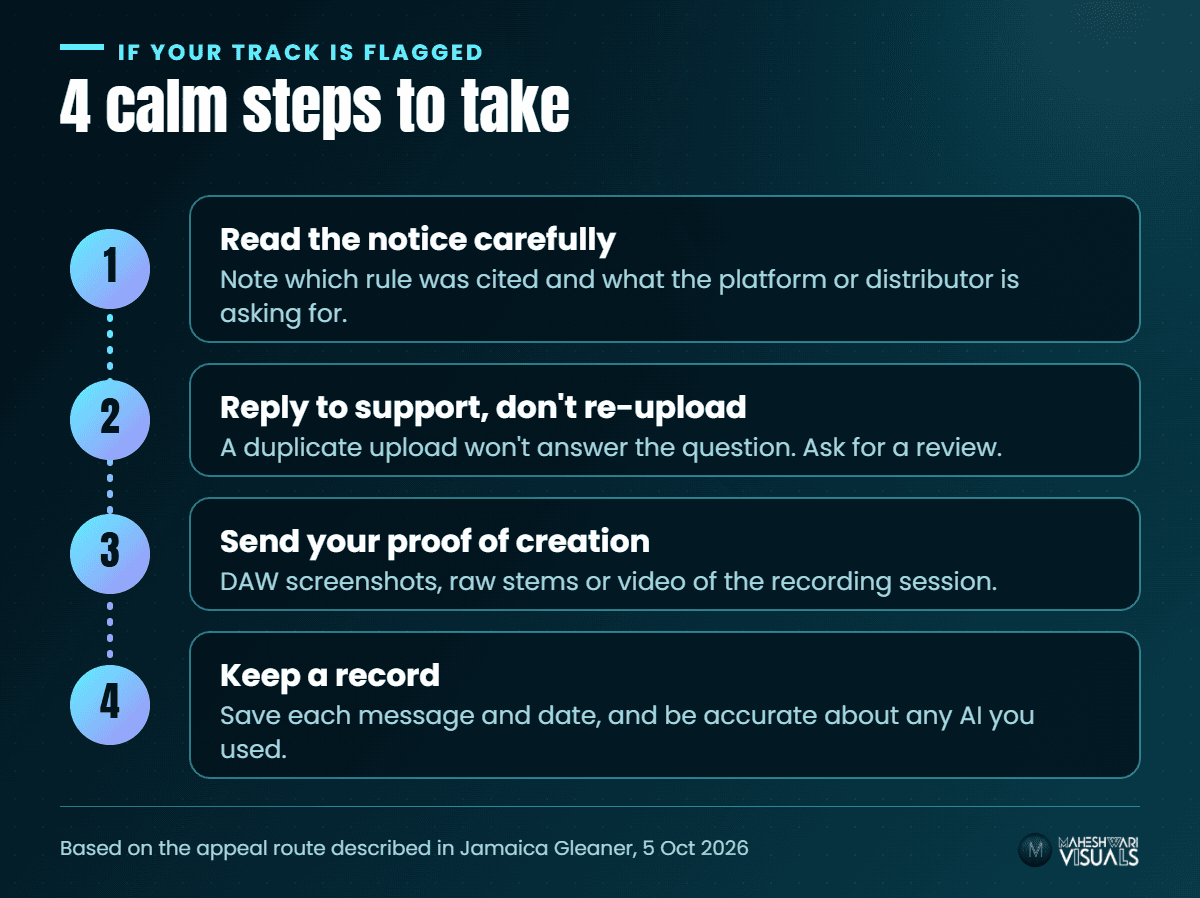
Stay calm and work through it in order. The steps below follow the appeal route described in the Gleaner report: contact support and show proof of creation.
How MV Distribution helps
At MV Distribution, your music reaches 100+ stores including Spotify, Apple Music, JioSaavn, Amazon Music, YouTube Music and Gaana, usually live within 24 hours. You keep 100% of your rights.
When something goes wrong with a release, you can reach human support that replies within 24 hours. No distributor can decide a platform's final call, and we won't pretend otherwise. But having real people to talk to, along with your proof folder, makes a stressful moment far easier to handle.
Conclusion: make your humanity easy to prove
Three things are worth remembering. AI detector false positives are real, and even recordings from the 1980s have been flagged. A detector score is an estimate, not proof of how a song was made. And your best protection is ordinary habit: dated sessions, stems, demos and credits, saved for every song.
You don't need to fear these tools or change your sound for them. Keep making your music your way, and keep the receipts. Ready for a release partner with real people behind it? Start distributing your music with Maheshwari Visuals.
FAQs
Can an AI detector flag my song even if I didn't use AI?
Yes. In the tests reported this week, a human-made album and older recordings from the 1980s were rated as possibly AI. Detectors give estimates, so wrong results do happen.
Does a high AI score mean my song will be removed?
Not by itself. Each platform and distributor has its own process, and a score from a public tool isn't a platform decision. If you do get a notice, read exactly what it asks for and respond with your evidence.
What proof shows that my music is human-made?
Useful evidence includes DAW session files, raw stems, dated demos, screenshots, video of you recording, credits and session invoices. Keep them organised per song from the first day of recording.
Will Auto-Tune or programmed drums get my song flagged as AI?
There's no public, tested rule. One music lawyer says heavy tuning and fully quantised drums can trigger filters, but this hasn't been proven. Use the tools your song needs and keep your session files.
Do I have to declare AI use when I release music?
Requirements differ by platform and are changing quickly. If AI generated part or all of a track, declare it accurately wherever you are asked, including in your release metadata.
Source: Digital Music News, "AI Detector False Positives Threaten Indie Musicians and the Music Industry", 4 November 2026; Vice, 5 November 2026; Jamaica Gleaner, 5 October 2026; Music Ally, 21 July 2026; Afchar, Meseguer-Brocal and Hennequin, "AI-Generated Music Detection and its Challenges", ICASSP 2025.
Comments
Related Articles

Billboard Will Count Free Streams More From 2027: What It Means for Indian Artists

Gully Gang Launches Fifty Nine Records: What It Means for Regional Independent Artists
