
Picture this — your song drops on a Friday. You share it on Instagram, send it to your WhatsApp contacts, and post the link everywhere you can. A few hundred streams come in. Then things go quiet.
Meanwhile, another artist releases a song the same week. Within days, it's sitting on a Spotify editorial playlist with 200,000 followers. Streams climb steadily, listeners save the track, the algorithm picks it up. Two weeks later, it's still growing.
The difference between those two outcomes — more often than people realise — comes down to playlist pitching.
It is one of the most powerful and most misunderstood tools available to independent artists today. Not because it's complicated, but because most artists don't know it exists, don't know how to do it, or pitch in a way that doesn't stand a chance of working. This guide changes that. You'll understand exactly what playlist pitching is, how the system works in India and globally, and what genuinely makes a pitch land.
What Is Playlist Pitching?
Playlist pitching is the process of submitting your music — with context, metadata, and a targeted appeal — to playlist curators, editorial teams, or playlist placement services, with the goal of getting your track added to a playlist that your ideal listeners are already using.
A playlist placement puts your music in front of an audience that didn't know you existed. When a listener discovers your song through a playlist — rather than searching for you by name — that is organic, algorithm-friendly discovery. It is one of the few promotional channels in music where the listener is already in a receptive, listening mindset. They are not scrolling past an ad. They are sitting with headphones on, ready to hear something new.
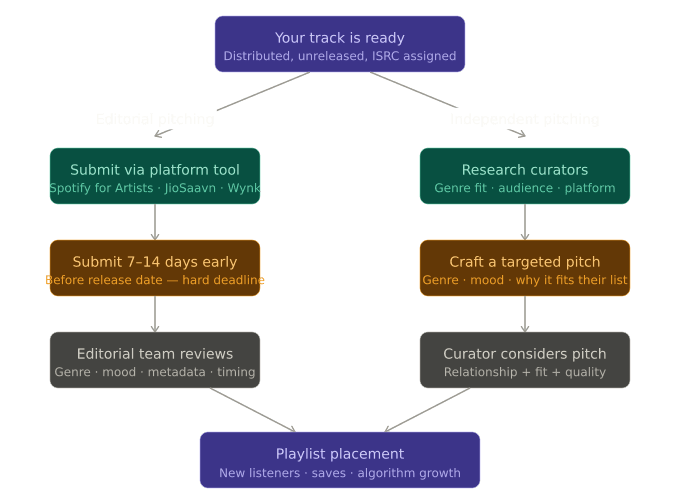
There are two distinct types of pitching, and understanding the difference matters enormously.
Editorial Playlist Pitching
Editorial playlists are curated by the platform's internal teams. On Spotify, playlists like Mellow Morning, Desi Hip Hop, A-List Bollywood, or New Music Friday India are maintained by Spotify's editorial staff. Apple Music has its own equivalents. JioSaavn, Wynk Music, and Gaana have editorial teams curating Hindi, Bhojpuri, Punjabi, and regional language playlists for their massive Indian user bases.
Getting onto an editorial playlist is competitive. Spotify's editorial pitching tool — Spotify for Artists — allows artists to submit one unreleased track per release for editorial consideration, and it must be submitted at least seven days before release. The editorial team reviews genre, mood, instrumentation, language, and release context before making placements.
Independent Playlist Pitching
Independent playlists are run by individuals — music bloggers, genre enthusiasts, playlist curators with dedicated followings, and influencers who have built audiences around their taste. These playlists exist on Spotify, YouTube, and even dedicated platforms, and their follower counts can range from a few thousand to several hundred thousand.
Independent pitching is more accessible than editorial pitching and, done well, can generate meaningful streams and listener growth — particularly for artists building a niche audience in specific genres or regional markets.
[Image suggestion: An artist's song appearing on a curated Spotify playlist on a mobile phone screen, with visible follower count] Alt text: "Independent Indian artist's song featured on a Spotify editorial playlist on a mobile phone, showing playlist pitching success"
Why Playlist Placement Matters Beyond Just Stream Numbers
The immediate benefit of a playlist placement is obvious — more streams. But the downstream effects are what make it genuinely valuable.
Algorithmic Momentum
Spotify's algorithm is powered by listener behaviour. When listeners save your track, add it to their own playlists, or listen all the way through without skipping, the algorithm reads this as a signal that your music is worth showing to more people. A strong playlist placement creates a concentration of engaged listeners that can trigger Spotify's personalised recommendation features — Discover Weekly, Release Radar, Daily Mixes.
Save Rate and Listener Retention
Playlist listeners who discover your music organically tend to have a higher save rate than listeners acquired through paid ads alone. They were already in listening mode. If your song connects, they save it. They follow your artist profile. They come back for your next release. A single well-placed track can convert passive listeners into long-term fans.
Social Proof and Credibility
A placement on a respected editorial or independent playlist is a credibility signal — for labels, sync licensing teams, and other curators. It shows your music has been validated by tastemakers beyond your existing audience. This matters more than most artists realise when it comes to pitching to labels, brands, or sync opportunities later.
[Link: Sync Licensing Explained — How Indian Artists Can Get Their Music in Films and Web Series → sync-licensing-explained-indian-artists]
What Makes a Playlist Pitch Actually Work?
This is where most artists go wrong. They send a generic message — "Please listen to my song, I worked really hard on it" — and wonder why they never hear back. Curators receive dozens, sometimes hundreds, of pitches every week. A pitch that doesn't immediately communicate the right information gets ignored.
Here is what a strong pitch contains:
A Clear, Honest Description of the Song
Describe your track the way a music journalist would — genre, mood, tempo, language, and the sonic influences that shaped it. "An upbeat Hindi-English crossover track with Punjabi percussion and a melancholic hook" tells a curator far more than "a song about love and loss." Be specific.
A Defined Listener Profile
Who is this song for? Which existing playlist does it fit — and why? Curators want to know that you've actually listened to their playlist and understand their audience. A pitch that references a specific playlist and explains why your track belongs there has a dramatically higher chance of getting through.
Release Timeline
For editorial pitching through Spotify for Artists, your track must be submitted before release — ideally seven to ten days ahead. This is a hard deadline. If your music is already live, you've missed the editorial pitching window. Plan your release schedule around this.
Professional Metadata
Your track must have a genre tag, mood tags, language tags, and a properly filled artist profile. Curators and editorial teams use this information to assess fit. Incomplete metadata signals that the artist hasn't taken the release seriously.
Playlist Pitching in the Indian Music Context
The Indian music ecosystem has a dimension that most global guides completely overlook — the scale and diversity of regional language audiences.
JioSaavn, Wynk Music, Gaana, and Hungama collectively serve hundreds of millions of listeners across Hindi, Bhojpuri, Punjabi, Marathi, Tamil, Telugu, Kannada, and more. These platforms have their own editorial teams curating playlists for specific regional audiences — and those playlists are not as aggressively pitched to as the Spotify editorial queues.
For a Bhojpuri artist, landing on a JioSaavn regional editorial playlist can be a more impactful placement than a mid-tier Spotify independent playlist. For a Punjabi pop artist, Wynk Music's Punjabi editorial can deliver a highly targeted listener base. Understanding which platform's audience aligns with your music — and pitching to that platform's curators — is a smarter strategy than chasing Spotify placements by default.
This is a nuance that artists pitching on their own often miss. Knowing where your listeners actually live — and which platform they open first — shapes an entirely different pitching strategy.
[Image suggestion: Indian artist's music appearing on a JioSaavn or Wynk Music curated regional playlist on a smartphone] Alt text: "Hindi language song featured on a JioSaavn editorial playlist on a smartphone, representing playlist pitching for Indian independent artists"
Should You Pitch Yourself or Work With a Professional?
Artists can — and should — learn the basics of editorial pitching, particularly through Spotify for Artists, which is free to use. But there is a meaningful difference between submitting your own track through Spotify's portal and working with a team that has established relationships with independent playlist curators, understands submission timing, and knows how to position a track for different playlist formats.
Editorial pitching is democratic — anyone can submit. Independent playlist pitching, on the other hand, relies heavily on relationships, timing, and knowing how to reach the right curators for the right genre. This is the work that a dedicated music marketing team does every day.
At MV Marketing, playlist pitching — both editorial and independent — is part of how releases are built. The goal is not just to get your music onto any playlist, but onto the playlists where your listeners are already listening. That distinction is what separates placements that convert fans from placements that just add stream numbers.
Conclusion
Three things to carry forward from this:
First, playlist pitching is not luck — it is a craft. The artists who consistently land placements are the ones who understand the system, pitch early, and speak the language that curators respond to.
Second, editorial pitching has a hard deadline. If you are not submitting your track to Spotify for Artists — and the equivalent tools on other platforms — before your release date, you are leaving one of the most valuable promotional windows unused.
Third, India's regional platforms deserve as much attention as Spotify. For most independent artists in India, the biggest untapped playlist opportunity isn't in San Francisco — it's on JioSaavn, Wynk, and Gaana, where the listeners are.
If you want your next release to reach beyond your existing circle, MV Marketing handles playlist pitching, editorial submissions, and independent curator outreach — so your music finds the listeners it deserves.
Frequently Asked Questions
How early do I need to pitch my song to Spotify editorial playlists? Spotify recommends submitting at least seven days before your release date through Spotify for Artists. In practice, submitting ten to fourteen days before gives the editorial team more time to review your track. Once a song is live, it can no longer be considered for editorial playlist placement.
Do I need a distributor to pitch to Spotify editorial playlists? Yes — your music must first be distributed and have a confirmed release date on Spotify before you can submit through Spotify for Artists. A distributor like MV Distribution handles this and ensures your release is live in the system with enough lead time for editorial pitching.
How many streams do I need before curators will take me seriously? There is no fixed threshold, but having a complete Spotify for Artists profile, professional cover art, and some listener history does help establish credibility. Independent playlist curators tend to focus more on the quality of the music and how well it fits their playlist than on follower count alone.
Is paying for playlist placement legitimate? This is a grey area. Paying for genuine independent playlist placements from curators with real audiences is a recognised practice. However, "pay-to-stream" services that use fake or bot accounts to inflate stream numbers violate Spotify's terms of service and can result in your account being removed. Always verify that a playlist pitching service uses real, organic placement methods.
Can I pitch my music to Indian platforms like JioSaavn and Gaana? Yes — JioSaavn, Wynk Music, Gaana, and Hungama all have editorial and content teams that work with distributors and music marketing partners for playlist placements. These pitches typically happen through your distributor or marketing partner's industry relationships, rather than through a self-serve portal.
