
On 29 October 2026, Universal Music Group (UMG) — the world's biggest music company — reported its July–September results. The numbers were strong, but the bigger story came from its CEO, Sir Lucian Grainge. He told investors that the way streaming services pay for music is broken, and that "the structure of our DSP agreements has to change."
When the largest label on the planet says streaming payouts should be rewritten, every artist who earns from streams should pay attention — including independent artists in India releasing on JioSaavn, Spotify, YouTube Music, Gaana, Apple Music and Amazon Music. In this explainer, we break down what UMG said, what "pro-rata" payouts actually are, and the practical steps Indian independent artists can take now so that any change in streaming payouts works in their favour.
What UMG Reported in Q3 2026
UMG's revenue for the quarter was about €3.39 billion, up 11.7% year on year at constant currency, according to Music Business Worldwide. Part of that jump came from a company it acquired earlier this year; without it, growth was 5.3%.
Subscription streaming remains the engine. It brought in €1.42 billion, the single largest revenue line, and grew 9.5% even after stripping out the acquisition. UMG credited higher wholesale prices and healthy subscriber growth. Ad-supported streaming added €387 million, while physical formats such as vinyl and CDs grew to €392 million.
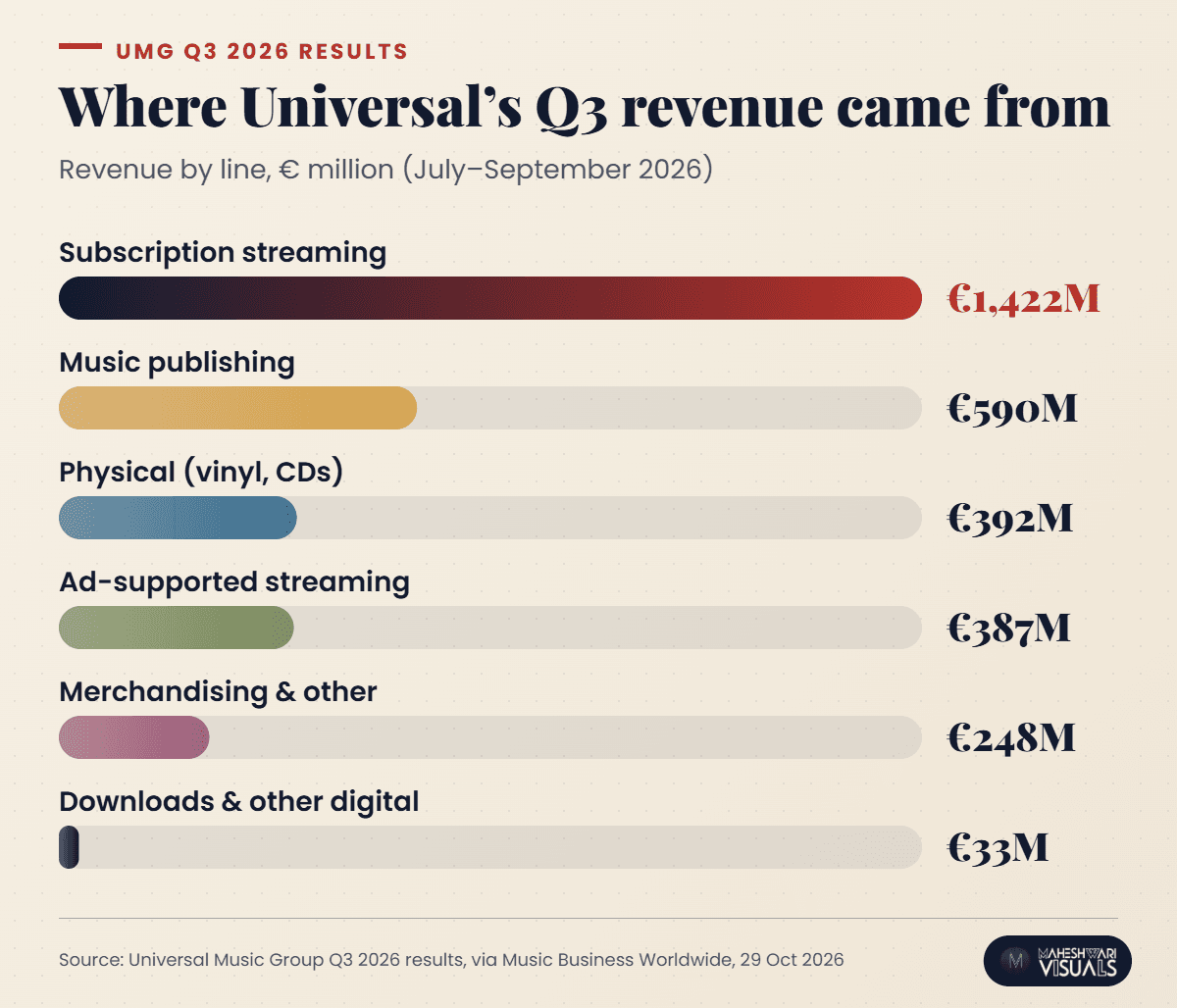
The takeaway is simple: paid subscriptions are where the money is. That is exactly why the fight over how subscription money gets divided matters so much.
Why Grainge Wants Streaming Payouts Rewritten
Most streaming services pay rights holders on a pro-rata basis. All subscription and ad revenue in a market goes into one pool, and each track gets a share based on its slice of total streams. A stream is a stream, whether it comes from a superstar's new single or a 30-second AI-generated filler track.
On the earnings call, Grainge argued that this one-size-fits-all approach rewards "industrial-scale content production" and dilutes what real artists earn. As reported by Digital Music News, he said "the uniform application of pro-rata payments makes the problem worse," and that unethically generated AI tracks should never be paid on the same basis as music that creates real, lasting demand.
UMG says it has begun a new phase of its business plan running to the end of 2028, focused on "win-win partnerships" with streaming services — including how platform deals are priced and structured. It also expects its licensed AI partnerships to start generating revenue in fiscal 2027.
What this does not mean
UMG has not announced a specific new payout formula, and no platform has said it will change its model because of this call. What it tells us is the direction of travel: the biggest rights holders want money to flow towards music that people actively choose, and away from low-engagement or spam content.
Payout Rules Are Already Shifting
This is not just talk. Since 2024, Spotify has required a track to reach 1,000 streams in the previous 12 months before it earns recorded royalties. According to Spotify for Artists, tracks below that line were earning an average of just $0.03 a month, while tracks above it account for 99.5% of all streams. Spotify estimated the change would move about $1 billion towards emerging and working artists over five years.
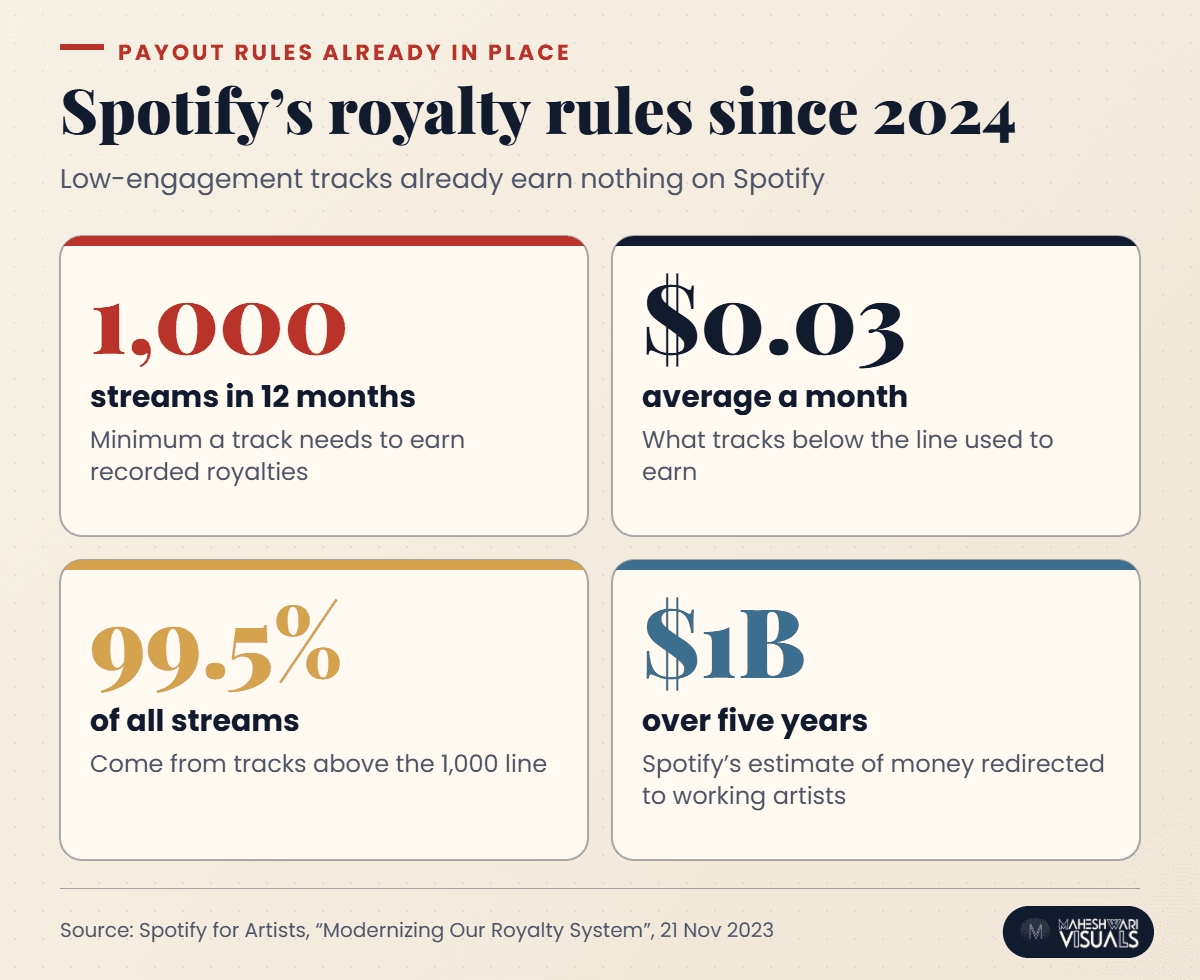
Earlier this month we also covered how Spotify pulled 50 million AI spam tracks from recommendations. Put together, the pattern is clear: platforms and major labels are rewarding engagement and authenticity, and penalising volume for volume's sake.
What It Means for Indian Independent Artists
For independent artists in India, this shift is more opportunity than threat — if you are building a real audience.
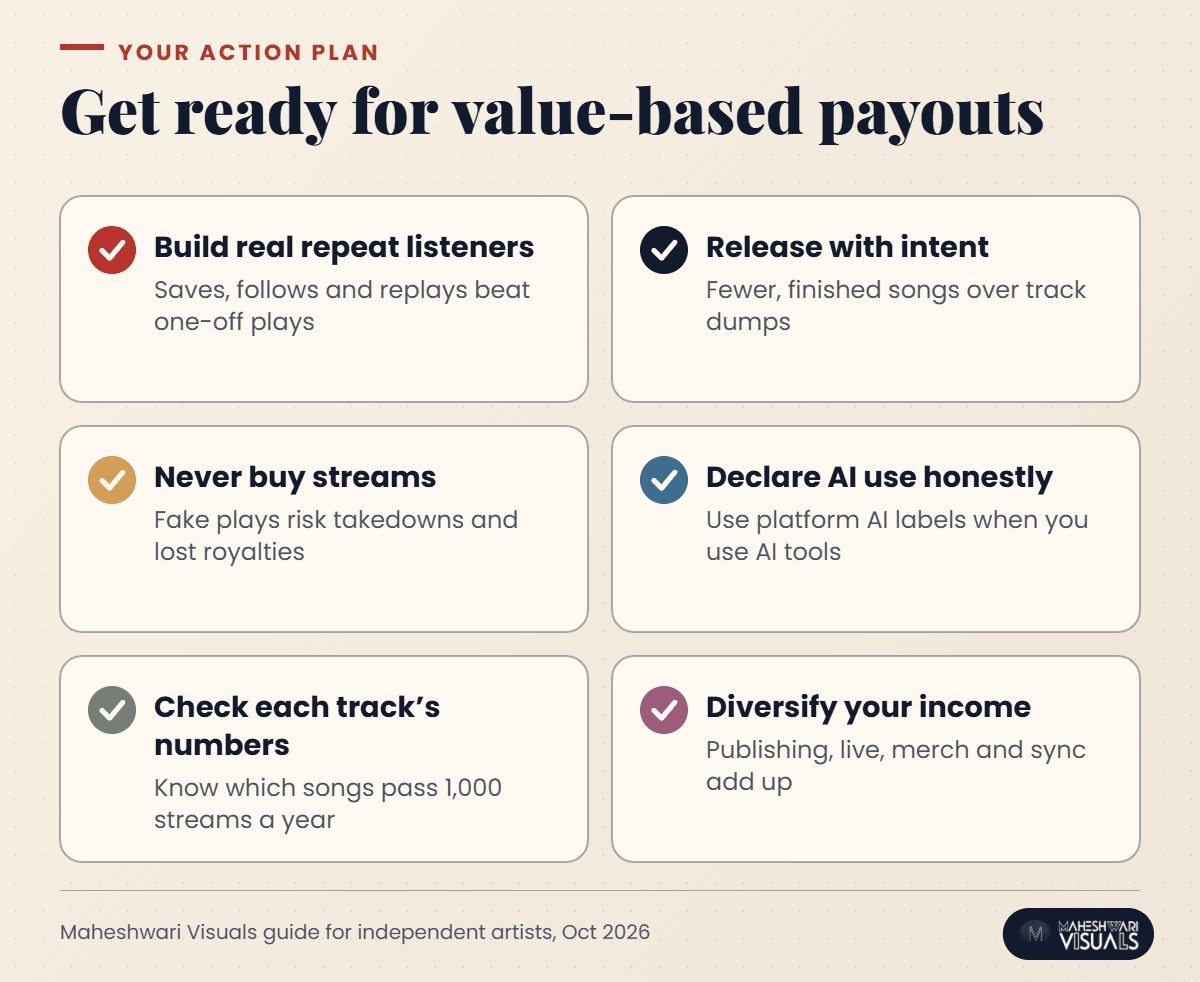
- Real fans become more valuable. If payouts move towards "music that creates real and lasting demand", songs that listeners save, replay and seek out by name are likely to be the winners. A loyal Bhojpuri, Punjabi or Tamil fanbase that streams you repeatedly is exactly that kind of demand.
- Track dumping stops paying. Uploading dozens of rushed songs hoping a few catch on was already a weak strategy. Under engagement-based rules, tracks that never cross minimum thresholds may earn nothing at all.
- Fake streams carry bigger risks. As platforms tighten up, artificial plays can lead to takedowns, withheld royalties and a damaged reputation with editors and curators.
- Honest AI use matters. Using AI tools in your workflow is not the problem; passing off mass-generated tracks as artist releases is. Platforms such as YouTube Music now ask for AI disclosures, and being transparent protects you.
Remember that Indian services like JioSaavn and Gaana negotiate their own licensing deals. Global label pressure can influence the wider market over time, but there is no confirmed change to Indian platform payouts today.
What Artists Should Do Now
Focus on depth, not just reach
Track saves, follows, repeat listens and playlist adds in your Spotify for Artists, YouTube Studio and JioSaavn dashboards. These signals show real demand — and they are what platforms increasingly reward.
Plan fewer, stronger releases
Give each song a proper rollout: a pre-release teaser, short-form video clips, a creator push and follow-up content after release day. One well-supported single usually beats five quiet uploads.
Audit your catalogue
Check which tracks are crossing 1,000 streams a year on Spotify. Songs that consistently fall short may be better used as bonus content, bundled into an EP, or re-promoted with a fresh video.
Diversify your income
Register your compositions with IPRS for publishing royalties, explore live shows, and consider merchandise and sync. Streaming should be one pillar of your music business, not the only one.
How Maheshwari Visuals Helps
With MV Distribution, your music reaches 100+ stores including Spotify, Apple Music, JioSaavn, Amazon Music, YouTube Music and Gaana — usually live within 24 hours. You keep 100% of your rights, and our human support team replies within 24 hours if a royalty or delivery question comes up. More than 200K artists already trust us with their releases, and we only work with genuine, artist-owned music — no stream manipulation, ever.
If you want help building the engagement that payout rules now reward, MV Marketing can support your release campaigns.
Conclusion
UMG's Q3 2026 results confirm that subscription streaming is the industry's biggest money-maker, and its CEO wants the way that money is shared to change. Payout rules are already moving towards engagement — Spotify's 1,000-stream threshold is proof — and AI spam is being pushed out. For Indian independent artists, the message is encouraging: real listeners, thoughtful releases and honest practices are becoming more valuable, not less.
You don't need a major label to benefit from this shift. You need great music, a fanbase that keeps coming back, and a distribution partner that has your back. Ready to release your next song the right way? Sign up with Maheshwari Visuals for music distribution and get your music live across India and the world.
FAQs
What are pro-rata streaming payouts?
Under the pro-rata model, a platform pools all its subscription and ad revenue in a market and pays each rights holder according to their share of total streams. Every stream counts the same, regardless of who is listening or why.
Will UMG's comments change how JioSaavn or Spotify pay Indian artists?
Not immediately. UMG has not announced a new formula, and no platform has confirmed a change linked to these comments. They signal where major-label negotiations are heading, so it is smart to prepare now.
How many streams does a song need to earn royalties on Spotify?
Since 2024, a track needs at least 1,000 streams in the previous 12 months to generate recorded royalties on Spotify, according to Spotify for Artists.
Can independent artists still earn well from streaming?
Yes. Rules that favour real engagement can help independent artists with loyal fans. Focus on repeat listeners, consistent quality releases and income beyond streaming, such as publishing, live shows and merch.
Source: Digital Music News — "Universal Music Posts Mixed Q3 '26 Results, Eyes New DSP Deals" (29 October 2026); Music Business Worldwide — UMG Q3 2026 results (29 October 2026); Spotify for Artists — "Modernizing Our Royalty System" (21 November 2023).
Comments
Related Articles

Billboard Will Count Free Streams More From 2027: What It Means for Indian Artists

Gully Gang Launches Fifty Nine Records: What It Means for Regional Independent Artists
