
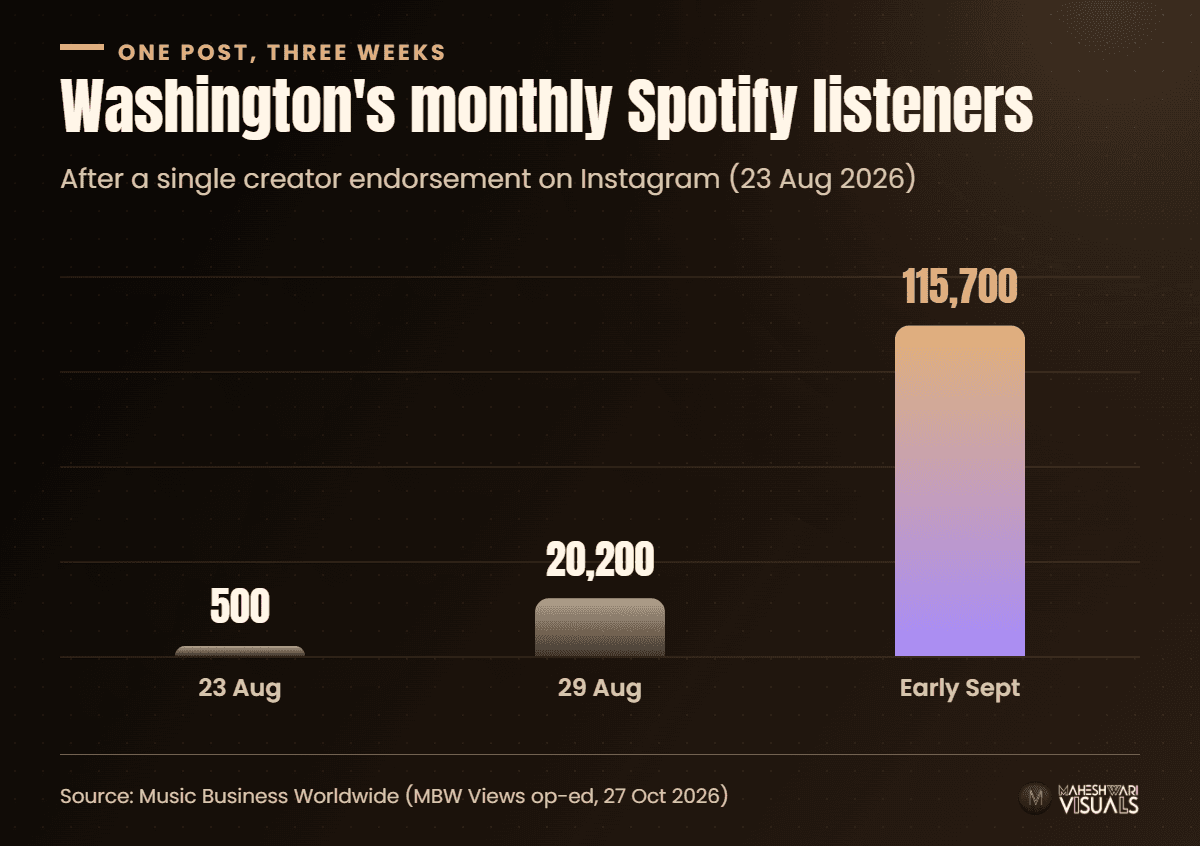
One Instagram post. Six days. A singer called Washington went from 500 monthly Spotify listeners to more than 20,000 — and to about 115,700 by early September. No label push, no editorial playlist, no ad budget. Just one person with taste and reach telling his followers, "listen to this."
That story sits at the centre of a sharp op-ed published by Music Business Worldwide on 27 October 2026. Its argument is simple: the music industry keeps building better discovery tools, but the real music discovery bottleneck is no longer finding songs. It is human attention — and the people whose recommendations others trust.
For Indian independent artists releasing on Spotify, JioSaavn, YouTube Music and Gaana, this changes where your energy should go after release day. In this explainer, we break down what the piece says, the data behind it, and a practical plan to turn listeners into advocates — with your distribution handled by MV Distribution so you can focus on the people who matter.
What Happened: Music Business Worldwide Says We're Fixing the Wrong Problem
The op-ed, written by music writer Diana Umana for MBW's Views section, argues that playlists and recommendation algorithms have not solved the problem of too much new music. Algorithms read signals, but somebody has to create those signals first.
According to the piece, the thing that actually moves an artist forward is advocacy — a trusted person putting their name behind a song. And those advocates usually start out as fans.
The Washington example shows how fast that can work. A creator with a large following shared the song on 23 August 2026. Within six days, monthly listeners had jumped from 500 to 20,200, and by early September they reached about 115,700 — a 231x rise in under three weeks, as the article describes it.
Why the Music Discovery Bottleneck Matters: 106,000 New Tracks a Day
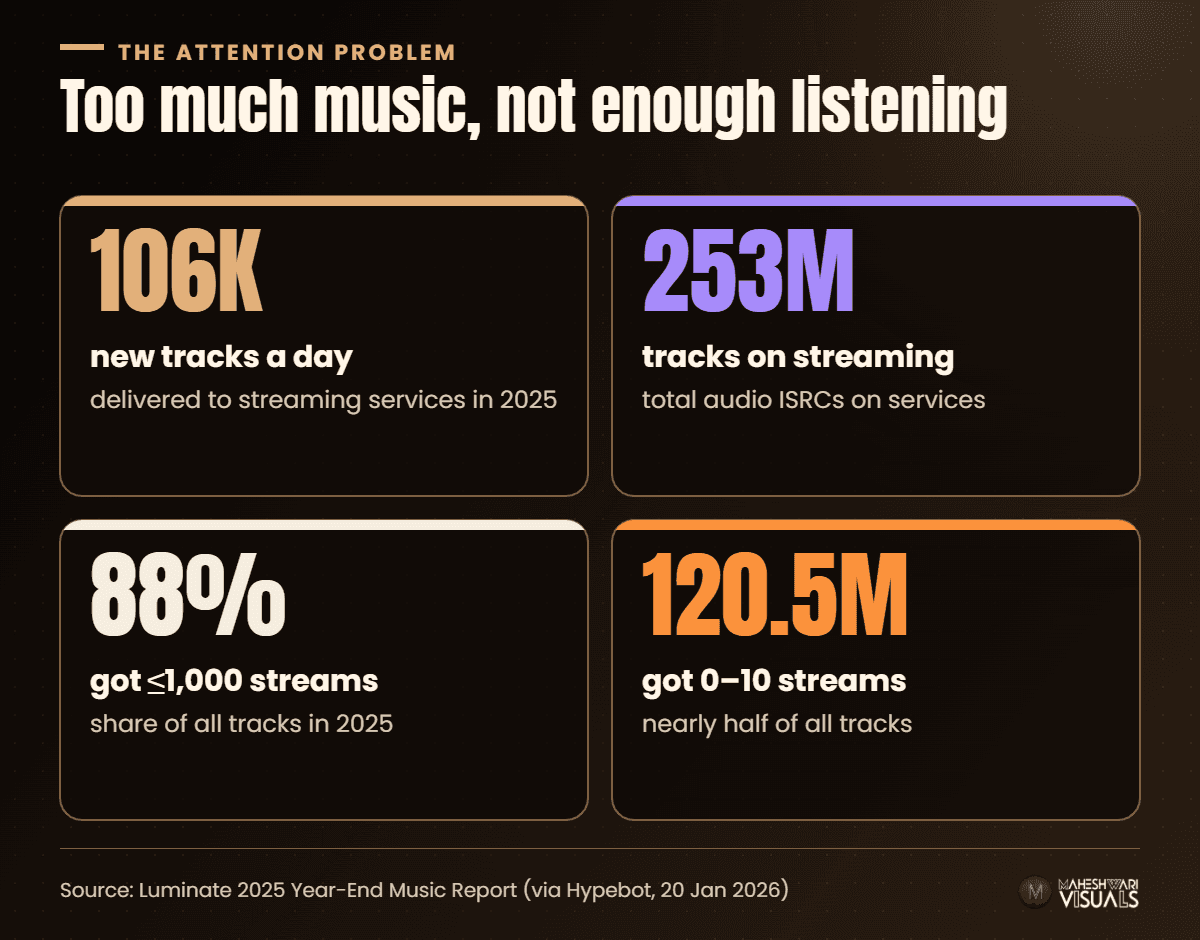
The numbers explain why attention is now the scarce resource. Luminate's 2025 Year-End Music Report, cited in the op-ed and reported by Hypebot in January 2026, found:
- About 106,000 new tracks reached streaming services every day in 2025, up from 99,000 a day in 2024.
- Streaming services now hold around 253 million tracks.
- 88% of tracks got 1,000 streams or fewer during the year.
- Roughly 120.5 million tracks — nearly half — got between 0 and 10 streams.
Add AI to that pile. Deezer reported nearly 90,000 fully AI-generated tracks arriving every day in June, more than half of all new music it received on peak days. We covered how platforms are pushing back in our post on Spotify removing 50 million AI spam tracks from recommendations.
Curators are overloaded too
The op-ed also asked curators how much they receive. One playlist and blog team said it gets around 400 songs a week and reviews about 75. A former music editor gets about 115 submissions a week and listens to at least 25. In other words, most cold submissions are never fully heard — not because the music is bad, but because there are only so many hours in a week.
What This Means for Indian Independent Artists
India is one of the busiest release markets in the world, across Hindi, Punjabi, Bhojpuri, Tamil, Telugu, Haryanvi and more. That makes the attention problem even sharper here. A few lessons stand out.
Algorithms amplify; people ignite
Spotify's Release Radar, YouTube's recommendations and JioSaavn's trending lists all respond to early signals — saves, repeat listens, shares, playlist adds. The MBW piece's point is that someone has to start that chain. For most independent artists, that someone is a real person: a fan, a creator, a local blogger, a DJ, a college fest organiser.
Your first 100 true fans are your marketing team
You don't need a celebrity endorsement. A Bhojpuri artist whose song is shared by ten local Instagram pages, or a Punjabi indie act whose track becomes a favourite among a handful of dance creators, is building the same kind of trust-based momentum — just at a different scale.
A finished product earns a full listen
The op-ed notes that curators give a submission a proper listen when it arrives with a trusted referral, a record that sounds finished and distinctive visuals. Rushed mixes and missing artwork get skipped in seconds.
What Artists Should Do Now: A 5-Step Advocacy Plan
Here is a practical plan you can start with your next release.
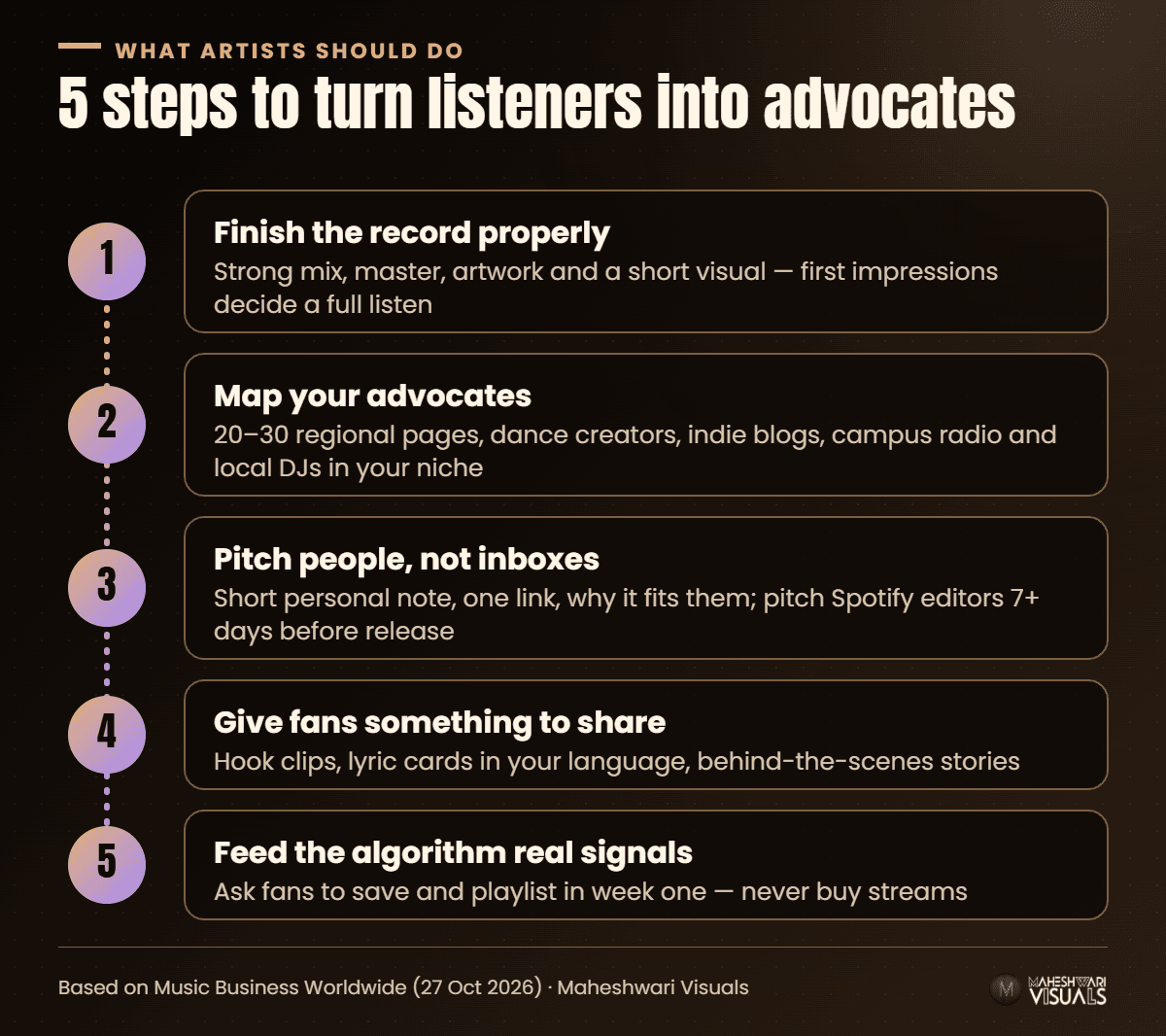
- Finish the record properly. Get the mix and master right and create artwork and a short visual that look like a real release. First impressions decide whether a curator keeps listening.
- Map your advocates. List 20–30 people who already influence your niche — regional meme pages, dance creators, indie bloggers, campus radio, local DJs — and follow their work before you ask for anything.
- Pitch people, not inboxes. Send short, personal messages with one link, one line on why the song fits them, and a release date. Pitch your unreleased track to Spotify editors through Spotify for Artists at least seven days before release.
- Give fans something to share. A hook-sized clip, a lyric card in the song's language, a behind-the-scenes story. Make it easy for your first listeners to become your loudest ones.
- Feed the algorithm with real signals. Ask fans to save and add the song to their own playlists in the first week. Never buy streams — fake activity can get tracks removed and royalties withheld.
If you want help with the outreach side, explore MV Marketing and our playlist pitching page.
How Maheshwari Visuals Helps
Advocacy only pays off if the song is live everywhere a new fan might look. MV Distribution delivers your music to 100+ stores — including Spotify, Apple Music, JioSaavn, Amazon Music, YouTube Music and Gaana — and releases can go live within 24 hours.
You keep 100% of your rights, and our human support team replies within 24 hours, so you are never stuck while a moment is building. More than 200K artists already trust Maheshwari Visuals with their releases.
Conclusion: Win Attention One Advocate at a Time
The MBW op-ed is a timely reminder that the music discovery bottleneck is human attention, not technology. With over 100,000 tracks arriving every day and most getting fewer than 1,000 streams, the artists who break through are the ones real people choose to champion.
So make a release worth sharing, build genuine relationships with the curators and creators in your scene, and give your earliest fans the tools to spread the word. The algorithm will follow the signals they create.
Your music deserves to be heard — and it starts with one person pressing share. Sign up for music distribution with Maheshwari Visuals and get your next release live on every major platform, ready for the fans who will carry it.
FAQs
How do independent artists get discovered in India in 2026?
Mostly through a mix of real people and algorithms. Fans, creators, bloggers and curators share a song first; platform algorithms then pick up the saves, shares and playlist adds that follow. A finished release and a clear outreach plan matter more than luck.
How many songs are uploaded to Spotify every day?
According to Luminate's 2025 Year-End Music Report, about 106,000 new tracks reached streaming services each day in 2025. That figure covers all major streaming services, not just Spotify.
Is it worth pitching to independent playlist curators?
Yes, if you pitch the right people with a personal message and a finished track. Curators receive hundreds of songs a week, so targeted, respectful pitches to curators who already play your genre work far better than mass emails.
Can one social media post really make a song go viral?
It can help, as the Washington example in MBW's op-ed shows, but it is not guaranteed. Building relationships with many smaller advocates over time is a more reliable path than hoping for a single big share.
Should I buy streams to trigger the algorithm?
No. Platforms actively detect and remove artificial streams, and fake activity can lead to tracks being taken down and royalties withheld. Real saves and shares from real listeners are the only signals worth building.
Source: Music Business Worldwide — "The music industry is solving the wrong bottleneck" (MBW Views, 27 October 2026); Luminate 2025 Year-End Music Report via Hypebot (20 January 2026).
Comments
Related Articles

Billboard Will Count Free Streams More From 2027: What It Means for Indian Artists

Gully Gang Launches Fifty Nine Records: What It Means for Regional Independent Artists
